Moving Furniture Records super sale
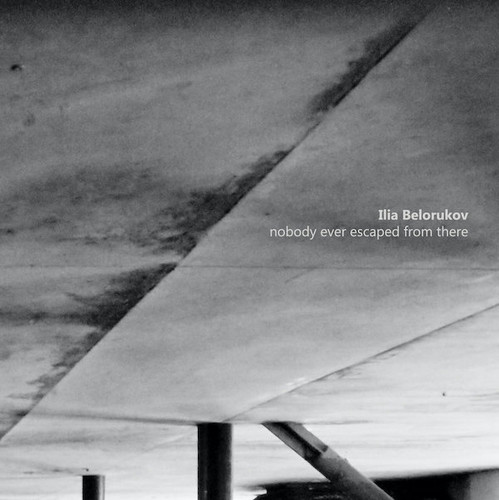
Nobody Ever Escaped From There
Follow-up to There Was Hardly Anybody There (Spina!Rec, 2016). Belorukov moves once again away from improvised saxophone toward electroacoustic studio composition. A central role is taken by Boris Shershenkov's reconstruction of the Variophone, a 1930s photo-electrical instrument by Evgeniy Sholpo that produces sound from cut-out discs recorded as optical film tracks, prized for its instability and colour. These are layered with field recordings, samples and synthesis, weighted to the low end.
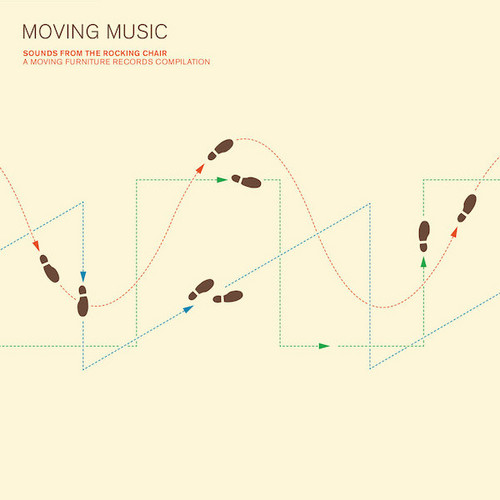
Moving Music - Sounds From the Rocking Chair
Compilation that grew out of the label's December 2019 crowdfunding campaign. Twenty-four musicians contributed across sixteen tracks, mixing solo pieces with ten new collaborations (TVO & Jos Smolders, Radboud Mens & BJ Nilsen, Kouw & Petrovic, and others). The set holds together with surprising consistency across modular composition, minimalist ambient drone and electroacoustic experiment, functioning as a cross-section of the label's network at a precise moment.
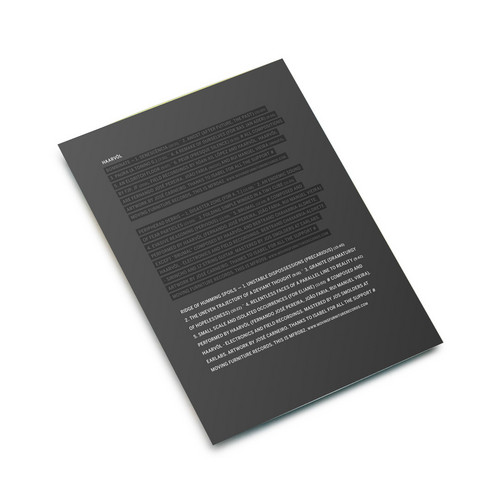
Ridge Of Humming Spoils
Final volume of Haarvöl's trilogy. After the noisy beginning of Bombinate and the move toward the periphery of Peripherad Debris, the trio arrives at the frontier as a psychoanalytic empty signifier: an edge that holds both interior and exterior. The album is built from what they call 'whispering remains', material left behind by previous compositional decisions, here treated as a vantage point looking both backward and forward. Drone microsound at the limit of the project's own grammar.
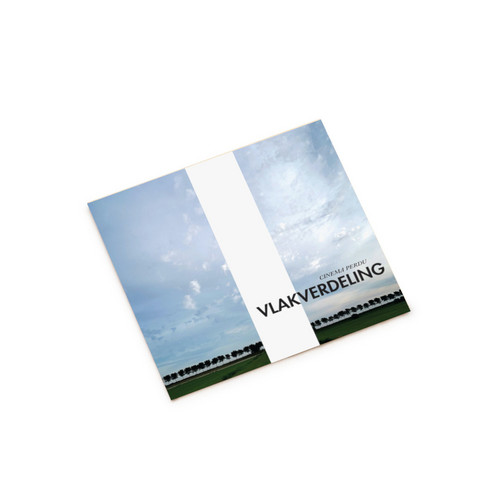
Vlakverdeling
Cinema Perdu's third album for the label, extending his investigation of human impact on landscape after Interventions in a Landscape and Amsterdam CS. The material here is drawn from trips through the Frisian polder, where the strict demarcations of the Dutch countryside change atmosphere with weather and light but above all with the geometric clarity of human marking. Field recordings are read as abstract forms and colours, then translated back into new compositions.
Assemblée, Relâche, Réjouissance, Parade
Two compositions on the social and ritual function of music, drawn obliquely back into the experimental frame. The first piece, L'Anglard de St-Donat, takes a Central-French mazurka recorded from Alfred Mouret as its hidden source, building solid drones and recurrent structures from bowed and struck metal objects with quasi-melodic counterpoint. In Le désir the strategy inverts: detuned organs provide the rigid harmonic context within which bowed metal sticks are tuned.
Winter Trilogy / The Big Fall
The Winter Trilogy and The Big Fall trilogies were realized between 2015-2019 in the Netherlands and implemented into a sequence of live shows during the same period. Both inspired by cultural sonic imprints, the Winter Trilogy (computer & accordion) and The Big Fall (computer & analogue synthesizer) explore the potential and the antitheses between analogue versus digital while expressing a personal view of particular rural landscapes.
Not Knowing
Costa Monteiro's fifth solo accordion album, and the one in which he deliberately reverses his earlier recording strategy. Where previous works placed microphones almost inside the instrument to foreground materiality, structure and deconstruction, Not Knowing instead treats the accordion as an object in space, with the architecture of the recording room becoming essential to the work. The result blurs the limits of identification, holding the instrument's identity in productive uncertainty.
Horizontal Alliances, Vertical Conflicts
Nine years after Play Cat's Cradle, Rose and Sandy return to the same ecclesiastical source - here an auto-harp from the same convent - for a second extended collaboration, again played and processed live. The album divides into nine spectral bands functioning as strings to be stopped, muted or amplified, and reads the intervening years as a shift from devotion and idealism to entropy and conflict. The acoustic body remains, but its overtones now turn cold, shrill, fractured.
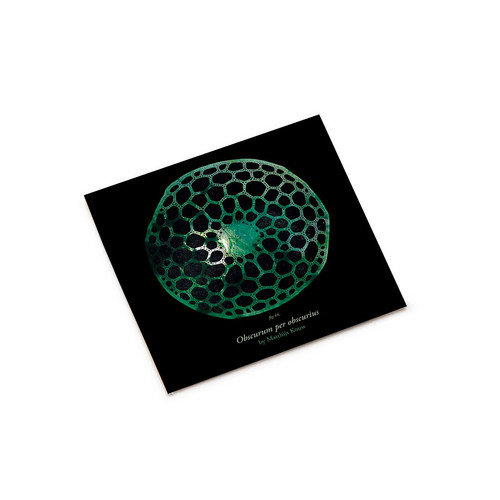
Obscurum per oscurius
The Latin title - 'explaining the obscure by means of the more obscure' - frames a collection of drones composed by Kouw across an extended period, in which the initial moments of inspiration are deliberately obscured in the final material. Long-form ambient drone work, mostly close to alien stillness with the occasional submerged rhythmic emergence, the album positions itself in the alchemical lineage where the act of explanation projects further mystery into what it claims to clarify.
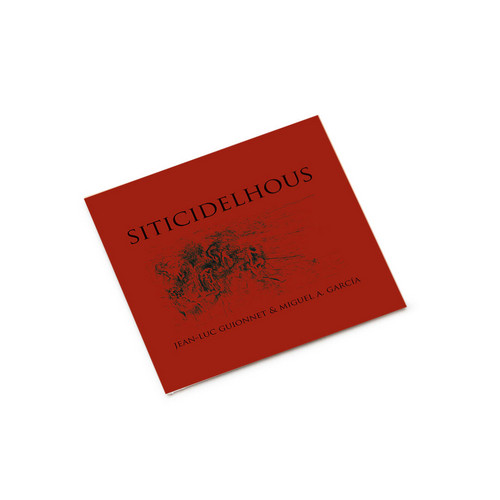
Siticidelhous
Companion volume to Parkustomnie, drawn from the same 2016 sessions at the Conservatorio Jesús Guridi in Vitoria-Gasteiz. Guionnet (church organ) and García (electronics) again use volume as a compositional variable: the music is engineered so that at low playback levels the performance feels restrained and exquisitely subtle, while at high volume entirely new sonic strata emerge in overwhelming detail. Electroacoustic improvisation that turns the amplifier into part of the score.
Breach
Zeno van den Broek's most aggressive work for the label, framed around chaotic systems and the energetics of protest and riot. Sine waves, noise and grid logics from his architectural-conceptual practice are pushed into pitch-black metal-electronic territory, with polyrhythmic structures driving the buildup and release of accumulated tension. A formal study of chaos that retains his rigorous minimalist vocabulary while shifting it into visceral, high-energy mass.
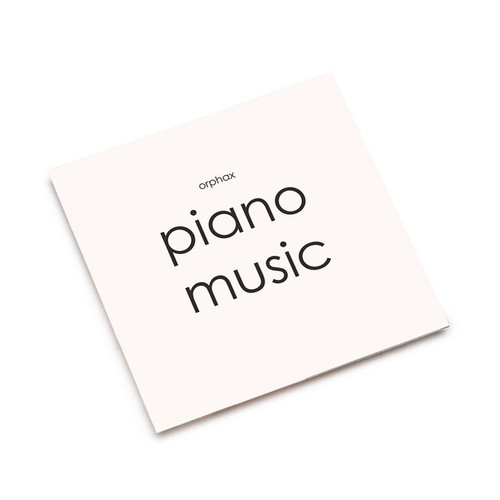
Piano Music
Two short pieces built from piano recordings made by Orphax at De Ruimte in Amsterdam Noord during summer 2017. The 7-inch marks a deliberate break with his usual drone vocabulary, foregrounding more openly melodic ambient writing and treating the piano as the primary voice rather than as raw material. One of his most personal works to date, dealing in textural terms with closure, regret and the slow effort of moving on.
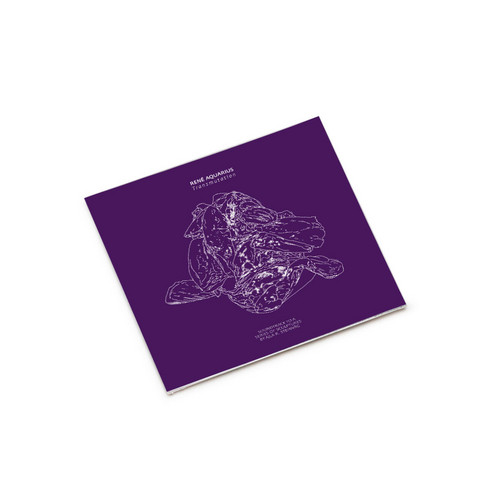
Transmutation
Two long-form pieces forgoing melody and rhythm in favour of pure texture. René Aquarius works in a register adjacent to Thomas Köner's darker drone music: a metallic sheen distributed across slowly shifting masses, gestures held to the minimum, every sonic event magnified by the quietness around it. The result is unmistakably dark ambient, but built with restraint rather than gothic excess, the focus turned to the ghostly imagery that emerges from sustained low-density listening.
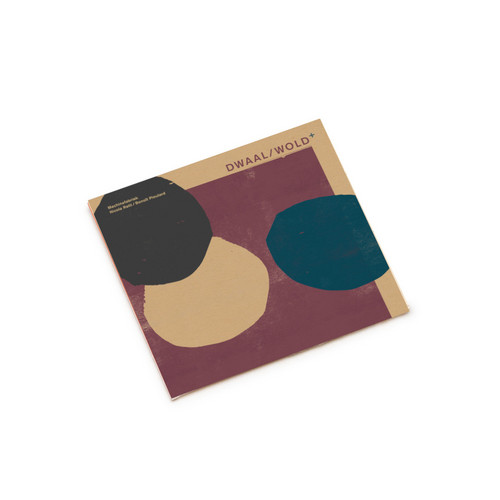
Dwaal / Wold +
Originally released by Ghent's Dauw tape label in 2016 and quickly sold out, here reissued on CD with two new interpretations added. The original is a pair of eighteen-minute pieces: Dwaal layers orchestral washes against radio static and erratic noise, while Wold spreads sparse piano notes over a bed of fine hiss, supported by wind and bird recordings from Vriescheloo. The reissue adds remixes by Benoît Pioulard (organ and guitar) and Nicola Ratti (synth sputters and rhythm).
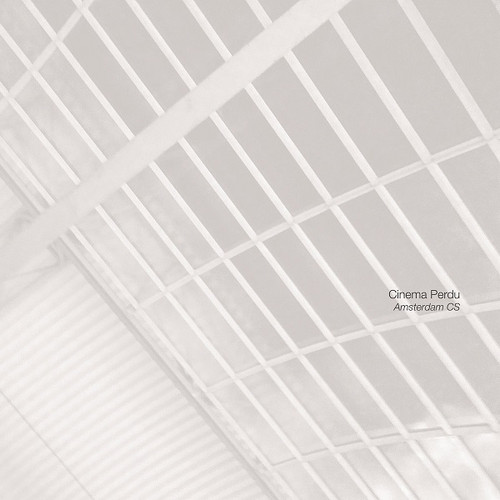
Amsterdam CS
Cinema Perdu turns the spaces of Amsterdam Centraal Station - the roofs, the three access tunnels, the IJ-passage - into compositional material. The everyday sonic vocabulary remains constant (announcements, suitcases, conversation) but is reshaped by the changing acoustics of each space. The pieces are built in a Cagean attitude: not romantic vignettes of the station nor pure documentation, but interpretations of how each architecture stages its own atmosphere.
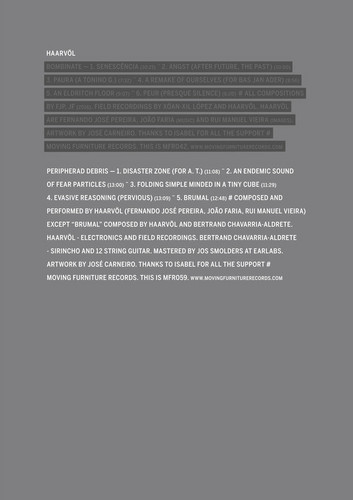
Peripherad Debris
Second album in Haarvöl's trilogy, picking up where Bombinate left off. Where the earlier work announced its sonic intention (bombinate, to hum), Peripherad Debris turns toward the conceptual periphery and to remnants of what has already been said: away from the centre, toward the outer turbulence where residual materials remain most stimulating. The album moves between quasi-ambient stillness and dense mass-sound nearly turning to noise, holding all positions in the same hesitant qualifier.
You Are The Universe
A remix/recycle project by Preliminary Saturation (Steffan de Turck and Wouter Jaspers) built entirely from Jos Smolders's Textures and Mobiles (CONV, 2004), an album originally derived from a strictly limited palette of DTMF and CCITT telephone tones and pure interfering sine waves. The duo reprocesses Smolders's source material and folds in their own additions across tape, contact microphones, field recording and synthesis. A recursive electroacoustic exercise within a closed lineage.
Kulverzuchter
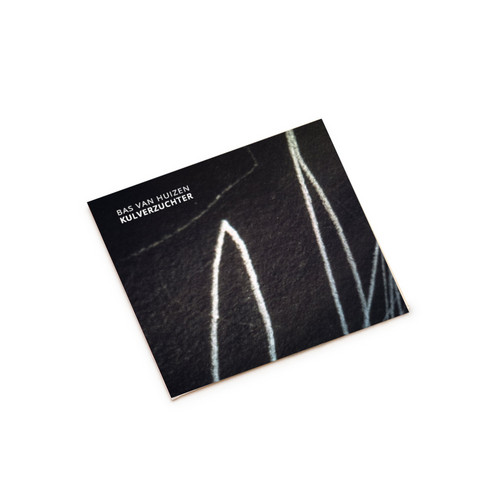
Bas van Huizen's third album for the label, and the point at which he turns explicitly toward the minimal and the ambient after the visceral noise of Kluwekracht and Waanzintraan. Kulverzuchter is hazy, ambiguous and understated: textures toned down and surface less layered, with most of the activity unfolding just beneath. Track titles are absurd compound Dutch neologisms; the artwork was made entirely from his daughter's first drawings. A study in subtle contradiction within an ambient frame.
ABC 1-6
Score for indeterminate ensemble by Swiss composer Stefan Thut (2012), here realised by Cristián Alvear, Cyril Bondi and D'Incise. The piece is governed by three categories of sonic material - 0 for faintly coloured noise, 1 for amalgam of noise and pitch, 2 for pure pitch - circulated across six pages and as many rounds in an ever-shifting structure of repetition and turn. A rigorous taxonomy of sound material in the lineage of Wandelweiser and post-Cage indeterminacy.
2.20
Inspired explicitly by Eliane Radigue's Vice Versa..., Orphax records two source pieces in AudioMulch using nearly identical virtual modular settings, varying only a single parameter, and then sculpts the resulting material in Reaper into two strict twenty-minute compositions. The two pieces are conceived to be played independently or simultaneously, the listener encouraged to build their own mix; the album includes a download with both tracks plus a guide mix made with Jos Smolders.