Reissues
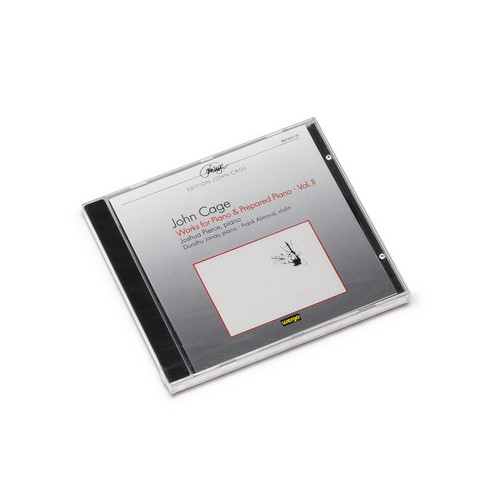
Works For Piano & Prepared Piano · Vol. II (1944-1958)
*2022 stock* This recording deals with works composed between 1944 and 1958, including several of Cage's lovely and masterful prepared piano pieces, which will come as a major surprise to those familiar only with his chance compositions. Joshua Pierce is the principal pianist (assisted by Dorothy Jonas on the Three Dances, written for two pianos) and attacks the pieces with a nice balance of delicacy and aggression, although compared to the earlier Angel recording of the abovementioned Three Dan…
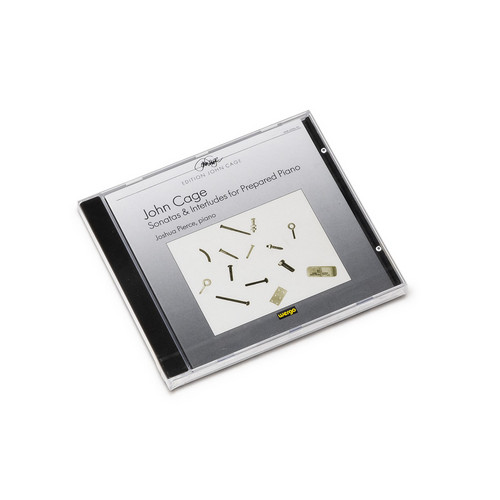
Sonatas & Interludes For Prepared Piano
*2022 stock* Sonatas and Interludes for Prepared Piano, a cycle of 20 short pieces for prepared piano (a piano modified by inserting nuts and bolts and other objects between the piano strings in order to produce percussive and otherworldly sound effects) by American composer John Cage. Created in 1946–48 after the composer had been introduced to Indian visual and performing arts, the cycle was intended to represent the so-called permanent emotions—the heroic, the erotic, the wondrous, the comic,…
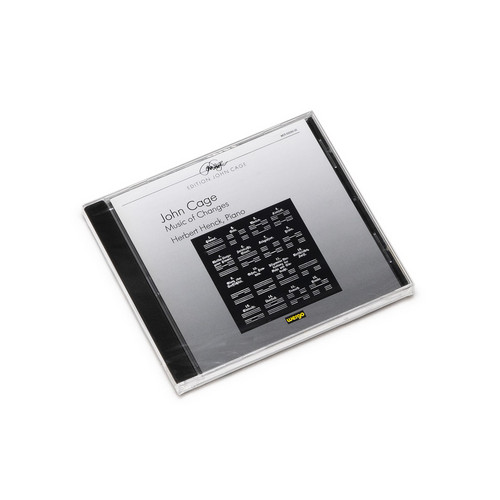
Music Of Changes
*2022 stock* It's over 70 years since John Cage wrote his pivotal Music of Changes, and it's beginning to show its age. It feels very much of its time, with its uncompromising adherence to the 64 hexagrams of I-Ching, the Chinese book of changes, determining the direction of the piece and its use of sudden, percussive attacks on the strings or the body of the instrument. But for all that there is no denying the extreme stamina and concentration required of the performer, and here Herbert Henck e…
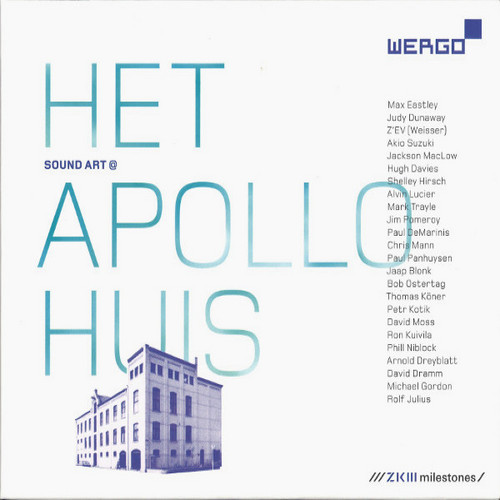
Sound Art at Het Apollohuis
*2022 stock* This amazing double CD Box presents excerpts from previously unpublished concert and performance recordings of important artists who appeared during the lifespan of Het Apollohuis - between 1980 and 1997, artists presented a panoply of exhibitions, installations, performances, and concerts, and engaged in lively debate on art theory, at Het Apollohuis in Eindhoven, the Netherlands. Under the direction of founders Paul and Hélène Panhuysen, the building became an important center for…
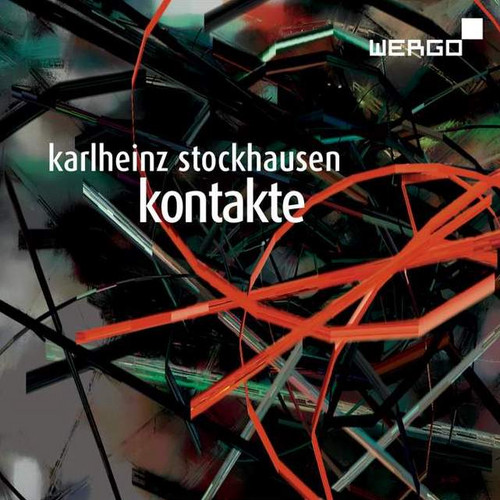
Kontakte
Kontakte is a Stockhausen classic from 1959, for electronics, percussion and piano (played here by David Tudor). One of his "moment form" compositions, which "...lead up to no climax, nor do they have prepared, and thus expected, climaxes, nor the usual introductory, intensifying, transitional, and cadential stages which are related to the curve of development in a whole work; they are rather immediately intense and -- permanently present -- endeavor to maintain the level of continued 'peaks' up…
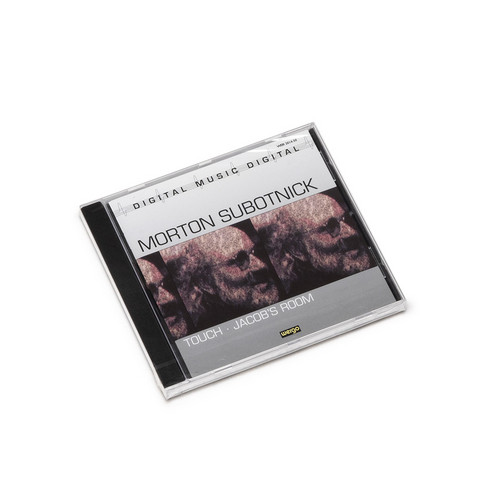
Touch • Jacob's Room
'I believe Jacob's Room is one of the most extraordinary examples of extended vocal techniques that I have ever heard. Touch is the child of the original Buchla electronic music triumvirate that included Silver Apples and Wild Bull. Its exploration of the sound and texture possibilities of electronic music is a variation on the two previous compositions. Jacob's Room is a vehicle for Subotnick's wife, Joan LaBarbara to demonstrate why she is universally considered the master of extended vocal te…
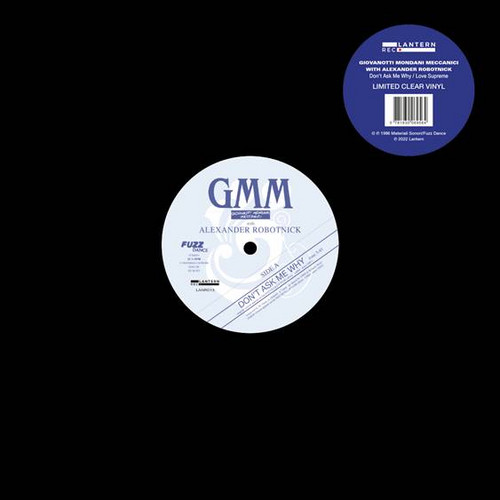
Don't Ask Me Why/Love Supreme
*Fully remastered and licensed* One of the most sought-after italo-disco release, the combined effort of Giovanotti Mondani Meccanici and Alexander Robotnick saw the light of the day in 1986 on Fuzz Dance, Materiali Sonori sub-label ran by the wizard Giampiero Bigazzi. Florence born producer and musician Maurizio Dami, created a mysterious character, a so-called "modular structure born out of a soviet calculator and promptly runaway". His classic "Problemes D'amour" was featured on the influent…
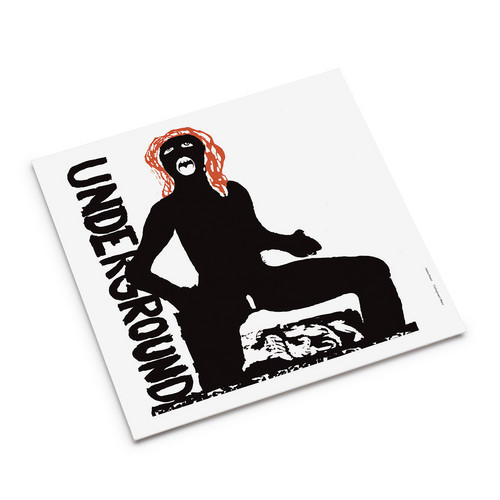
Underground Altena
Alga Marghen returns with an absolute stunner, the LP “Underground Altena”, comprising a never before heard or released series of recordings capturing Anima - the duo of Limpe Fuchs and Paul Fuchs - in 1973. Largely rendered on a striking array of instruments, invented and played by the couple, its otherworldly, visionary sounds upend nearly every perception held about underground music transpiring in Germany during this period. Wild, wonderful, truly free, and inspiring as records come.
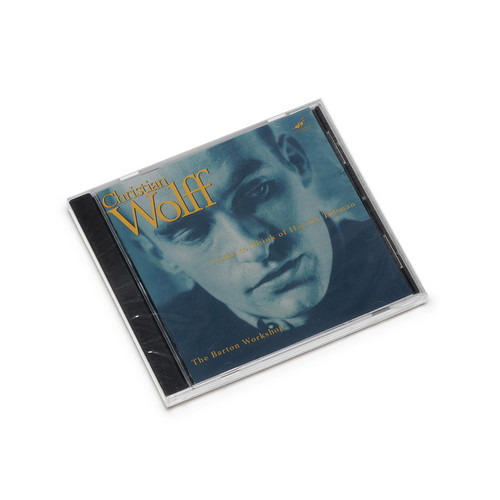
I Like To Think Of Harriet Tubman
*2022 stock* 'A true Leninist would argue that art in a smoothly running socialist state would become redundant and disappear, though while waiting for such a perfect society to come about, we have an idea of what socialist literature, painting, sculpture and cinema are like. But what does socialist music sound like? Luigi Nono? Eisler? Robert Wyatt? The Ex? Well, all four. and you may add Christian Wolff to the list. Like fellow experimental composers Cornelius Cardew and Frederic Rzewski, Wolf…
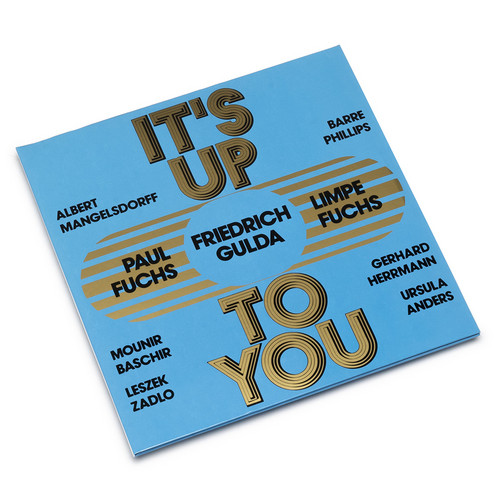
It's Up To You
** Limited to 300 double vinyl copies, two inlays with photos and liner notes. Originally released in 1974 on Preiser Records** »It’s Up to You« is a free sound art and performance project by sound artist and singer Limpe Fuchs, sculptor and sound artist Paul Fuchs, and pianist and recorder player Friedrich Gulda, who formed the trio Anima at the time of the recordings in 1974. As musical guests they were able to enlist the trombonist Albert Mangelsdorff, the bassist Barre Phillips, the oud play…
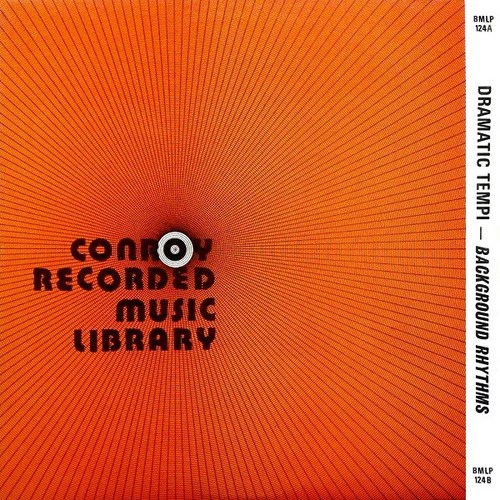
Dramatic Tempi - Background Rhythms
Be With Records present a reissue of Dramatic Tempi / Larry Robbins Background Rhythms, originally released in 1975. Classic library breaks and beats set of heavy drums and louche funk. The first side, "Dramatic Tempi", is made up of four tracks each from Sammy Burdson and Klaus Weiss. Sammy Burdson was one of the many, many aliases of the mighty Austrian composer, arranger and conductor, Gerhard Narholz. Klaus Weiss produced essential records on German library labels Coloursound, Selected Sound…
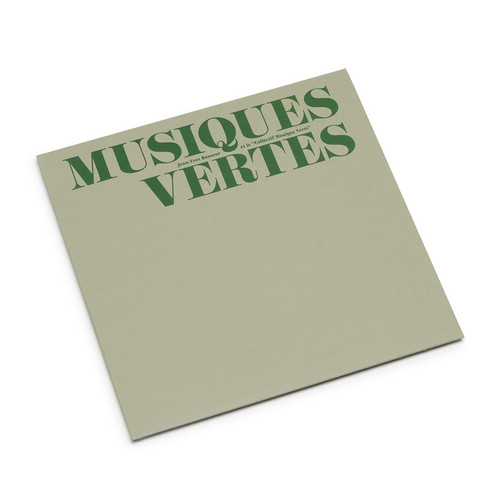
Musiques Vertes
A document of pure sonic magic and stunningly organic creativity, Holidays Records drops the first ever vinyl reissue of Jean-Yves Bosseur's visionary 1982 LP “Musiques Vertes”, recorded by the legendary French ornithologist and wildlife field recordist Jean-Claude Roché. Utilizing handmade instruments constructed from plants and other natural materials, played by collective of children and untrained musicians, its radically experimental sounds build a revelatory bridge between the avant-garde a…
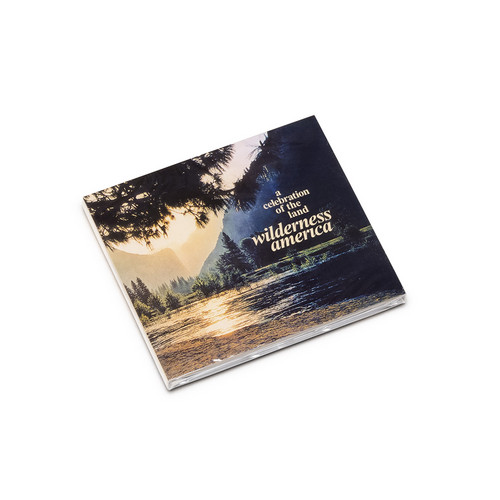
Wilderness America, A Celebration Of The Land
Before I’m gone I’d like to see us turn the corner and give up being spoilers of the land . . . In 1975 Wallace ‘Wally’ Smith Broecker published a paper that popularised the term ‘global warming’ and against a backdrop of change and environmental uncertainty, a musical concept album was commissioned. ‘Wilderness America / A Celebration of the Land’ - is a musical exploration of our place within the cycle of living things. All compositions were specially commissioned for the album and blended wit…
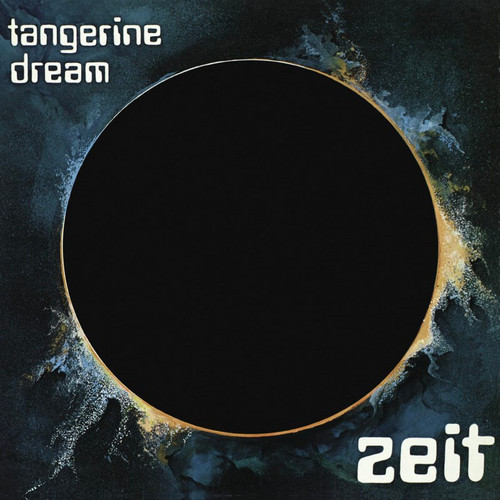
Zeit
Blue Translucent Vinyl Originally released in 1972, Zeit would be Tangerine Dream's third full length album, and the first to feature the main trio of Edgar Froese, Peter Baumann, and Chris Fanke. The German electronic group pioneered the entire dark ambient genre with this work, whose title translates to "time," and was based on the philosophy that "time was in fact motionless and only existed in our own minds." Also worth noting is that Popol Vuh's Florian Fricke plays Moog synthesizer on th…
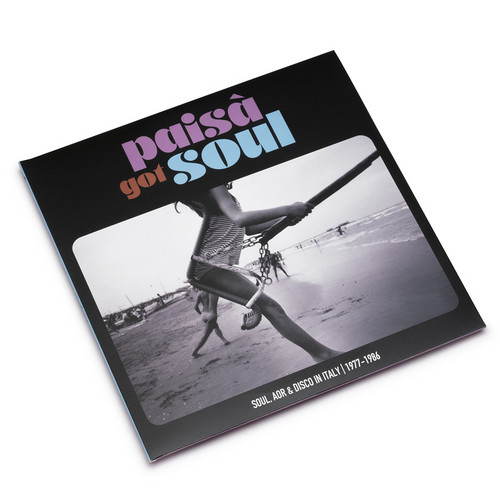
Paisà Got Soul - Soul, AOR & Disco in Italy (1977-1986)
*In process of stocking* Compiled and conceived by David Nerattini partnered by Pierpaolo De Sanctis. Between the late 70s and the early 80s, pop music was in a transitional phase. After a return to the roots of punk, rock was morphing into new wave, while disco was rapidly declining and the electronic revolution, already on the rise, was ushering in the transition from analog to digital. This period also saw the emergence and relatively brief flowering of a commercially dominant style that mixe…
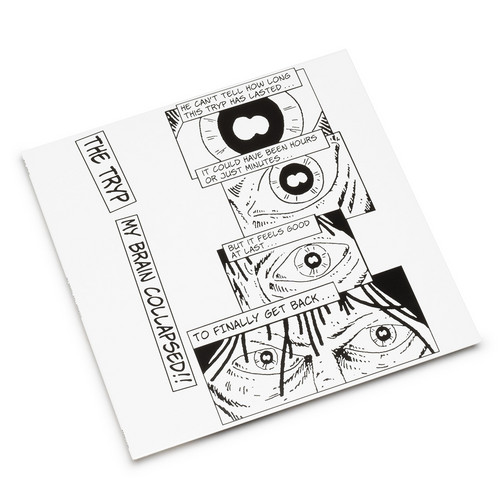
My Brain Collapsed
The roots of 80s English psychedelic freak band The Tryp lie in a hoax perpetuated by Steve Lines’ indie mag Mardenbeat, based in the town of Calne in the Marden Delta, which reviewed a gig by a non-existent band; former JP Sunshine main man Rod Goodway and partner Christine Cotter then gave flesh to the beast with Lines and Paul Ricketts of Unhinged mag, cutting My Brain Collapsed! as an exploration of mushroom-fuelled mental instability. First issued on cassette label Mardentapes and later by …

Reality
Obscure prog rockers Second Hand began as the Next Collection, formed at a south London secondary school; engineer/manager Vic Keary scored them a contract with Polydor as the Moving Finger, but their legendary debut LP was credited to Second Hand, due to a rival Moving Finger. Channelling psych and spacey acid hues, there is blues-rock underpinning Bob Gibbons’ guitar and keyboardist Ken Elliott helps aim the sound towards deep space; this edition features rare tracks ‘James in the Basement’ an…
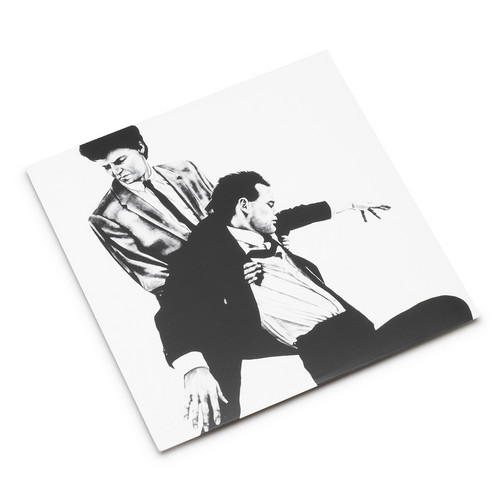
The Ascension
2025 Repress. Glenn Branca's first full-length album The Ascension is a colossal achievement. After touring much of 1980 with an all-star band featuring four guitarists (Banca, fellow composers Ned Sublette and David Rosenbloom, and future Sonic Youth member Lee Ranaldo) along with Jeffrey Glenn on bass and Stephan Wischerth on drums, Branca took his war-torn group into a studio in Hell's Kitchen to record five incendiary compositions.
Originally released in the summer of 1981, The Ascension eff…
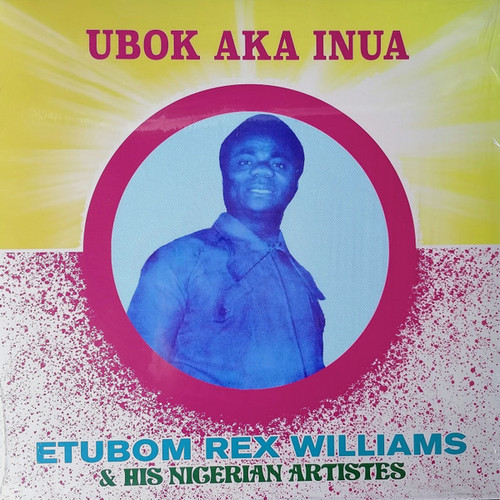
Ubok Aka Inua
*In process of stocking* Originally released in 1976, Ubok Aka Inua is the fifth album by legendary Nigerian saxophonist and band leader, Etubom Rex Williams. The album features Psychedelic Shoes and One Woman Is Enough Trouble, both heard on countless funk and soul compilations. The album was restored from the original tapes by Noah Mintz and artwork restored and recreated by Steve Lewin.
"Etubom Rex Williams occupies the genuine space of legend of Nigerian Highlife. His incredible professional…
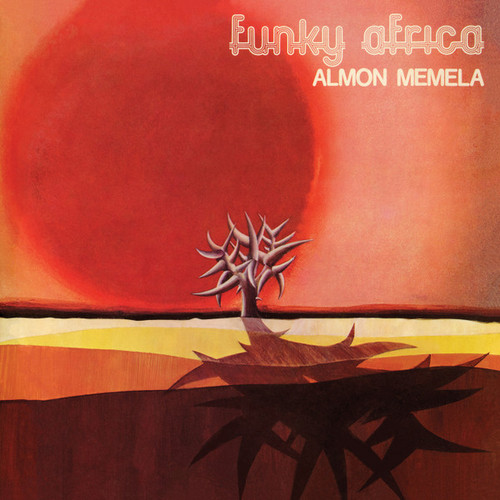
Funky Africa
*In process of stocking* We Are Busy Bodies is proud to present a reissue of composer, guitarist, and later producer, Almon Memela’s ultra rare 1975 album, Funky Africa. From the original liner notes: 'Africa has always been many things to many people. To some, Africa is the Dark Continent, a mysterious, romantic and vast expanse of unexplored territory. To others, again, Africa is the ultimate symbol of man's triumph over his environment: a wakening giant destined to play a significant role in …