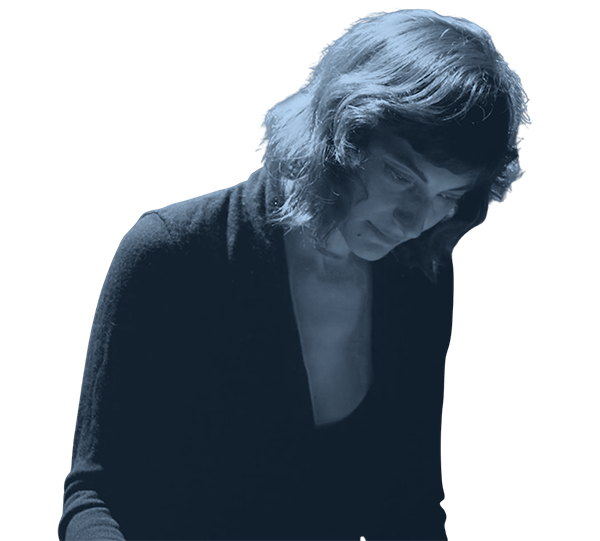
Lea Bertucci - The Days Pass Quickly Immersed in the Shadow of Eternity
It is our ability to step toward an imagined future that defines us, while the act of rendering the achievements of our predecessors obsolete contributes to our sense of worth. In such a world, what does it mean to employ one of humanity’s oldest known technologies, the flute - appearing in human hands tens of thousands of years before the advent of the wheel - within an experimental, electroacoustic composition that is inherently forward-thinking, as Lea Bertucci has with The Days Pass Quickly Immersed in the Shadow of Eternity? Throwing even greater challenge to the notions through which we tend to evaluate progressive artistic expression, the piece was written for, and created in collaboration with the musician, Norbert Rodenkirchen, utilizing his collection of Renaissance, Medieval, and Neolithic instruments, harnessing sounds that have been largely absent from the modern world.
Much like the work at hand, Lea Bertucci’s life and career rest at the conjunction of extreme poles, illuminating art as a means to produce intricate layers of meaning at odds. She is a woman working within a creative landscape that has been historically dominated by men, and pointedly working-class in a field largely activated by varying degrees of social and economic privilege. Unsurprisingly, this has infused her work with a distinct sense of tension, urgency, and drive. Since her emergence within New York City’s Noise scene during the early 2010s, Bertucci has balanced a fierce dedication to the DIY ethos and immediacy of the underground with a refined sense of creative rigor and ambition, gracefully moving, over the last decade and a half, from her early body of brittle, challenging compositions - incorporating various combinations of saxophone, electronics, and tape - into more constrained investigations of acoustic phenomena, site-specific resonance, and complex harmonic interplay, imbuing minimalist sensibilities with complex arrangements, dissonance, and a deeply emotive human touch.
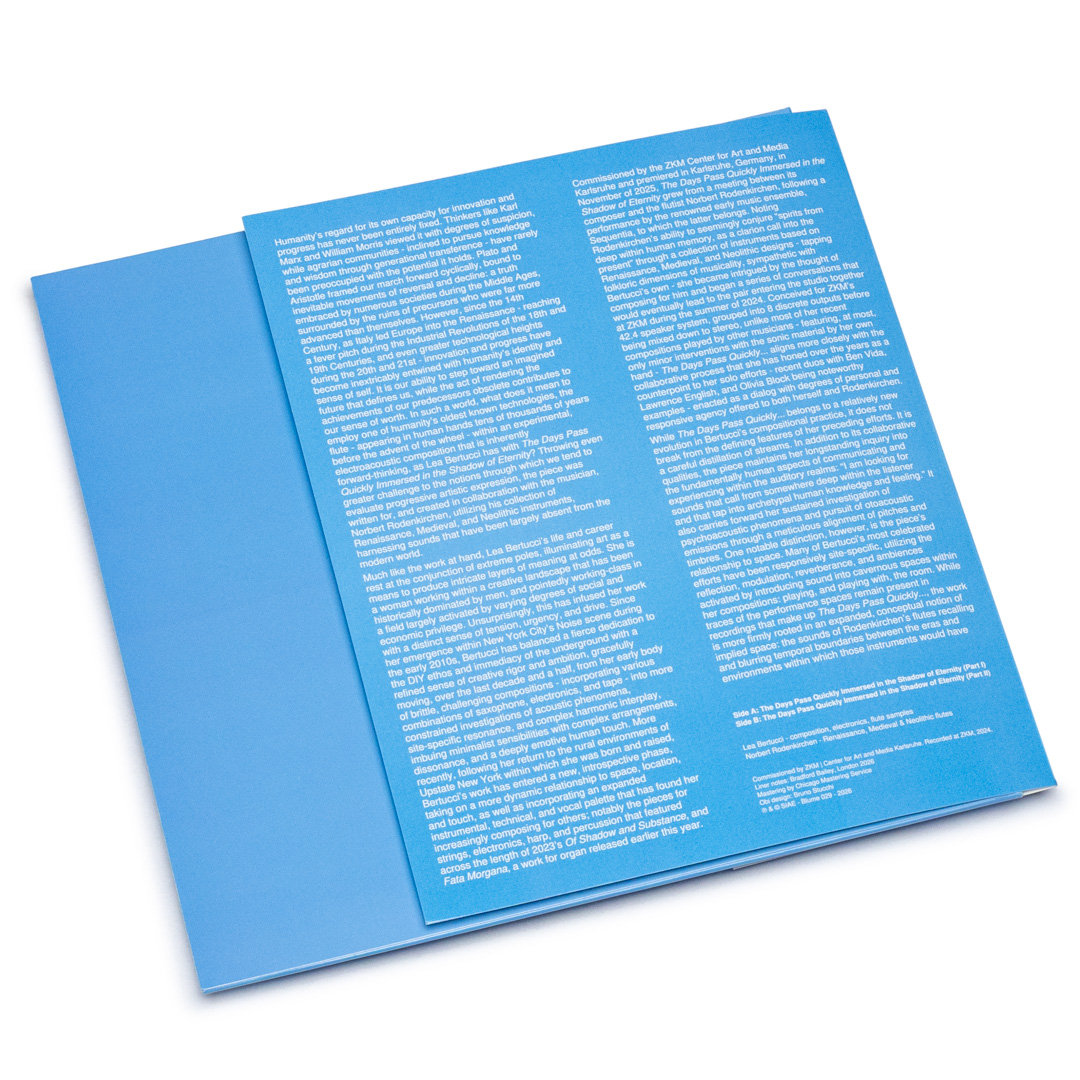
Commissioned by the ZKM Center for Art and Media Karlsruhe and premiered in Karlsruhe, Germany, in November of 2025, the inception of The Days Pass Quickly Immersed in the Shadow of Eternity grew from a meeting between its composer and the flutist Norbert Rodenkirchen, following a performance by the renowned early music ensemble, Sequentia, to which the latter belongs. Noting Rodenkirchen’s ability to seemingly conjure “spirits from deep within human memory, as a clarion call into the present” through a collection of instruments based on Renaissance, Medieval, and Neolithic designs - tapping folkloric dimensions of musicality, sympathetic with Bertucci’s own - she became intrigued by the thought of composing for him and began a series of conversations that would eventually lead to the pair entering the studio together at ZKM during the summer of 2024.
While The Days Pass Quickly... belongs to a relatively new evolution in Bertucci’s compositional practice, it does not break from the defining features of her preceding efforts. It is a careful distillation of streams. In addition to its collaborative qualities, the piece maintains her longstanding inquiry into the fundamentally human aspects of communicating and experiencing within the auditory realms: “I am looking for sounds that call from somewhere deep within the listener and that tap into archetypal human knowledge and feeling.” It also carries forward her sustained investigation of psychoacoustic phenomena and pursuit of otoacoustic emissions through a meticulous alignment of pitches and timbres. One notable distinction, however, is the piece’s relationship to space. Many of Bertucci’s most celebrated efforts have been responsively site-specific, utilizing the reflection, modulation, reverberance, and ambiences activated by introducing sound into cavernous spaces within her compositions: playing, and playing with, the room.
A key challenge rendered by Bertucci’s The Days Pass Quickly... centers around a widely accepted contemporary relationship to human progress and innovation, and how that is often expressed through avant-garde and experimental music: that the defining properties of a given work of art are specific to its own era, and that by embracing innovation and change, it indicates a cultural entropy that moves away from the past and toward the future. Since its inception during the early decades of the 20th Century, avant-garde music has served, in some ways, to validate the hopeful desire that we are progressively becoming more evolved and aware. To challenge, intervene with, discard, or undermine historically defining features of European chamber and orchestral music - the canon of which is widely regarded to carry some of humanity’s most refined expressions of human intelligence and reason - infers that we have advanced beyond the expressive and experiential needs pursued during previous eras, or come to understand something about our needs that was previously unfulfilled.
Bertucci is not the first to offer this challenge to the musical context to which she belongs. Harry Partch’s self-designed, just-intoned instruments were heavily influenced by ancient Greek, Chinese, and Japanese precursors. Artists as diverse as Lou Harrison and Dewa Alit, among many others, have composed for gamelan; an instrument thousands of years old. The composer and ethnomusicologist, Charles Duvelle, while working under Pierre Schaeffer at Radio France during the late 1950s, observed striking similarities between avant-garde music and the recordings of numerous indigenous folk traditions, housed in the institution’s collection, from different parts of the world, and helped to illuminate these connections through his founding of Ocora Records. Alvin Curran regularly works with one of the oldest known instruments: a conch shell.
When compared to what might be regarded as its closest cousin, Phill Niblock’s Four Full Flutes - a suite of works, acknowledged by Bertucci as points of influence, that firmly rest within the historical canon of electroacoustic music - the distinctions of The Days Pass Quickly... become rapidly clear. Despite a shared use of prerecorded, closely aligned flute pitches and electronic process, the two pieces couldn’t be more divergent in their conceptual frameworks. Niblock’s pieces - discernible through his use of electronic process - are firmly rooted in modernist temperaments, as the sounds of his flutes are largely manipulated beyond clear audible recognition of the instruments that generated them, and thus any past to which they might be associated. We regard these organizations of sound ahistorically, through the lens of the technology that made them possible.
Where Charles Duvelle’s aforementioned observations imply that avant-garde and experimental music had inadvertently come full circle and returned to the very roots of musical expression, Bertucci’s sounds consciously integrate the past, present, and future into a single form, proposing an entirely different perception of the notions of time, progress, and the self. Within an era where human innovation and advanced technology can be perceived to undermine the human spirit and its expressive potential - seeding experimental music’s hope and optimism with the dystopian - by conjoining one of our earliest known technologies - the flute - with our most recent and advanced, as The Days Pass Quickly... does, Bertucci proposes that our tools are not the message, but rather the unending continuum of humanity itself.
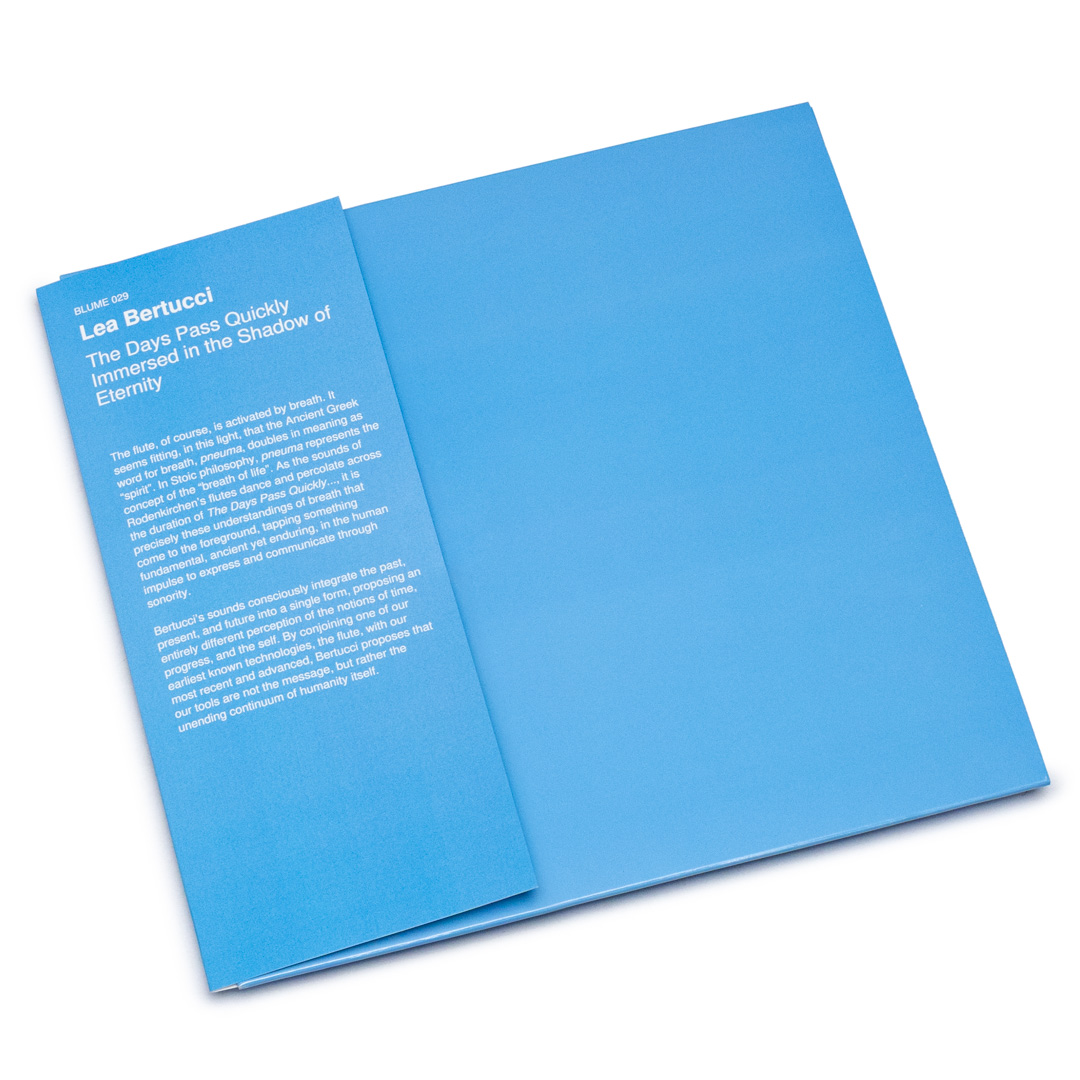
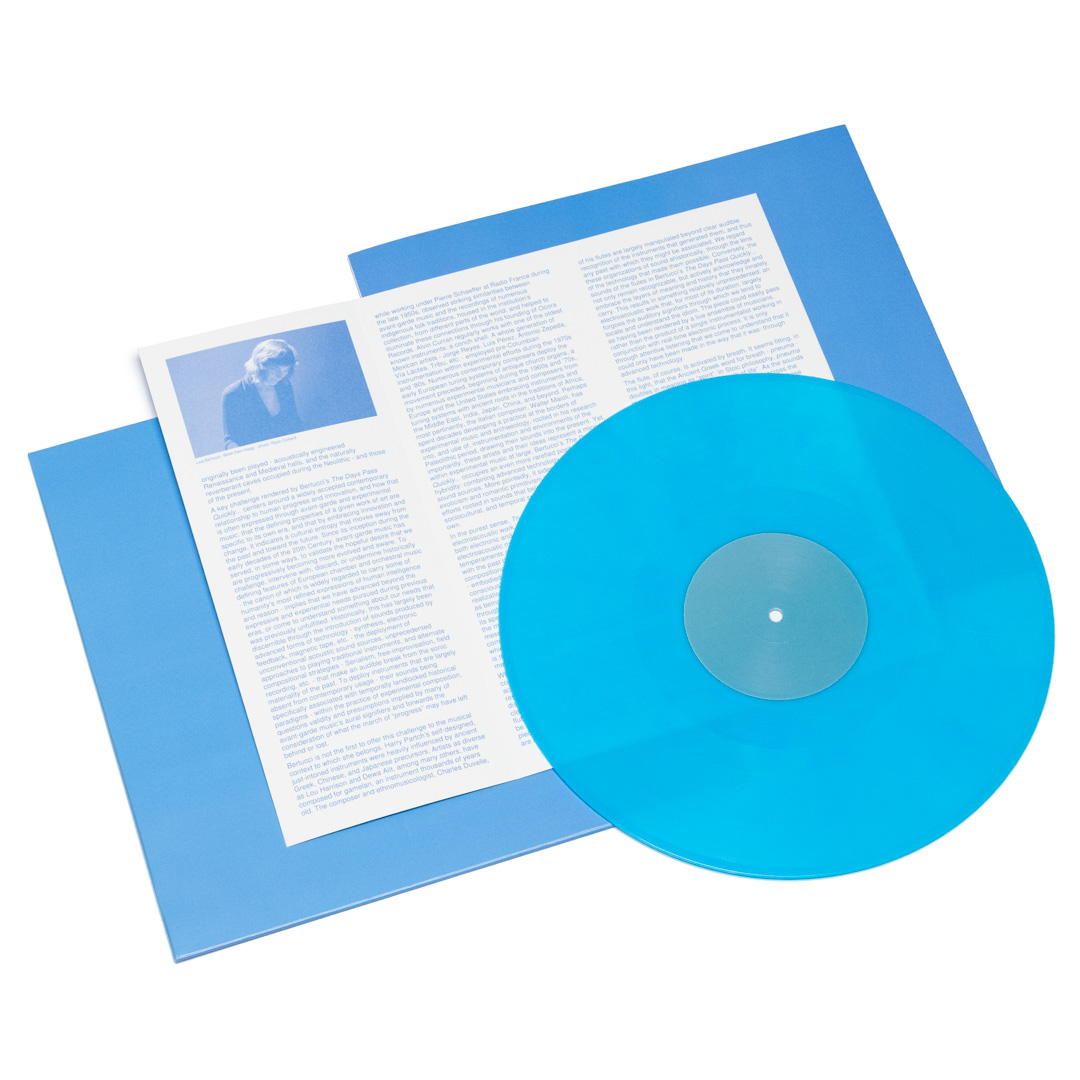
Lea Bertucci, The Days Pass Quickly Immersed in the Shadow of Eternity (Part 1, Part 2). LP, BLUME 029, edition of 300 copies, transparent light blue vinyl.
Issued by Blume, with liner notes by Bradford Bailey.