We use cookies on our website to provide you with the best experience. Most of these are essential and already present.
We do require your explicit consent to save your cart and browsing history between visits. Read about cookies we use here.
Your cart and preferences will not be saved if you leave the site.

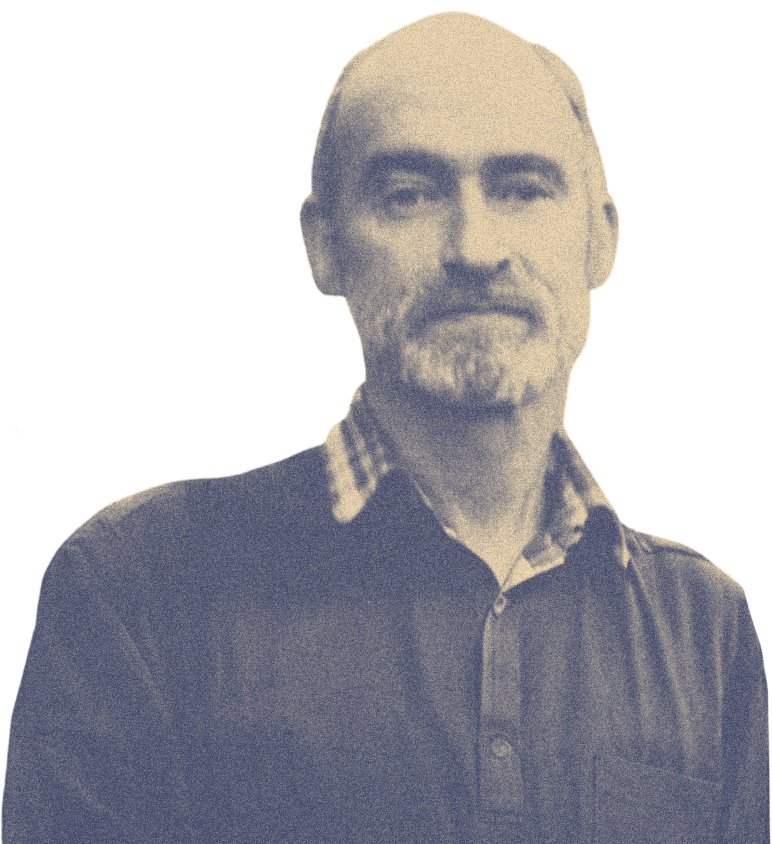
Christian Wolff

(b. 1934) American composer whose indeterminate scores redefined performer agency. As the youngest member of the New York School (with Cage, Feldman, Brown), his works like 'Burdocks' (1971) use graphic notation and chance elements to create unique democratic spaces where musicians become co-composers. Wolff's political engagement surfaces in pieces incorporating protest songs, while his later works explore fragile tonal relationships, proving that experimentalism need not abandon beauty.

(b. 1934) American composer whose indeterminate scores redefined performer agency. As the youngest member of the New York School (with Cage, Feldman, Brown), his works like 'Burdocks' (1971) use graphic notation and chance elements to create unique democratic spaces where musicians become co-composers. Wolff's political engagement surfaces in pieces incorporating protest songs, while his later works explore fragile tonal relationships, proving that experimentalism need not abandon beauty.

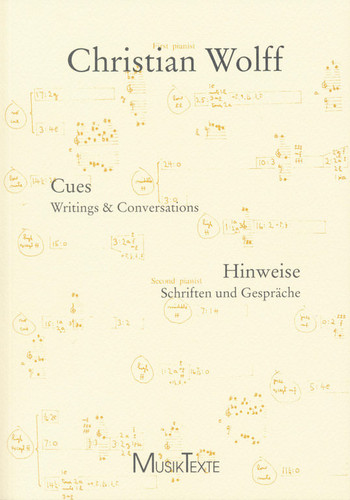
Cues: Writings & Conversations
544 page English/German Edition. In 2002 Christian Wolff was a guest composer at the Huddersfield Contemporary Music Festival and during the course of the festival he was interviewed by Christopher Fox and by James Gardner. Fox's interview took place before an audience in the Lawrence Batley Theatre on 25 November; Gardner's interview was recorded in private in the George Hotel, Huddersfield on 27 November, and edited excerpts from that recording were subsequently used in a programme produced by…
Desert Plants
**Essential reading!** Walter Zimmermann interviews Morton Feldman, Christian Wolff, John Cage, Philip Corner, Jim Burton, Phil Glass, Steve Reich, Robert Ashley, Alvin Lucier, Joan La Barbara, Pauline Oliveros, David Rosenboom, Richard Teitelbaum, Larry Austin, James Tenney, J. B. Floyd (about Conlon Nancarrow), La Monte Young, Charlemagne Palestine, Charles Morrow, Garrett List, John Mc Guire and Ben Johnston (about Harry Partch).
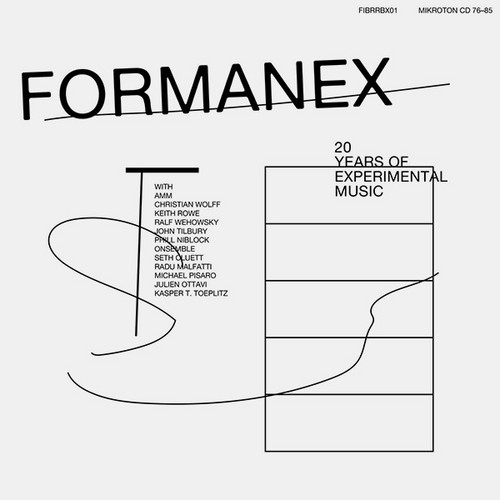
20 Years Of Experimental Music
**Edition of 300 copies** Nantes trio Formanex celebrates 20 years of activism in experimental music with a 10 CD edition full of amazing collaborations with ONsemble (contemporary music group from Nantes and Saint-Nazaire) and composers they have worked with. The box set includes early works by Formanex’s own Julien Ottavi, unique compositions created by Keith Rowe, pieces by Kasper T. Toeplitz, Ralf Wehowsky, Seth Cluett, Michael Pisaro, Radu Malfatti, as well as other giants of contemporary m…
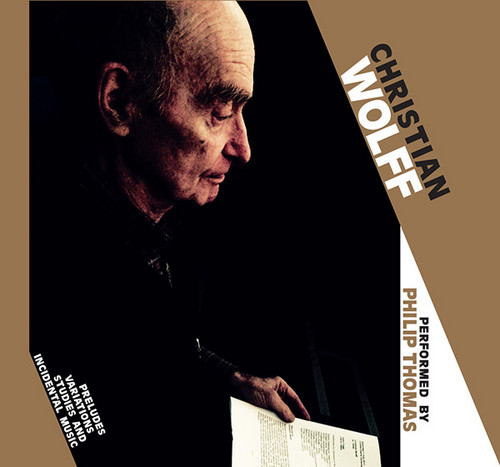
Preludes, Variations, Studies and Incidental Music
These two discs reveal Christian Wolff as a composer fully exploring, in different ways, the continuum between music which is highly fragmented, embracing extended silences [composed or indeterminate], to that which is more progressive and seemingly driven, albeit taking in disarming and unconventional routes. As a body of repertoire, these works are remarkable for their freshness of musical thought and energy (John Cage considered Wolff to be the most 'musical' of the experimental composers).Ch…
Two Orchestra Pieces
This recording is the first ever devoted to the orchestral music of Christian Wolff (b. 1934) and thus documents a little-known aspect of his wide-ranging work. John, David (1998) introduces in its second part a prominent role for solo percussionist, playing a wide range of pitched and non-pitched instruments, including marimba, glockenspiel, a variety of drums, wood and metal instruments and other sources, the exact choice left to the performer. Rhapsody (2009), in contrast, uses instruments of…
Where Are We Going, Today
Christian Wolff, piano, objects, charango, flute. Antoine Beuger, voice, whistles, EWR recordings (1995) of Christian Wolff’s “Stones”.Antoine Beuger started composing music in 1990 and has released on his own label, Edition Wandelweiser Records, as well as Erstwhile Records. Beuger’s work is best exemplified by two releases, his first, Calme Étendue (Spinoza) and A Young Person’s Guide to Antoine Beuger. Calme Étendue (Spinoza) is an album that attempts to take the 17th century philosopher Spin…
Tilbury Pieces
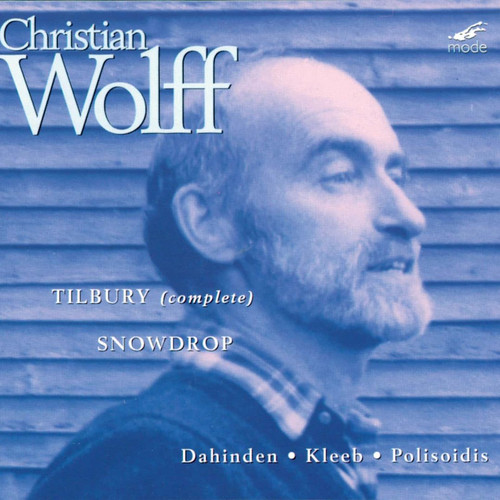
At 65-years old in 1999, Christian Wolff is enjoying a renewed interest in his work, with many performances of his music worldwide. The works on this disc, volume 3 of Mode's Christian Wolff Edition, belong to his minimalist, and open-form, styles. The Tilbury pieces (1969-70) are named for the pianist John Tilbury, whom Wolff had recently met at that time. Snowdrop (1970), from the same period, was named for the snowdrops among the earliest Spring flowers found in the Vermont countryside w…
Uncertain Outcomes
Two concerts of experimental improvisation from Eddie Prevost and Christian Wolff, two giants of conceptual improvisation and composition, recorded at Ikletick in London in 2015 and at Dartmouth College, in Hanover, New Hampshire in 2016; with superb pacing and brilliant execution, these dialogs between keyboard and percussive instruments explore unique sound worlds with depth, inquisitiveness, and a sense of wonder.
Berlin Exercises
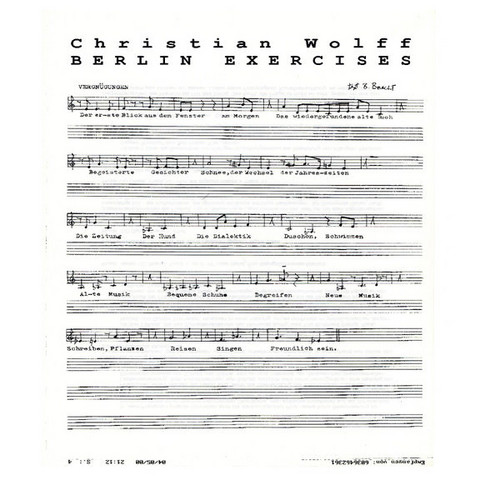
Christian Wolff on Berlin Exercises: "'Exercise' indicates relatively shorter pieces in which the process of work, of practicing and of trying things out within specified limits, in short a kind of discipline in process, are being attempted. I regard them as both exercises in composing and for performers, especially as the performers function as members of an ensemble." Your first encounter with the music of Christian Wolff leaves you with the impression you’ve just heard (or played, or re…
John Cage / Christian Wolff
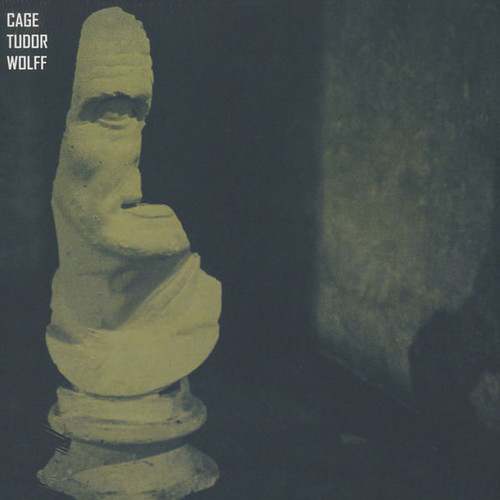
Jeanne Dielman present a reissue John Cage and Christian Wolff's self-titled album, originally released in 1963 on legendary Times Records. This album was an early showcase of both 20th century composers's experimental chops, and is highly regarded as some of their finest work. Cage's piece, which spans the whole of the first side, was originally composed in 1960, and like many of his pieces, would never be performed the same way twice. "My hope is that it forms a possible landscape on one …
San Francisco Museum Of Art, January 16th, 1965
Recorded live by KPFA Radio in the halls of the sculpture court of the San Francisco Museum of Art on January 16, 1965, the day of 39th birthday of fellow pianist and longtime associate David Tudor, this historic concert with John Cage opens with a duet for Cymbal with contact microphones agitated by a wide gamut of objects and concludes with Variations IV in which loudspeakers outside the performance space interacted with speakers next to the audience. First release on vinyl for a very importan…
Incidental Music and Keyboard Miscellany
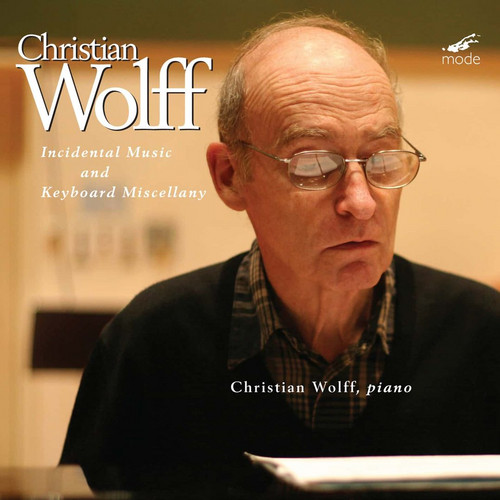
“Incidental Music and Keyboard Miscellany, though both consisting mostly of quite short musical items, have as a whole different origins and different shapes. Keyboard Miscellany is an ongoing collection, a place to deposit occasional pieces which seem to have no place else to go. The earliest is “Variation on Morton Feldman’s Piano Piece 1952” (1988). The piece came about when I was asked to contribute an analysis of a Feldman piece to a collection of essays on Feldman’s music. To do this I tri…
Looking Around
Christian Wolff, prepared piano, whistles, stones. Michael Pisaro, electric guitar, harmonica, stones. Recorded in 2014. Chistian Wolff (1934), American composer of avant-garde music. Michael Pisaro (1961), guitarist andcomposer, member of Wandelweiser. The album was mastered by Joe Panzner and designed by Yuko Zama
11 Microexercises
2013 release ** "11 Micro-Exercises were invented by Christian Wolff in response to a commission from the Miniaturist Ensemble. For Wandelweiser Editions, other miniaturists perform these eleven pieces (plus two bonus pieces): Beat Keller and Reza Khot. Keller and Khot are two electric guitarists who pierce the ivory (sometimes tear it) and respect the principle of a musical art free from preconceptions. Nine seconds, twenty-two, one minute and thirteen, or eleven minutes and forty-seven… The le…
Exercise 15
"Exercise 15" was made out of and invites transformations or transcriptions. It's for piano or ad hoc instrumental arrangement. Its material is from a 1920s song "Union Maid" (as I found it in Edith Fowke and Joe Glazer's collection "Songs of Work and Protest") by Woodie Guthrie using an earlier popular song tune.  The tempo of the music is not specified. Sometimes it's played rather fast, as the original tune probably was, sometimes at a deliberate, 'prosaic' tempo. Here it's in a slow motio…
Angelica Music
The music of Christian Wolff has long occupied the fertile borderland between composition and improvisation, as both are usually understood. More a set of suggestions than a writ of prescriptions, his scores can take the form of graphic symbols floating freely against a white background—as in 1968’s Edges—or of pitches notated and other parameters left unspecified, as in the Exercises. He is on record as having said that a score is only a means to an end, the latter consisting of the performance…
Pianist: Pieces
As a body of repertoire, these works are remarkable for their freshness of musical thought and energy (John Cage considered Wolff to be the most 'musical' of the experimental composers). Christian Wolff uniquely blends experimental concerns with classical tendencies. In these pieces not only are older composers referenced (Ives, Schumann) but Wolff's love of clarity of line and transparency of texture betrays an empathy with Webern, Haydn and Bach. This aesthetic is, however, combined with a ten…
8 duos
Born in 1934, Christian Wolff is the last surviving member of the group of composers that also included Morton Feldman and Earle Brown, which gathered around John Cage in New York in the 1950s. Wolff's own music has remained faithful to that Cageian experimental tradition ever since, and the eight works for pairs of instrumentalists here show how, in the right hands, the varying degrees of freedom his works allow their interpreters can produce astonishingly beautiful results. The common denomina…
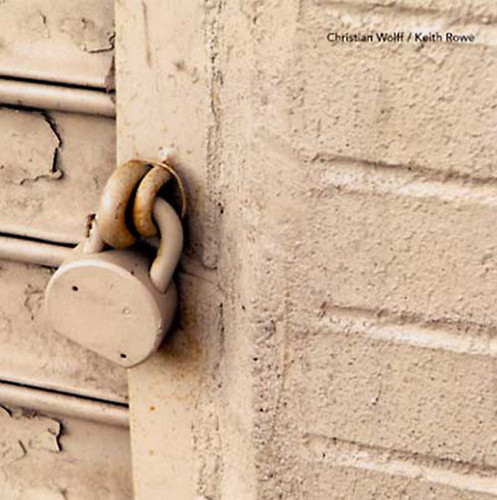
Christian Wolff / Keith Rowe
In September 2011, Erstwhile producer Jon Abbey was invited to curate two weeks of shows at John Zorn's legendary Manhattan venue The Stone, which he used as an opportunity to invite many of his favorite musicians from Japan, Europe and the US to perform. A second three night festival at Issue Project Room was later appended onto the end, making the AMPLIFY 2011: stones festival a 35 set, 17 night extravaganza in all. Four of those thirty-five sets will now be available in the ErstLive se…
Kompositionen 1950 - 1972
A portrait of Christian Wolff, documenting the composer's early activity through recordings made close to the time of their composition from artists including Cornelius Cardew, Frederic Rzewski, David Tudor
1 2 3