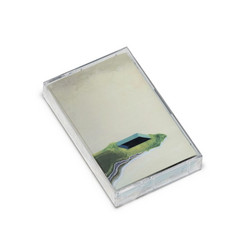
** Edition of 150 ** Leviathan Whispers moves like a tide at night: slow, massive, and charged with things half-seen. Across these pieces, Tim Hill turns baritone, alto and soprano saxophones into engines of breath, hum and bone-song, wrapping their grain around drifting tape loops, ghosted synths and detritus from outdoor performances and art installations. It is an album of longings and laments, of drones that feel both savage and tender, as if the British landscape itself were exhaling through metal and reed. Rather than a neat studio statement, it plays as a haunted archive of impulses - ritual fragments, street remnants, solitary meditations - threaded into a single, murmuring leviathan.
Hill’s background in rough music, industrial folk, free jazz, dub, post-punk and avant-rock is everywhere, but never in the form of genre cosplay. You hear it in the clang of a distant procession folded into a harmonic smear; in the way a hymn-like phrase rises out of noise, only to dissolve back into granular hiss; in the half-dubbed sense of space, where echoes feel like they are bouncing off brick, bone and water rather than plug-in presets. These are pieces written for giants tramping through streets, for torches and effigies, for the strange civic theatre of Olympic relays and riverside festivals, yet they also feel intensely private, like voices caught talking to themselves long after the crowd has gone home.
As festival director of The Sound of the Streets and musical director of the Wye Valley River Festival, Hill has spent years animating outdoor spaces with brass bands and street ensembles. That public-facing work bleeds into Leviathan Whispers in curious ways. Snatches of live recordings are repurposed as spectral backdrops, turning once-extrovert events into distant, flickering memories. The music feels attuned to Albion’s mythic underside: Blake’s visionary England of mills and angels, but also the post-industrial quietness of car parks, canal paths and small-town parades at dusk. Saxophones sigh and keen over low, thrumming beds, as if calling across valleys; reeds and woodwinds intertwine like smoke drifting through trees.
The sonic architecture is deepened by the presence of two key collaborators. Colin Potter, long associated with Nurse With Wound, processes elements of Hill’s material into smudged halos and subterranean rumbles, giving the album a porous, dream-logic continuity where every sound seems to seep into the next. Drone artist Jonathan Coleclough adds a further layer of slow tectonic movement, anchoring the floating lines with tones that feel almost geological. Together, they nudge the music toward a zone where drones, hymns and improvised laments become indistinguishable currents within the same dark water.
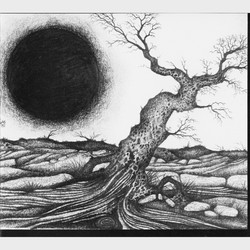
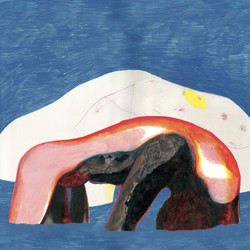
Visuals are an integral part of this world. The album’s artwork and accompanying videos feature sound sculptures by Michael Fairfax, whose carved forms and resonant structures extend Hill’s fascination with objects that both shape and channel sound. These are paired with unsettling, alchemical imagery from film-maker David Young, whose junk-born visions mirror the music’s ability to find occult charge in the overlooked and discarded. The result is a project that exists as much as an environment as a record, a drift through a parallel England of rusted metal, damp stone and half-remembered songs.