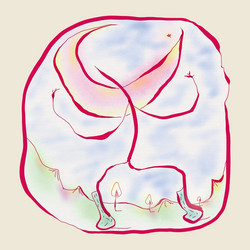
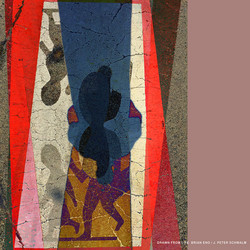
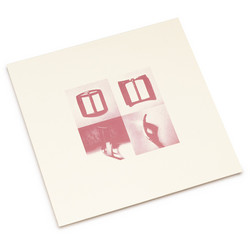
“In The Birth of Tragedy, Nietzsche wrote, ‘Without music, life would be a mistake.’” Mumiaseems to take that line literally and then turn the volume almost all the way down. Rather than dramatizing pain or flaunting confession, Bobby Would lets the record unfold quietly, almost cautiously, like breath condensing on glass. Each side feels like a single, held thought: unified meditations on stillness, numbness and the thin, persistent seam of beauty that can run through sadness when it stops needing to explain itself. There are no crescendos, no displays of unique feeling, just a sustained attention to what remains when grief has settled and become part of the room.
Behind this apparent calm lies a story that could have been told as a novel but is instead treated with radical restraint. In late 2020, in the thick of the pandemic, Robert Pawliczek (aka Bobby Would) began working on Mumia after the sudden death of his close friend, artist Sven Sachsalber. Sven had travelled to visit him in Vienna and died unexpectedly in his accommodation. Rumours bloomed in the vacuum left by shock and isolation; grief congealed into something formless, not yet nameable. Medical explanations eventually pointed to a complex heart condition, but by then uncertainty had already taken hold. Rather than turning that experience into narrative catharsis, Pawliczek treats it as an underground current, an unstable foundation over which the music slowly builds.
At the time of his death, Sachsalber had been painting Pantone cards of extinct pigments. One pigment in particular preoccupied him: Caput Mortuum, a deep iron‑red historically tied to depictions of skulls and mortality. But he had confused it with Mumia, the ancient brown pigment made from ground mummies, believed to retain some residue of life. That error - two colours, two histories bleeding into one another - became the conceptual hinge of Bobby Would’s album. Mumia and Caput Mortuum: death and the remnants of life, bone and embalming, iron red and earthy brown. The record doesn’t illustrate this mistake so much as inhabit it, taking the misalignment of names and materials as a way to think about how grief mixes stories, how memory misremembers, how different shades of loss can become indistinguishable.
The interplay between sound and colour on Mumia is more than a metaphor. The drones are sleek yet weighty, deliberate, moving at the edge of perception. They slide like weather systems rather than melodies, thickening and thinning, shifting from grainy opacity to translucent wash. Listening, it is easy to imagine deep browns and iron reds smearing into one another, dissolving into cooler tones and shadow. These are not ornamental backdrops; they feel like atmospheres in which thought itself is suspended. The pacing is unhurried, almost ritualistic, as if each frequency band were being laid down with a small brush and then left to dry.
For listeners drawn to “visual music” - sound that seems to generate images, hues, textures in the mind’s eye - Mumia occupies a compelling threshold. Grief here does not announce itself with sobs or dissonant shocks; it hums underneath, unwavering and matter‑of‑fact. Each side of the record becomes a kind of synesthetic field where tones move between light and dark, saturation and fade, echoing the way memory cycles through moments of clarity and fog. The soundscape is both background and foreground, like a painting that you can’t quite step out of: from a distance it feels monochrome, up close it reveals layers, brushstrokes, small departures from symmetry. As the drones saturate and then gently cool, they sketch the quiet presence of the lost more than their absence.