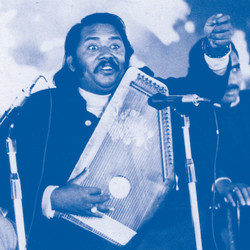
Includes deluxe 12-page booklet with unpublished photos, lyrics, translations, and liner notes written by NTS radio host Jamal Khadar. Before there was a Zambia, there was Alick Nkhata. Born in Kasama in 1922 to a Tonga father and Bemba mother, Nkhata would become the voice of a nation that did not yet exist - and help sing it into being. Vocalist, guitarist, bandleader, broadcaster, archivist, freedom fighter: he moved between these roles as effortlessly as he moved between lonesome country slide, big band pop, and the tight vocal harmonies rooted in Bemba traditional song. Radio Lusaka collects his work for the first time on vinyl, a dizzying, inclusive, expansive portrait of an artist who understood that music could be both entertainment and weapon.
Nkhata's path to becoming Zambia's first musical star wound through the jungles of Burma, where he served with the East African Division during World War II. Returning home to what was then Northern Rhodesia, he began collaborating with South African ethnomusicologist Hugh Tracey, traversing the country with mobile recording equipment to document indigenous songs and instruments. This work instilled in Nkhata a lifelong devotion to preservation - the understanding that traditional music was not merely heritage but living culture, constantly evolving yet rooted in something essential.
In 1950, he joined the Lusaka branch of the Central African Broadcasting Corporation (CABS) as an announcer and translator. "I can sing a bit," he told them. Within years, he had formed the Lusaka Radio Band - later renamed the Big Gold Six Band - and established himself as a regional icon whose popularity stretched across Northern Rhodesia into Southern Rhodesia (now Zimbabwe) and Nyasaland (now Malawi). His songs transcended tribal and linguistic barriers, blending town and country, past and present, the traditional and the unmistakably modern.
The tracks on Radio Lusaka document this synthesis. Lonesome country laments like "Nafwaya Fwaya" and "Fosta Kayi" drift along the railways that carried workers to urban centers and copper mines, their slide guitar weeping with displacement and longing. "Nalikwebele Sonka (I Told You Sonka)," sung in "deep-Bemba," pairs honey-soaked yodels with a stark warning about the downward spiral of unemployment in the townships. "Mayo Na Bwalya (Mother of Bwalya)" captures a mother's plea to a traditional songbird for guidance of her wayward son - ancient ritual dressed in modern arrangement.
Then there are the syncretic pop masterpieces. "Shalapo," "Kalindawalo Na Mfumwa," and Nkhata's biggest hit, "Imbote," infuse piano, big band horns, and even early electronic instruments into something that belongs to no single tradition yet encompasses them all. These are songs that could fill a dance hall while carrying the weight of history.
In the early 1960s, as independence approached, Nkhata wrote campaign songs for Kenneth Kaunda and the United National Independence Party. When Zambia was born in 1964, Nkhata was there - not merely as witness but as architect of the new nation's cultural identity. He rose to become Director of Broadcasting and Cultural Services at what became the Zambia National Broadcasting Corporation (ZNBC). A 1965 decree by President Kaunda mandating that 95% of music on Zambian radio be local content gave Nkhata's work - and the work of countless musicians he had championed - unprecedented reach.
In 1963, CABS had sponsored him to study broadcasting with the Voice of America in Washington, where he became one of the earliest hosts of the African Panorama programme. He returned to Zambia carrying new techniques and broader horizons, but his commitment to local music never wavered.
Nkhata retired in 1974, settling on a farm in Mkushi District. He continued to play occasionally, surrounded by the country air he loved. But conflict still raged in the region. On October 19, 1978, Rhodesian special forces - the notorious Selous Scouts - launched a raid on a nearby camp where ZIPRA guerrillas were training. Nkhata, driving home, was caught in the crossfire. His vehicle was sprayed with bullets. He was fifty-six years old.
Today, Alick Nkhata Road runs through Lusaka, past the ZNBC headquarters he helped build. His recordings survive in the national archives, played on radio programmes decades after his death. His son David Nkhata continues the family tradition from the same Mkushi farm.
Radio Lusaka - assembled from original 78s held in collections across the globe - brings these songs to vinyl for the first time. The audio has been painstakingly restored by Jordan McLeod at Osiris Studio in Nashville. Jamal Khadar of NTS Radio contributes liner notes that situate Nkhata within the broader context of African independence movements and musical innovation. Ellen Banda-Aaku provides lyric translations that reveal the depth of Nkhata's storytelling. The deluxe 12-page booklet includes unpublished photographs from the Nkhata family archive.
This is music from the copper mines and the townships, from the radio waves that united a nation before it had a name. This is the sound of freedom being sung into existence.
Includes deluxe 12-page booklet with unpublished photos, lyrics, translations, and liner notes written by NTS radio host Jamal Khadar. Comes in a poly outer sleeve with a small "Made in Czech Republic" sticker on the back. There is a typo in the track A5 title on the jacket: "Nalikwebele Soka" should be "Nalikwebele Sonka". Runouts are machine etched. Vinyl pressing company derived from runouts.