Felicia Atkinson
Sans Visage (LP)
Félicia Atkinson first saw Les yeux sans visage (Eyes Without a Face), the 1960 horror film by Georges Franju, when she was a teenager, around the turn of the century. At the time she was frequenting arthouse movie theaters, immersing herself in cinema, and she was encouraged to go by her father. The film made an impact for its iconic imagery and the way Franju draws on the aesthetics of early filmmaking, from its score that relies on stylistic markers typical of the 1940s or 50s to the decision to shoot in black and white. Even four decades after its first release, it was clear that this was a work that stood outside of the cultural moment that birthed it, speaking through time in ways that were uncanny, but profound.
A quarter-century later, Atkinson was approached by the Belgian cultural center Viernulvier to create a new score for Les yeux sans visage for its celebrated Videodroom series, which has seen artists like claire rousay, Mabe Fratti, Lee Renaldo, and many more create new original scores for cult classics and genre cinema. Atkinson’s music, with its sublime meditations on space and proximity, its elusive sense of narrative development, mirrors the pacing and mystery at the heart of horror filmmaking. There is a shadow at the heart of her soundtrack to Les yeux sans visage, an ever-shifting wisp and an insinuation of encroaching transfiguration. Echoing a climactic moment in the film, the music obliquely points to “the Beyond,” an impossible place of discovery and revelation.
There are many cages in the film - for young women, for dogs - but Atkinson envisioned her music as something akin to the air moving throughout and beyond them, unconstrained by the bars and with undefined borders. Unlike many of her recent full-length albums, there are no voices in the soundtrack, which is driven instead by piano and keyboards that were improvised along with the film. Those cages hold the victims of a madman surgeon, determined to graft a new face onto his daughter, the protagonist Christiane Génessier, who lost hers in a car accident while he was behind the wheel. Atkinson was reminded of her predecessors at the pioneering French studio the GRM, who approached sound in a less sinister, but similarly surgical manner, and took inspiration from their playful approach to cerebral soundmaking for the electroacoustic topography into which the piano is embedded. As such, Atkinson’s reactions to the larger themes and the minute-by-minute happenings onscreen are both audible simultaneously.
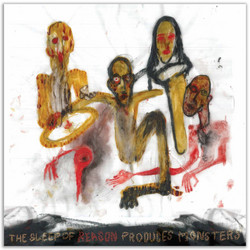
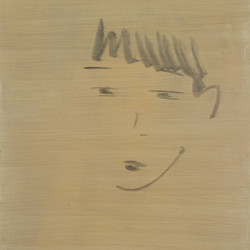
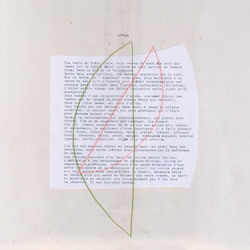
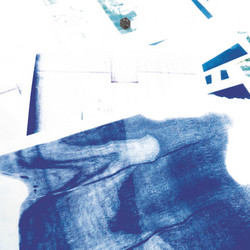
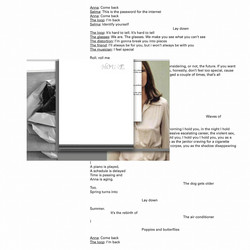
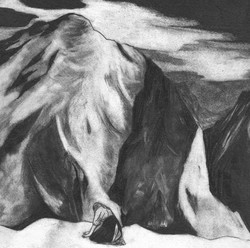
This recorded version of the soundtrack is a 34-minute synthesis of the full 90-minute score, presented on LP along with an essay by writer-musician Claire Cronin and drawings by Momo Gordon. A complex reflection on the themes of the film emerges from these three perspectives. Gordon sketches the cages hidden in the basement, the front gate of the surgeon’s mansion, the staircase that acts as a portal between the terrible events below and the ornate, but still penitentiary, main living space. The line-drawings seem to invite the music to fill the spaces between pencil marks, just as the essay clarifies the narrative and brings in the symbolism that the music poetically references. Cronin touches on the film’s subtly meaningful absurdity, notes the similarities between the depictions of blood and ink in black and white, and contextualizes Christiane’s rageful moment of awakening as she sees the results her father’s work, recognizes her captivity, and makes an uncertain break from it.
In presenting Les yeux sans visage in a retro style for its contemporary era, Fraunju insinuates the tragic timelessness of the themes Cronin describes. A film about a man who destroys the lives of young women marked by their beauty and similarity to his daughter in a shame-fueled rage has clear, continuous cultural resonance. Atkinson dedicates her soundtrack to Gisèle Pelicot, a woman who refused to be faceless after being inflicted with repeated patriarchal violence. If these sounds move as if the bars of cages are no barrier, they also intimate the freedom and power of those held behind them. Rather than simply mirroring the fear and confinement shown onscreen, Atkinson offers an elusive escape, a beacon for the characters, and the listener, to follow as they reckon with the narrative and move through it.