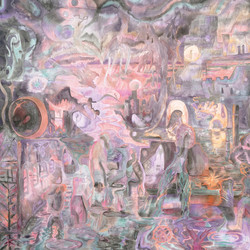
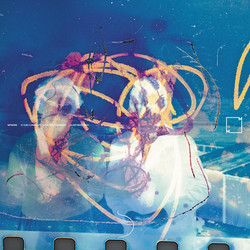
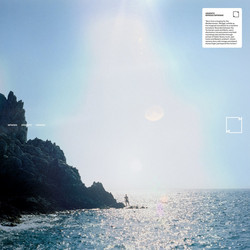
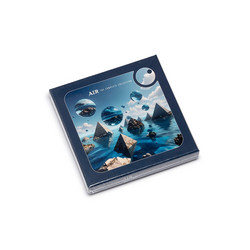
Waves of Time lands as the moment Gazzi turns his gaze inward, pivoting from the immediacy of club‑adjacent productions toward something more vulnerable and slow-burning. The Andalusian producer, long regarded as a quietly influential presence in the Spanish electronic underground, uses this LP to test how far he can move away from obvious peaks without losing intensity. Rooted in ambient and new‑age minimalism, the album leans on piano, feather‑light synth work, and the expressive potential of silence: tracks breathe, hesitate, and open out, as if the record were less interested in filling time than in dilating it. What might have been background music in lesser hands becomes, here, a series of attentive rooms where every note is a deliberate interruption of quiet.
Across these pieces, Gazzi circles a single question: what does it mean to slow down when everything around you insists on acceleration? The arrangements are almost ascetic in their delicacy - a handful of tones, a distant harmonic swell, the soft ghost of a rhythm that never quite hardens into a beat. Yet within that restraint there is a great deal of movement. Melodic fragments reappear like déjà vu, slightly shifted in colour; pauses expand until they feel charged, like the space between breaths in the middle of a confession. The music holds open a zone for reflection, offering not grand catharsis but a low, persistent glow of nostalgia and stillness, with just enough light at the edges to imply that hope has not entirely left the frame.
The LP also deepens Gazzi’s dialogue with Glossy Mistakes, a label that has built its identity around championing adventurous, emotionally nuanced work from Spain and beyond. In that context, Waves of Time reads like both a personal milestone and a statement of intent: a young artist trusting subtle sound design, sensitivity, and formal openness to carry a whole record, and a label confident enough to foreground that quietness as a virtue rather than a risk. The music’s warmth and fragility dovetail with the imprint’s broader project of reshaping Spain’s sonic identity away from caricature and toward something more shaded and forward‑thinking.
Gazzi has framed the album with a line that feels like both invitation and warning: “These songs were made to sit with the wound - to let you drift, to feel scattered, contemplative; they're meant to keep you from thinking too much - or maybe to make you think a lot.” That paradox lies at the core of Waves of Time. This is music that doesn’t tell you what to feel, but creates conditions in which feeling becomes harder to avoid: long, gently undulating stretches where the mind is free to roam, and where half‑buried memories or anxieties have time to surface. In the end, the record stands as a meditative, deeply personal chapter in Gazzi’s catalogue and as a quiet cornerstone in the ongoing story of Spanish electronic music - proof that one of its most compelling voices is willing to let the volume drop in order to hear what’s actually going on inside.