“The rediscovered 1960s and 70s archives of Colombian electroacoustic composer Jacqueline Nova are given new life”
“Amplifiers, filters, recorders, microphones, audio frequency cables, universal coupling, reduction coupling, pulleys, inputs, outputs, transformers, oscillators, speakers, controls, volume; elements adjusted to a certain tension; successively ordered movements; friction; lights that turn on; acting forces; moving gears; vibrations. We are here at the level of experience.” Written in 1966 for the Colombian magazine Revista Nova, “The Wonderful World Of Machines” was composer Jacqueline Nova’s exhortation to fellow composers and a larger listening public to embrace new multiplicities of sound as a way of understanding the wider world.
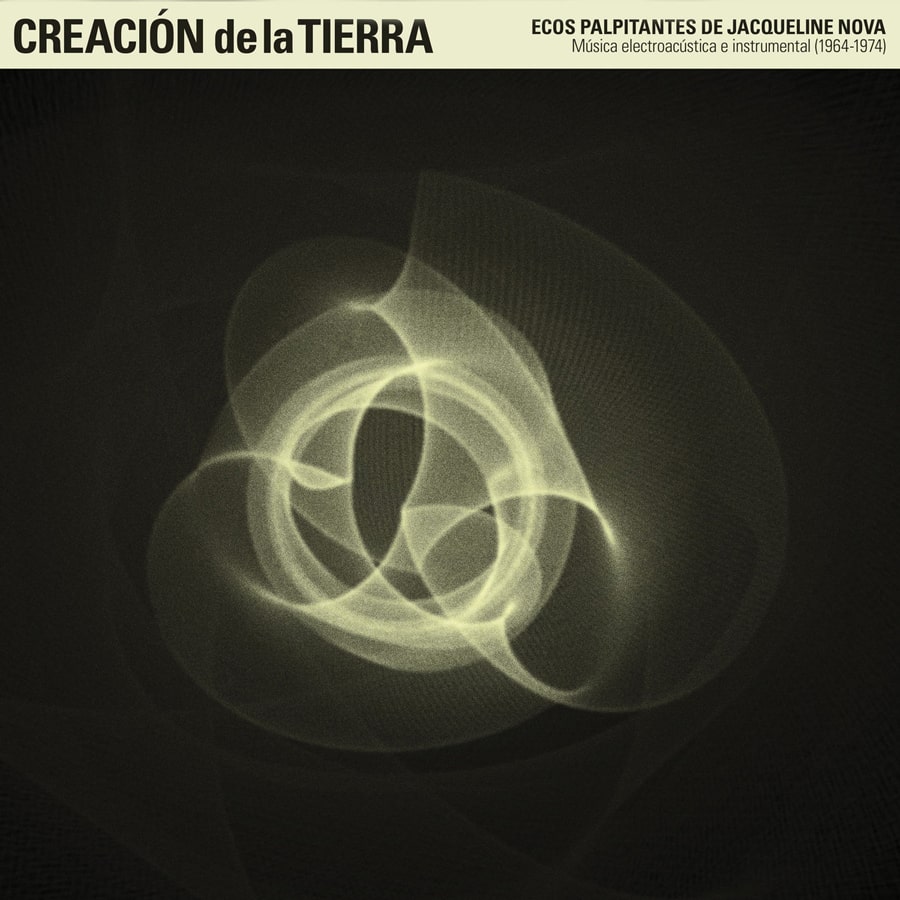
Before her death at the age of 40 in 1975, Nova’s urging of a new way of listening – to engage with sound not simply in the systems offered by musicology but on the “level of experience” – was revolutionary in the world of South American, and especially Colombian, electroacoustic music in the 1960s and 70s. Thanks to the detective work of fellow Colombian composer and sound artist Ana María Romano G in locating Nova’s archival material, audiences can now hear for themselves just how prescient her music really was. Spanning two LPs and seven works, the new compilation Creación De La Tierra – Ecos Palpitantes De Jacqueline Nova: Música Electroacústica E Instrumental (1964–1974) maps the breadth of Nova’s work. Its compiler Romano was a student at the Universidad de los Andes in Bogota when she first came across Nova. As its title (Creation Of The Earth – Throbbing Echoes Of Jacqueline Nova) suggests, the anthology throbs with vitalised electrical pulses.
“[The composer] Catalina Peralta Cáceres, then living in Vienna, was invited to Bogota to participate in the contemporary music festival, and she gave some talks at my university. One of these was on Jacqueline Nova,” explains Romano in a Skype call from the Colombian capital. “She shared [Nova’s] Creación De La Tierra [a 19 minute electroacoustic work for processed voices] with us and it took my breath away.”
Created in 1972 in the electronic studio of the Universidad de Buenos Aires in Argentina where Nova had a scholarship to study at the Centro Latinoamericano de Altos Estudios (CLAEM), Creación’s original vocal material comes from creation story chants delivered by members of the U’wa nation from northeastern Colombia. Using standard techniques of musique concrète, Nova experimented with layers of sound, bringing at first submerged and unrecognizable voices to the fore in a way that proposes the U’wa’s presence underpins the modern Colombia. She considered the finished piece to be at once ritualistic and profoundly political, making the voices of Colombia’s indigenous population audible to the majority. “I was riveted by this when I heard it and very moved,” says Romano. “I thought, first, who composed this music? Then, who is capable of composing something like this?”
Years of research yielded an answer. If Nova had started her training as a musician and composer in a conventional way, she was always an outsider. For one, she was the first woman to graduate as a composer from Bogota’s National Music Conservatory. She was also a lesbian and a technologist with an interest in the haptic craft of using a reel-to-reel tape recorder. Transiciones (1964–65), for piano, is the only work on the album that predates this way of working. Even so, its clear interest in what Romano describes as the “behaviour of sound, the components of sound” points towards a more experimental mien.
Thereafter she found new ways of creating electroacoustic synthesis. Romano suggests that Nova saw electroacoustic methods as a way of making a composition that went “beyond the sound”. That phrase comes from an interview Nova gave towards the end of her life. Over Skype, Romano plays the interview and translates simultaneously from Spanish: “Nova’s actually saying that she thinks about a lot more than music: to go beyond the sound is to break historical precedents, to create new structures, to connect with the sensory.”
Nova’s interest in listening parallels, to some degree, what Pauline Oliveros was developing in the US in the form of Deep Listening. However, if there are similarities with Oliveros – gender, sexuality and musical method – they end quickly. At the time Nova was working, Colombia did not offer the experimental infrastructure that Oliveros benefited from. Nova operated very much at a tangent, even among her peer group. This might explain the breadth of her output. You get the sense that sound goes beyond music itself on her film scores, ensemble works and installations such as 1969’s Luz, Sonido, Movimiento (Light, Sound, Movement, with Julia Acuña) and 1974’s Las Camas (The Beds, with Feliza Bursztyn).
Although her music has had a few piecemeal releases in the past (Creación itself first featured on the 1976 album Tres Composciones Electroacusticas, released by the Uruguayan label Tacuabé), Romano’s compilation is the first significant release of Nova’s work. She intends it to be the next step in highlighting Nova’s compositional search for sonic knowledge, of going beyond. Jacqueline Nova’s Creación De La Tierra – Ecos Palpitantes De Jacqueline Nova: Música Electroacústica E Instrumental (1964–1974) is released by Buh
Originally published by The Wire.