“Thrilling and visionary from the first sounding to the last, it’s a startling journey from one of the most interesting artists currently at work in the United States.”
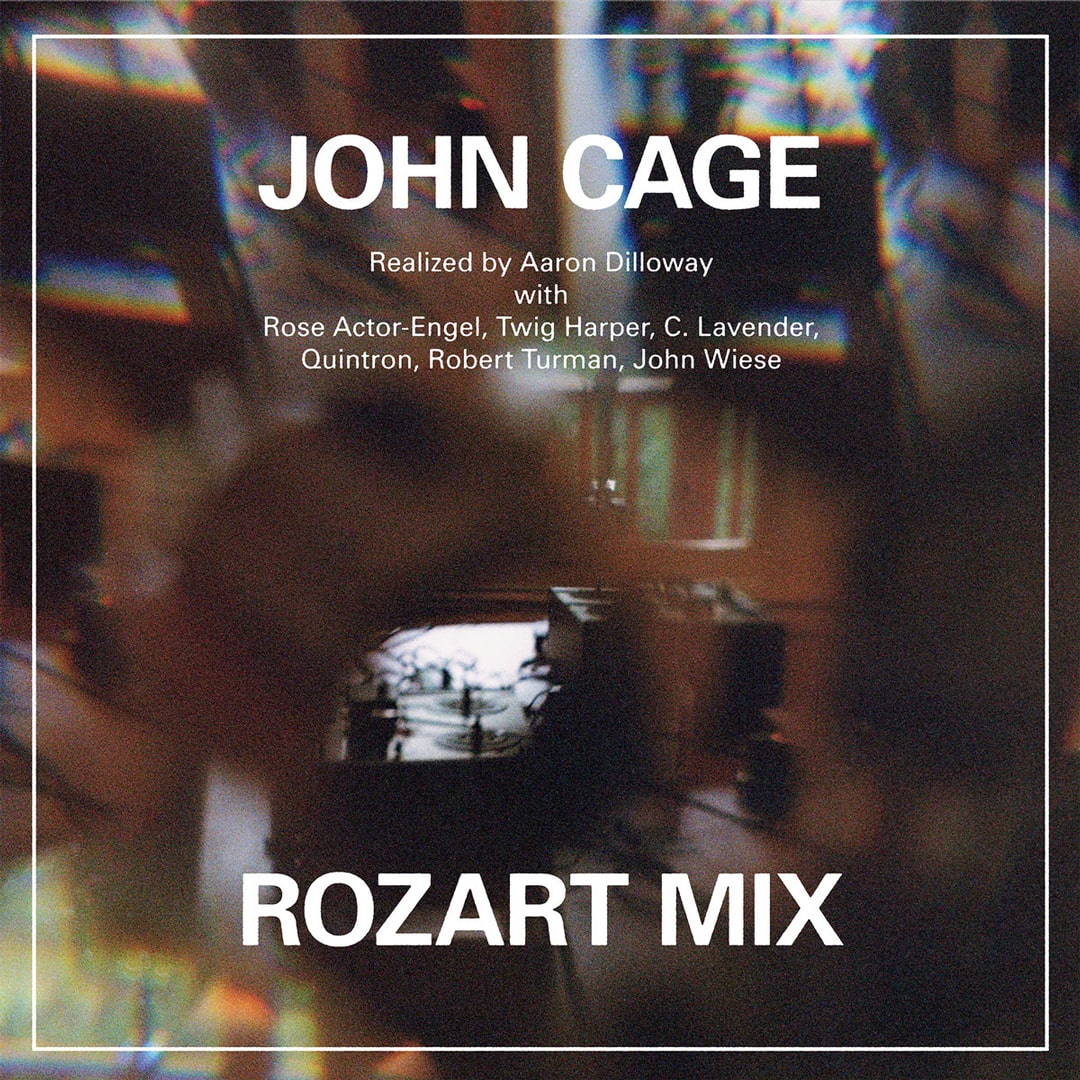
Emerging from the shadows of the American Mid-West, veteran noise visionary Aaron Dilloway delivers one of his most remarkable and unexpected releases to date, a stunning, brand new rendering of John Cage’s little known work “Rozart Mix”, composed for Alvin Lucier in 1965. Recorded at the John Cage Trust in 2021, enlisting a venerable group of collaborators to bring it to life - Rose Actor-Engel, Twig Harper, C. Lavender, Quintron, Robert Turman, and John Wiese - it’s an astounding, writhing body of sonority that draws unexpected and thrilling links between the historical American avant-garde and its contemporary realisations.
Since its inception toward the end of the 1970s, the idiom of noise has continuously produced some of the most groundbreaking gestures in creative sound that can be called to mind, hybridising the DIY ethos and furious energy of punk with the radical, forward thinking experimental tactics of the avant-garde. For roughly three decades, Aaron Dilloway - first entering the broader consciousness as a member of Wolf Eyes before carving a distinguished path as a solo artist - has stood at the forefront of the American noise movement, constantly rethinking what was possible within. With his latest LP, “Rozart Mix”, Dilloway has done it again, building an unexpected bridge between the historical musical avant-garde and his own highly singular world with a rare and personal rendering of a rarely heard or performed piece composed by John Cage for Alvin Lucier. Thrilling and visionary from the first sounding to the last, it’s a startling journey from one of the most interesting artists currently at work in the United States.
Growing up in Michigan where he made his early forays into the world of underground sound, Aaron Dilloway belongs to a long tradition of non-conformist music hailing from the American mid-west that has consistently worked with a sense of liberation from the pressures and ambitions of either coast, producing bands like the MC5, Stooges, Pere Ubu, Big Black, and countless, now legendary projects that emerged from Chicago during the 1990s and early 2000s. Even within this remarkable realm, Dilloway has always stood slightly apart and pushed the boundaries, first appearing within a handful of projects in Ann Arbor during the 90s - notably Universal Indians - before joining the fledgling noise outfit, Wolf Eyes, in 1998 alongside Nate Young and later John Olson, where he honed his blistering approach to tape loops in combination with voice, tape delays and various organic and electronic sound sources.
Following a highly prolific run with Wolf Eyes during what many regard as the band’s golden era, Dilloway departed the project in 2005 following a move to Nepal, where he recorded prolifically (his own material, field recordings, and Nepalese radio broadcasts), before relocating to Ohio in 2007, where he has steadily worked with numerous projects and produced an ever growing body of solo work, the latest being “Rozart Mix”, issued by Dilloway’s own Hanson Records.
Composed by John Cage for the composer Alvin Lucier in 1965 and premiered later that same year at Brandeis University, the score for “Rozart Mix” consists of correspondence between Cage and Alvin Lucier concerning preparations for its performance. It consists of tape loops which can contain any material and may vary in length (up to around 45 feet), with the specification that if a loop breaks, it should be fixed or replaced by another. A performance of the piece starts with the audience entering, and ends when the last member of the audience has left.
During 2020, Dilloway was approached by Wave Farm and John Cage Trust, who asked him to stage a performance of this seldomly performed piece. Following a period of research into the work and how to realise it at the John Cage Trust at Bard College, Dilloway then staged a towering six hour performance at the trust on October 23, 2021, enlisting an all-star cast of collaborators - Rose Actor-Engel, Twig Harper, C. Lavender, Quintron, Robert Turman, and John Wiese - to help him bring it to life, comprising twelve individually amplified reel to reel tape machines, placed around multiple floors of a house, playing 88 tape loops (one for each key of a piano), spliced together by 5 to 175 splices of multiple non-musical sounds, which created an overwhelming and joyous environment of cacophonous sound. Dilloway joyously recalls: “The performance culminated with John Wiese touching a frog for the first time as the final sound croaked through the speakers. The frog contact was just one of many magical moments that occurred during the preparation and presentation of the piece.”
Gathering selections from throughout the aforementioned performance, ranging from a full mix to slices of the individual tapes, “Rozart Mix” is a writhing and deeply engaging effort at the junctures of noise and musique concrete, binding the historical American avant-garde with the outer reaches of its contemporary manifestations, reimagining this rarely encountered piece with an entirely new body of sound material sourced from Wave Farm volunteers and discarded radio carts.
Originally published by Soundohm.