“Fischgeist, in truly striking ways, accomplishes what it set out to; before and around our ears emerge the images of a remarkably convincing, and dynamically abstract, aquatic world.”
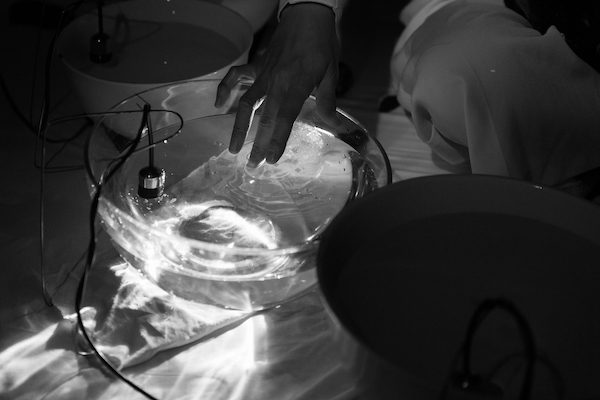
For more than a decade, the Paris-based Japanese experimental musician and sound artist, Tomoko Sauvage, has been dazzling us with her entirely singular approach to sound. Harnessing her unique ‘natural synthesizer’ by combining water, hydrophones and glass or ceramic bowls, she slowly built a body of work in live, installation, and recorded contexts that has almost no parallel. Her latest and third solo outing, Fischgeist - building on the ground explored within her acclaimed 2017 Shelter Press LP, Musique Hydromantique - takes us deep into the site-specific, environmental, and intimately responsive aspects of her work. It’s a truly mesmerizing and immersive body of sound, issued by the German imprint, Bohemian Drips, that leaves you longing for more.
Tomoko Sauvage has followed a fascinating path through music. Born and raised in Yokohama, Japan, Sauvage moved to Paris in 2003 after studying jazz piano in New York, where she began to develop her interests in Indian Classical music. In 2006, she attended a concert of Aanayampatti Ganesan, a virtuoso of Jalatharangam - the traditional Carnatic music instrument with water-filled porcelain bowls - and began to develop her approach to this realm of sonority, first with China bowls and chopsticks in her kitchen, before utilizing underwater microphones and a radically expanded range of vessels, to develop her own world of electro-aquatic instruments.
Sauvage’s music has historically grown from a live / performance-based practice, centered around improvisation and interaction of sound with an environment; the acoustic space and medium affected by architecture, temperature, humidity and those who occupy a given space, activated by the artist’s strikingly sensitive sense of touch, focus, and responsiveness, a deep devotion to chance, and a channeling of the ceremonially performative.
Each of these elements manifests within her latest, Fischgeist, with masterful grace. Recorded in a former water tank in Berlin, a building with a special architecture and acoustics, Sauvage further expanded her interests and palette by taking on inspirational nodes from the building’s history, discovered by chance during her recording sessions from a passerby, who explained that it had once been filled with fish. The vision preoccupied her over the course of the recording process, guiding the generation of her sounds in a space that was marked by an astoundingly long reverberation of up to 20 seconds.
While Fischgeist incorporates and builds upon the elements that defined her two previous solo efforts, particularly her long-standing research into hydrophonic feedback, the album encounters her taking on additional new gestures of stroking bowls’ surfaces to imitate the voices of sea mammals (Metamorphosis), drawing dots and circles by rubbing stones against stones underwater (Exit) ...The underwater amplification of quasi-inaudible sound is even more magnified in the air by the echo of the water tank. Not only tiny bubbles, but also micro-movements of the bones and veins of the hand holding the sonorous objects in the water, are intensely amplified - sounding like a tempest on the opening Deluge.
Fischgeist, in truly striking ways, accomplishes what it set out to; before and around our ears emerge the images of a remarkably convincing, and dynamically abstract, aquatic world. As immersive and densely populated as its subject, the interplay of detail of a vast range of sonorous objects is truly startling. A truly divine work of artistry that encounters one of the most interesting experimentalists of her generation delving forward, creating something without precedent as all avant-garde music should hope to do, we couldn’t possibly sing its praises enough.
Originally published by Soundohm.