“Each represents a singular and historically significant body of text from seminal voices in the realm of avant-garde sound.”
It’s been an incredible year for the New York based curatorial platform, Blank Forms, and arguably their most ambitious to date. They’ve given us two beautiful volumes of their journal, LPs by Maryanne Amacher, Catherine Christer Hennix, Masayuki Takayanagi New Direction Unit, and Patty Waters, all the while producing their signature series of astounding concerts and events. Now they’re upping their own game with the simultaneous release of three overwhelming books - Poësy Matters and Other Matters, by the Swedish composer, philosopher, poet, mathematician, and visual artist, Catherine Christer Hennix, Black Case Volume I and II: Return From Exile, by the legendary saxophonist, Joseph Jarman, and Loren Connors’ Autumn's Sun. Each represents a singular and historically significant body of text from seminal voices in the realm of avant-garde sound. If there were books to get in 2019, these have to top the list.
Catherine Christer Hennix is a legend within the field of experimental music, first emerging during the late 1960’s, with links to Fluxus, collaborating regularly with the likes of Henry Flynt - a beacon of her generation’s radical spirit and dedication to cross-disciplinary approaches which restructured the very understanding of creativity, folding sound, philosophy, poetry, mathematics, and visual art into the same practice.
The two-volume set, Poësy Matters and Other Matters, gathers an incredible array of selected texts by Hennix, spanning the years. The first volume, Poësy Matters, is divided into two sections: poetry and drama, with each graced by pieces of commentary by Hennix and her longtime collaborator Henry Flynt. Volume two, Other Matters, is also divided into two sections: the first, program notes and essays about a wide range of topics - music, psychoanalysis, and mathematics, while the second reproduces her 1989 work, The Yellow Book, a remarkable document of her singular hybridity of thought and action.
The first comprehensive publication of Hennix’s written work, and an absolutely essential document within the history of ideas surrounding avant-garde and experimental music, Poësy Matters and Other Matters takes great strides to illustrate the remarkable depth and variety of Hennix’s astounding contribution to the fields of contemporary music, art, literature, and mathematics. Issued as individual books, packaged together in a sprawling body of text which stretches to over 750 pages, the set is edited and introduced by Blank Forms founder, Lawrence Kumpf.
Joseph Jarman, who sadly passed away earlier this year, was a singular figure in African American music during the second half of the 20th century. Among the earliest members of Chicago’s Association for the Advancement of Creative Musicians, and a saxophonist and multi-instrumentalist of rare depth, sensitivity, passion, and fire, he remains best known as a founding member of the Art Ensemble of Chicago - not only offering crucial guidance to the development of their unprecedented sound, but also their signature painted faces and costumes, introducing theatrical and multimedia elements into their shamanistic performances, from dance, comedy, and performance art, to surreal pranks, or the recitation of Jarman’s poetry. In addition to the remarkable canon of recordings which he created with the Art Ensemble, his solo efforts and collaborative contributions have long held a revered place in the hearts of free jazz fans. Few players went to the places that Jarman went.
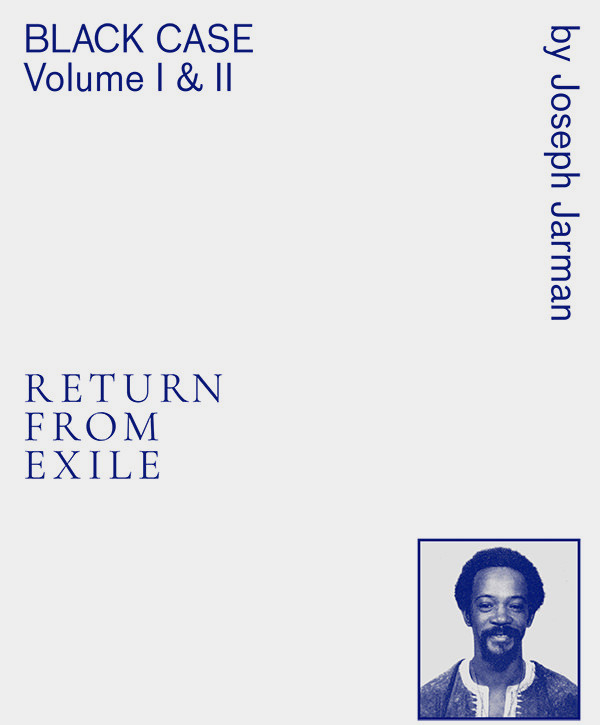
There are few text documents within the history of American free jazz which are as important as Black Case Volume I and II: Return From Exile - a collection of writing conceived by Jarman across America and Europe between 1960 and 1975. First self published in 1974, and then formally issued in 1977 by Art Ensemble of Chicago Publishing Co, this remarkable body of text is largely comprised of Jarman’s flowing, fiery, and free poetic verse, but also contains crucial documents like a manifesto for “GREAT BLACK MUSIC,” notated songs, concert program notes, Jarman’s photos, and impressions of a play written by legendary pianist and AACM founder, Muhal Richard Abrams. Written from a position of personal revolutionary intent, aimed at routing his audience’s consciousness towards growth and communication, this voice traverses, with compassionate urgency, the struggles of Chicago’s South Side, racist police brutality, and urban alienation, as well as the role of the arts as a healing force, nurturing beauty and community.
As relevant and topical today as it was when it was first published more than 40 years ago, Jarman’s Black Case Volume I and II: Return From Exile is a sensational body of writing - first marking his return from Europe, embarked upon by the Art Ensemble of Chicago, among many of their peers, at the end of the 1960s, his slow departure, drawn outward by his deep devotion to Buddhism, from music during more recent years, and now his return from another plane. This edition features a facsimile of the 1977 version, accompanied by two new introductory notes - a foreword by Thulani Davis and an introduction by Brent Hayes Edwards, breathing new life into a long forgotten document of the Black Arts Movement.
For fans of experimental music, Loren Connors needs little introduction. For decades, he has stood as one of the most singular guitarists in the field, scratching his remarkable sound on more than 100 records, not to mention endless, mind-bending live performances and astounding collaborations with the likes of John Fahey, Jim O’Rourke, Keiji Haino, Kim Gordon, Daniel Carter, and so many more.
During the mid-1980s, Connors took a partial break from music, focusing his energies on the art of haiku, for which he received the Lafcadio Hearn Award in 1987. It was during this period that Connors penned the material that appears in Autumn’s Sun, a chapbook first published by Thurston Moore and Byron Coley’s Glass Eye in 1999. It features diary excerpts from 1987, lyrically fragmented observations interspersed with haiku-like poems that paint an idyllic impression of the passing seasons and the landscape surrounding his home in New Haven, Connecticut. With synesthetic perception, Connors gazes from tranquil domestic streets - weaving metaphor laden images of trees, the wind, howling dogs - from which Connors derived his ‘Mazzacane’ moniker, and so much more. Like his music, Autumn’s Sun is tender without indulging the sentimental, conjuring those rare and delicate moments during which time stands still.
A crucial window into the mind of one of our great, visionary guitarists. Beautiful, immersive, and fascinating.
Originally published by Soundohm.