
“Incredible from start to finish, this is Bailey’s vision of a new global music, open and communicative, standing outside preconception, witnessed emerging in real time.”
Since 2017, Honest Jon’s, the London based record shop and imprint renowned for its forward thinking, democratic approach to music, has embarked on one of its most remarkable and ambitious projects to date - a close collaboration with Derek Bailey’s seminal record label, Incus, returning some of the most remarkable efforts in free improvisation and avant-gardism to the world. So far we’ve seen a stunning series of Bailey’s many solo and collaborative efforts reemerge, bringing his towering historical contribution into a deep resonance with the present day. Now Honest Jon’s returns with a whopping six more crucial artifacts from this seminal body of work - The Music Improvisation Company’s 1969, 1970, originally issued in 1976, Company’s 1981, a stunning double LP of previously unreleased recordings by various line-ups of Bailey’s endlessly evolving ensemble, made during the year after which it takes its title, three releases which lovingly expand the previously available material, issued as Company’s Epiphany, from 1982. The first - Epiphany, stretches the original two sides across four, the second, Epiphanies I-VI, doubles the original release’s second LP to two, while the final, Epiphanies VII-XIII, offers an astounding three LPs worth of unreleased material from Company Week that year. And finally, a long awaited reissue of 1983’s Trios, one of the most beloved artifacts in the ensemble’s output. All six are an absolute marvel for the ear, and as important within the history of improvised music as records come, none of these are to be missed. Honest Jon’s has done it again!
While technically the group’s second and final release, following on the heels of their 1970 ECM debut, The Music Improvisation Company’s 1969, 1970 captures the seminal quartet’s earliest recordings to have been released. Comprised of Derek Bailey, Hugh Davies, Jamie Muir, and Evan Parker, it’s hard to imagine many bands at the time being better than this - a product of each individual player’s deeply principled belief in free improvisation as an unparalleled vehicle for expression and collaboration, caught at a crucial moment as they pushed beyond the sonic palette of jazz - Jamie Muir’s drumming and Hugh Davies’ wild electronic interventions serving to push Bailey and Parker off a cliff.
Across six brilliant tracks, four of the most important figures in the history of British avant-garde music join as a single force - each pushing the next further into unexplored realms. Wild and fierce, bordering on the primal, deeply emotive textures and tones collide and dance in an uncompromising and exhilarating expanse of pointillistic sound, taking improvised music into new realms and proving, almost single-handedly, that England had a crucial stake in the game. Like nothing else that came before, this one is as historically important as they come. A true milestone.
Company - begun in 1976 - is one of the most important ensembles in the history of avant-garde music. There were no fixed members, thus the group was constantly in an evolving, purposeful state of flux - a system devised by Bailey to create challenging and artistically stimulating combinations of players who might not otherwise have had an opportunity to work together. From English heavyweights like Bailey, Evan Parker, Steve Beresford, and Pat Thomas, American luminaries like Wadada Leo Smith, Anthony Braxton, and George Lewis, or European giants like Han Bennink, Tristan Honsinger, and Misha Mengelberg, among so many others, the project’s documents, running from the mid 70’s until 1994, ring through ages as an astounding, global conversation in sound - pure freedom, achieved collectively, through mutual respect and open creativity.
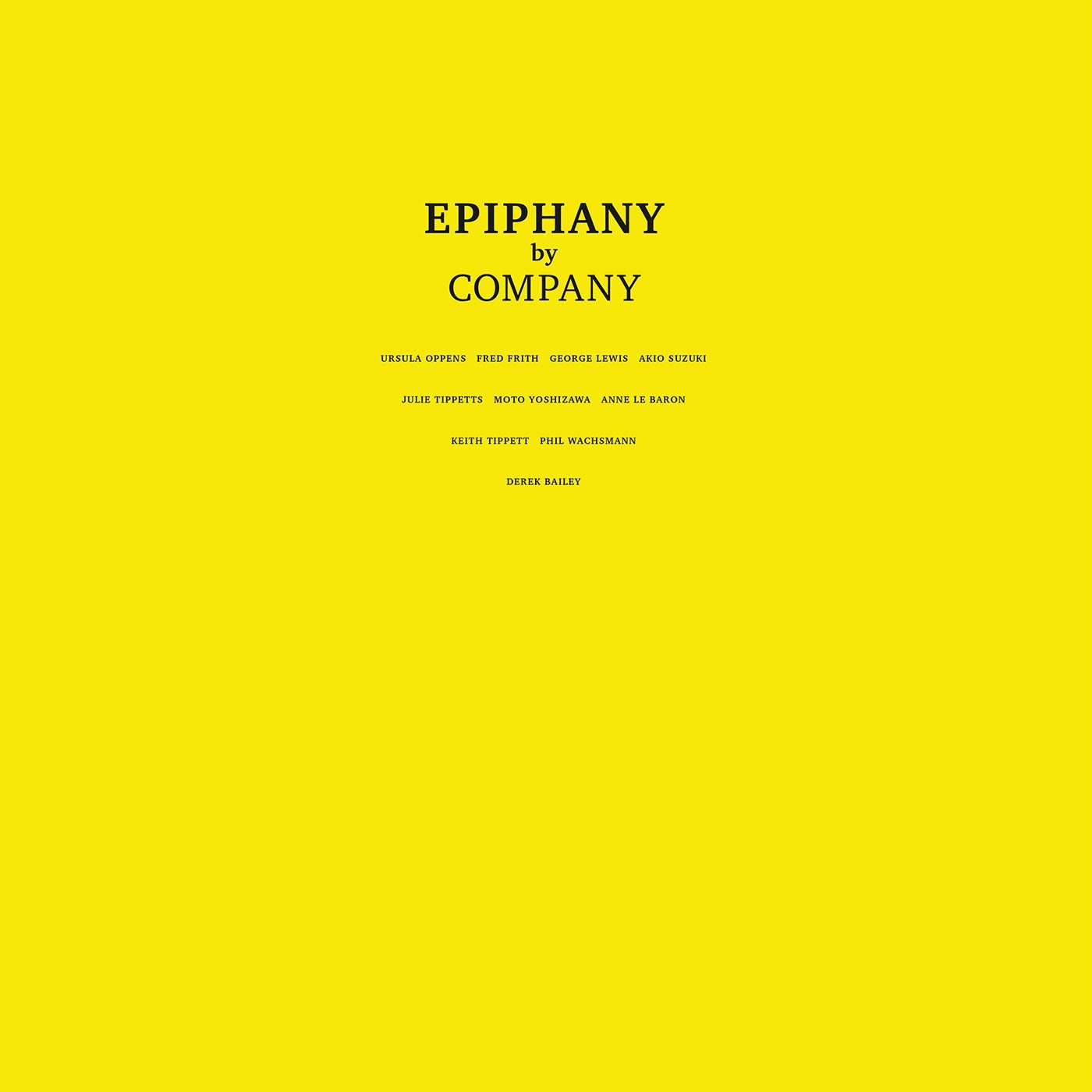
Epiphany, recorded and released in 1982, falls just shy of the mid-way point of Company’s nearly two decades of activity. Featuring an astounding ensemble, comprised of Bailey, Julie Tippetts, Moto Yoshizawa, Fred Frith, Akio Suzuki, Anne LeBaron, Keith Tippett, Ursula Oppens, George Lewis, and Phil Wachsmann, it’s a one of kind gathering of some of the greatest voices from the many, international contexts of avant-garde and experimental sound. There’s little wonder, once heard, why Honest Jon’s has decided to begin their forthcoming focus on the output of Company with this mind-bending release - a miracle of group interaction, marked by mounting intensity and tension. Bailey’s harmonics ring out against piano tremolos, shimmering electronics, soaring vocals, Akio Suzuki’s invented instruments, violin, and trombone, sculpting an immersive body of rippling sound - a wild ambience of incidental moments and careful interventions, offering an incredible image of the diverse places that music can go, charting previously unknown regions at every step.
This is pure improvisation taken far beyond the bounds known to jazz, or any other form. Brilliant, engaging, and creatively astounding at every turn. An intoxicating listen which draws the listener in, leaving them changed, with every falling texture and note.
Like Epiphany, the first in Honest Jon’s dedicated series to the material of Derek Bailey’s remarkable, revolving ensemble, Epiphanies I-VI was recorded during Company Week at London’s ICA in July 1982. Containing the material from the second LP of the original Epiphany, it encounters the group assembling and reassembling under different configurations - one duo, two trios, one quintet, and two sextets. Featuring the playing of Ursula Oppens, Julie Tippetts, Keith Tippett, Philipp Wachsmann, Fred Frith, George Lewis, Anne LeBaron, Motoharu Yoshizawa and Akio Suzuki, each ensemble displays a vast range, rethinking the voice of music at every turn - shattering the solid form of the extended improvisation Epiphany, within intimate lineups, into an alternate series of different Epiphanies.
Each of the players brings a radically different wheelhouse of creative backgrounds, temperaments and approaches to the fold, culminating in a pure proof for the virtues and remarkable possibilities opened by the collaborative spirit of open and responsive improvisation that Bailey spent his life pursuing. Rich timbres and textures rise and dance, before stepping back in favour of another voice, and then coming back again.
Incredible from start to finish, this is Bailey’s vision of a new global music, open and communicative, standing outside preconception, witnessed emerging in real time. It’s thrilling.
Just when you thought it couldn’t get any better, deep from the Incus vaults come more buried treasure from Company Week 1982 - a whopping three LPs, containing seven previously unissued Epiphanies by lineups involving Derek Bailey, Ursula Oppens, Julie Tippetts, Keith Tippett, Philipp Wachsmann, Fred Frith, George Lewis, Anne LeBaron, Motoharu Yoshizawa and Akio Suzuki.
Particularly noteworthy here is playing of guitar luminary, Fred Frith, who renders a solid, fluctuating to three of the seven works on offer - a tour de force of extended technique, dancing within a series of duos with Lewis, Anne LeBaron and Keith Tippett. As each emerges, a whole lifetime of musical exploration seems to condense into fleeting minutes. The final moments of Thirteenth, as his parry with Tippett comes to a close, offer a poignant reminder of the fact that the surprises rendered by this music are not experienced by the audiences alone, as the tapes capture both musicians bursting out laughing in amazement over what they set forth.
Across the remaining four unearthed Epiphanies we encounter a brilliant duo - Eighth - between Wachsmann and Oppens, both pushing their instruments into radical and uncharted realms, two stunning, spiky and dynamic trios which encounter Lewis and Bailey at the core - one with Yoshizawa and the second with Oppens, as well as a miraculous quintet of Julie Tippetts, Suzuki, LeBaron, Wachsmann, and Yoshizawa, which stretches out a mesmerising web.
Of huge historical value. A window into a lost world of avant-garde action from 1982, this one is as incredible as they come. How it’s remained unheard for so long boggles the mind.
Like Epiphanies VII - XIII, this one is a true revelation and crowning achievement in Honest Jon’s dedicated effort to the legacy of Derek Bailey and the Incus catalog. 1981 - stretching across two glorious LPs, features a miraculous series of previously unreleased recordings by various line-ups drawn from Derek Bailey, Tristan Honsinger, Christine Jeffrey, Toshinori Kondo, Charlie Morrow, David Toop, Maarten Altena, Georgie Born, Lindsay Cooper, Steve Lacy, Radu Malfatti, and Jamie Muir. It’s a window into how incredible and diverse the Company project was - breaking the perceived lines of jazz and the orthodoxies of improvised music, arguably even of Bailey himself, folding in outliers like Fluxus member, Charlie Morrow, former Henry Cow members Georgie Born and Lindsay Cooper, and figures like Toshinori Kondo and David Toop into the mix.
From delicate timbres and textures, to aggressive free for alls, 1981 proves that improvised music, under the guidance of Bailey, was eclectic and had no pure, ideological form in aesthetic terms. It was a pursuit of pure ideas, wide open and inviting, where anything was possible. Here, as the first LP gets rolling, we encounter Morrow injecting blasts of Cageian fun, blurting military fanfares from his trumpet, or inserting far-flung scraps of speech. Cellist Tristan Honsinger and vocalist Christine Jeffrey fire joyful tones, while Bailey, Toop, and Kondo rattle away in an unpredictable dance. Then, if that weren’t enough, we encounter the rising voice of an entirely different ensemble featuring Bailey, Maarten Altena, Georgie Born, Lindsay Cooper, Jamie Muir, Radu Malfatti, and Steve Lacy, collectively taking the ear to wonderful, singing heights, and into entirely new territories, as though offering proof of the range of this music which gets cast as a single thing.
A pure slice of pleasure for the ear, as inviting and listenable as it is challenging and mind blowing. A truly stunning body of work, emerging at long last, nearly 40 years on. It goes without saying that this one is an absolute must for any fan of Bailey, Company, or improvised music at large. It’s just about as historically important a body of recordings that is likely to emerge this year.
Fast forwarding two years, Company’s Trios, encounters a remarkable cast of artists joining Derek Bailey for Company Week in 1983 - the cream of the global improvisers scene - Evan Parker, Peter Brötzmann, Hugh Davies, Jamie Muir, Ernst Reijseger, J.D.Parran, Joëlle Léandre, Vinko Globokar, and John Corbett, adding quick understanding to why the LP, never before reissued since its initial 1986 release, has remained among the most sought after from the Incus catalog.
Trios is, for the most part, what it’s title describes - a vastly unpredictable and varied series of recordings made by recombinations of three members of the week’s participants, with two exceptions, both windows into Bailey’s dry wit and constant willingness to defy category and dogma. Trio Minus One is a duo of Bailey on guitar and Ernst Reijseger on cello, ranging from wild polyrhythmic strumming to a breakneck speed cello played against Bailey’s delicate responses, while Trio, the album’s final work, encounters all of the participants assembled as one overwhelmingly powerful ensemble, clattering, staggering, and dancing with each other in a crazed fury of tone, texture, and rhythm.
The remaining 7 works are a thrill for the ear - further proofs of the creative success born of Bailey’s principled beliefs, each player led by their ears, meeting the next on their own terms, while establishing a remarkable sense of common ground. Incredibly challenging, wide open space filled with ideas, no two trios are even remotely alike. An absolutely engrossing body of recordings that we’ve been forced to wait too long to hear again.
Originally published by Soundohm.