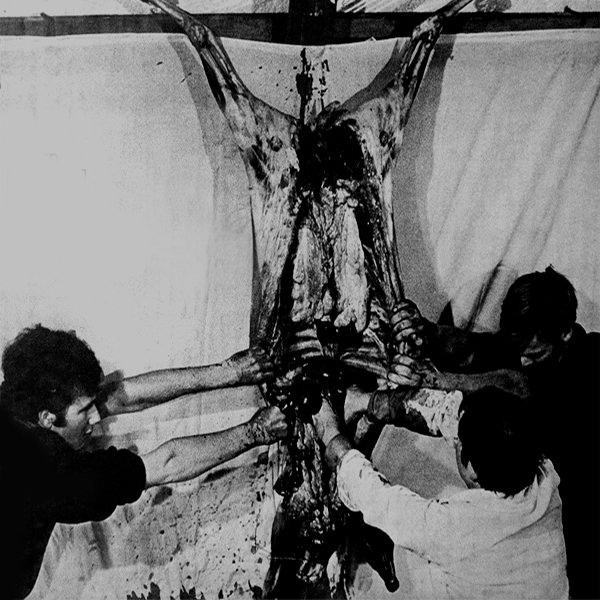
“Over the course of his career he has created dozens of albums, but 1972’s Akustisches Abreaktionsspiel, originally issued in a tiny edition of 100 copies by Galerie Klewan, is where it all began.”
One of the more fascinating territories of 20th century sound, centres around an often overlooked territory of practice that rests at the outer boundaries of the avant-garde; “the artist” record. While terms of definition vary, these objects are better understood as a variant on the artist “multiple”, rather than records in the popular sense. They are recordings made by artists whose work is primarily focused within the realm of visual and fine art, as opposed to those made by musicians and composers, representing a conceptual expansion of the gallery context into new, teleologically activated fields that stretched far beyond. Solidifying around early gestures by Kurt Schwitters, Hugo Ball, Marcel Duchamp, Jean Dubuffet, and numerous others - taking the form of incidental works of music, poetry, collage, etc. - the form rapidly developed during the 1960s and 70s, taken up and expanded by artists like Bruce Nauman, Dieter Roth, Joseph Beuys, Ben Patterson, Wolf Vostell, Terry Fox, and a near countless number of others. Among the most sought after of these recordings - most often released in small gallery editions or by the artists themselves - are those of Hermann Nitsch, whose incredible 1972 LP, Akustisches Abreaktionsspiel, has now been reissued by the veteran Berlin based imprint Tochnit Aleph.
Hermann Nitsch belongs to a generation of Austrian artists who came of age in the existential shadows and trauma that were spawned with the close of the second world war. Initially trained as a painter, at the beginning of the 1960s, like a similarly minded group of peers - Günter Brus, Otto Muehl, Rudolf Schwarzkogler, and a few others who became known as the Viennese Actionists - rather than looking away, Nitsch’s work delved toward the most brutal and ritualistic side of human experience, witnessing him embark upon his now legendary Orgien Mysterien Theater (Theatre of Orgies and Mysteries), an early realisation of performance art staged on the grand scale. Incorporating the primal, grotesque, and taboo, these works often involved or evoked slaughter, religious sacrifice, and crucifixion, using blood, animal carcasses, and entrails as a material, and were regularly accompanied with music, dance, and audience participation, as they embarked upon a deep cultural catharsis.
Like many artists of this moment - especially those involved with the parallel Fluxus movement - Nitsch can be seen to have been actively engaged with the notion of the availability of art through the notion of the multiple, and blurring the lines between high and low art forms through modes like recorded sound. Over the course of his career he has created dozens of albums, but 1972’s Akustisches Abreaktionsspiel, originally issued in a tiny edition of 100 copies by Galerie Klewan, is where it all began. Produced and recorded at the WDR Radio in Cologne, Germany, the Akustisches Abreaktionsspiel (Aktion 38b) is “neither a radioplay nor a work of music. it merely portrays the acoustic part of an ‘abreaktionsspiel’ (a play of abreaction), with the acoustic possibilities presented in the foreground, while the visual part of the play is communicated by a narrator.” A seminal document, writhing with often animalistic energy, stayed by the control of the narrator, that offers a crucial insight into Nitsch’s early actions, employing scream-choirs, beating, whistles, chaotic Austrian folklore juxtapositions, rough brass sections and dissonant strings.
Still capable of pushing boundaries and being creatively challenging, almost half a century after it was made, Tochnit Aleph’s reissue of Akustisches Abreaktionsspiel is about as important as they come in the field of artist records, blurring the boundaries between performance document, radio work, sound art, and music.
Originally published by Soundohm.