“Spanning the territories of driving jams, bent minimalism, and progressive ambience, it’s a wondrous journey the likes of which have rarely been heard since the time that Comelade and Pinhas first met.”
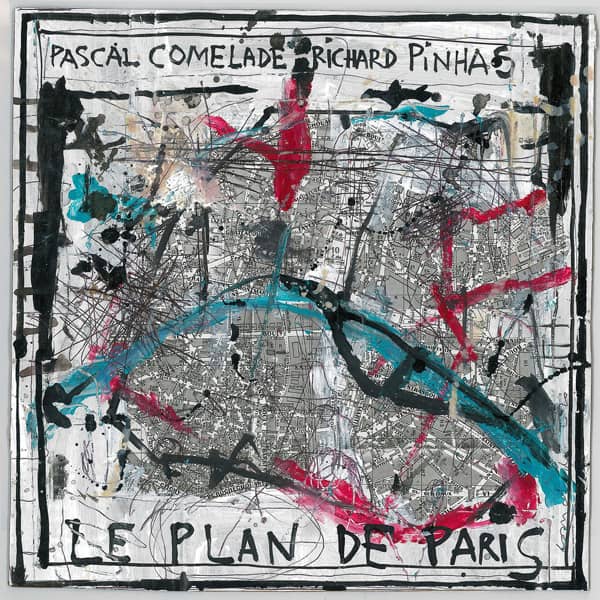
An absolutely stunning piece of work by two giants of the French underground, building on 45 years of working together, Pascal Comelade and Richard Pinhas’ latest collaboration, Le plan de Paris, out via Staubgold.
Often overlooked outside of the country’s borders, across the last few years a steady stream of reissues have illuminated the wilder and more ambitious spectrums of indigenous French music that emerged during the 60s, 70s, and 80s, bringing them long overdue attention and appreciation in the global consciousness. It’s been a wonder to behold. Of these figures, it would be hard to name any more important than Pascal Comelade and Richard Pinhas, each having individually left an indelible mark on French underground music at regular intervals since the mid 1970s. Now, we’re given a rare chance to encounter these two seminal giants at the peak of their game, locked in careful collaborative conversation across a brand-new body of work, Le plan de Paris, conceived and recorded in 2020. Spanning the territories of driving jams, bent minimalism, and progressive ambience, it’s a wondrous journey the likes of which have rarely been heard since the time that Comelade and Pinhas first met.
Pascal Comelade emerged within the French musical underground during the mid 1970s, first working under the moniker Fluence, producing only one stunning, self-titled LP, before reverting to his own name. Easily one of the most noteworthy creative outsiders and visionary minds on the scene, he has quietly occupied the outreaches of sonic exploration for almost 5 decades, issuing countless challenges and changing the face of music as he went. Among Comelade’s earliest collaborators was Richard Pinhas. The duo met in Paris in 1974, when Pinhas was embarking, with his seminal group Heldon, on the first stage of his highly influential career as a pioneer and accelerator of electronic music in both France and the global scene.
Despite often following radically divergent paths in their creative pursuits, the two artists have increasingly come together over the years to yield remarkable fruit. In 1975, Pinhas contributed parts to Comelade’s debut, Fluence, with Comelade recording pieces by Pinhas on his 1982 release, Irregular Organs, 1992’s Haikus De Pianos, and 1996’s Musiques Pour Films, Vol. 2, before the two reentered the studio as a jointly billed collaboration for 1999’s Oblique Sessions II. In 2012, they released a second duo album, Flip Side of Sophism, and then in 2018, Pinhas performed on Comelade’s Le cut-up populaire. All of this ground brilliantly solidifies across the length of Le plan de Paris.
Le plan de Paris comprises six works, previously unreleased or completely revisited, developed, remixed by the duo. While entirely cohesive as a single body, the album is perhaps best addressed as a landscape within which there are a series of free standing and independent totems, each built from an autonomous creative territory and pursuit. The album opens as a driving, metronomic jam that weaves vast sonorous textures from a root reminiscent of NEU!, before gracefully moving through cycling melodic, off-kilter minimalism, tense textural ambience, repetitive atonal experimentalism, and the fractured remains of the pair's long history in prog, amounting to a kind of vastness of space and ambition that currently feels excitingly rare within contemporary music.
A brilliant accomplishment and joy in listening that once again returns both to the front of the mind for the visionaries they've always been.
Originally published by Soundohm.