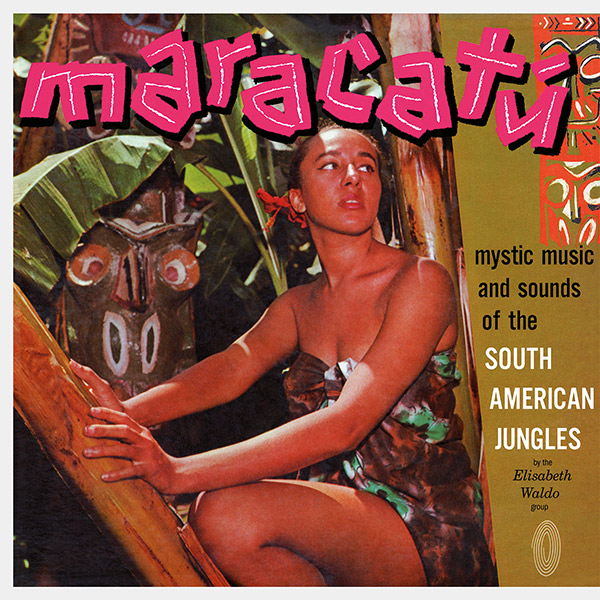
“Elisabeth Waldo is a fascinating, little known figure in mid 20th century music.”
A rare early gesture of hybridic musical multiculturalism from the 1950s, Pleasure For Music’s latest LP, a long overdue reissue of Maracatú, the renowned violinist and ethnomusicologist Elisabeth Waldo’s debut LP, is a stunning, interpretive immersion in the sounds of Latin American and pre-Columbian music and instrumentation. While entirely a product of its moment, beneath the surface bubble elements and temperaments that would define a great deal of 4th World and New Age music in the decades to come.
Across the history of recorded music, there are countless, stunning accomplishments that stand slightly apart, often having appeared years ahead of their time, while displaying a creative vision that resists easy categorization. Pleasure For Music’s latest LP, a long overdue reissue of Elisabeth Waldo’s Maracatú, originally released in 1959, is one such case. It has remained sinfully overlooked through the decades since its appearance. Occupying a similar territory to now widely celebrated, roughly concurrent albums like Eden Ahbez's Eden's Island and Chaino’s Jungle Echoes, Pleasure For Music’s reissue turns history on its head, offering a rare opportunity for a visionary and forward-thinking body of work to receive its rightful due.
Elisabeth Waldo is a fascinating, little known figure in mid 20th century music. Born and raised within a musical family in the state of Washington, she was briefly the first violinist with the Los Angeles Philharmonic, before moving to Mexico City and becoming deeply invested in the study of pre-Columbian music and instruments, leading to extensive work as an ethnomusicologist. At the suggestion of Diego Rivera, with whom she formed a friendship based on a shared interest in these sounds, she developed her own system of hieroglyphic musical notation for working with pre-Columbian instruments, designed to teach others how to play them. It is this deep investment and study of Latin American music - ancient and contemporary - that lies at the foundation of Maracatú, her debut LP.
Building on Waldo’s global-mindedness and remarkable talent as a composer and instrumentalist, Maracatú could be best understood conceptually as a historical precursor to the multiculturalism later embraced by members of the avant-garde and the New Age movements. While firmly rooted in certain musical temperaments of its era, it is an album founded on a deep respect and understanding of the forms of music that it channels, built on a desire to make them more accessible and celebrated by others. Beneath its surface lay many of the elements that would define the “4th World” statements of the 1970s and 80s, and Latin American / Mexican hybridic bodies of music that emerged from figures like Luis Perez, Jorge Reyes, and Antonio Zepeda.
Emerging as an entirely unique and deeply personal musical exploration of Indigenous Central and South American musical traditions, across the two sides of Maracatú - weaving a striking sound tapestry from the sounds of violins, woodwinds, guitar, and percussion, interspersed with field recordings from the natural world and occupying a liminal zone between interpretive folk and orchestral music - Waldo evokes the spirit of an ancient, mysterious world of Afro-Hispanic origins.
Originally published by Soundohm.