
“Don Cherry was a player of astounding touch and sensitivity; one of those rare artists who remains impossible to do justice with words.”
Possibly Blank Forms' most astounding accomplishment to date, the 6th instalment of their incredible journal - Organic Music Societies - sprawls across 496 pages in a deep dive into the life and work of the seminal American trumpet player, composer, and improvisor, Don Cherry, and his wife, the artist Moki Cherry. Absolutely staggering in its scope, it represents the first English-language publication on either figure. It's as historically important and essential as publications come!
Over the last few years, we’ve found ourselves with no shortage of praise for the New York based curatorial platform, publisher, and record label Blank Forms. Almost entirely unique in the landscape of experimental art and sound, they’ve brought forth a vast range of material at a startling pace - archival and contemporary texts and music - as well as presenting concerts, exhibitions, and talks. Central to the initiative’s output is the Blank Forms journal. So expansive that each volume would be better described as a book / anthology, rather than as a periodical / magazine, recently they’ve followed in the footsteps of legendary experimental publications like Peter Garland’s Soundings, by offering the entirety of each volume to a single artist - Masayuki Takayanagi, Maryanne Amacher, and Henning Christiansen - amounting to unprecedented, deep dives into their respective subjects. For the 6th instalment of the journal - Organic Music Societies - Blank Forms has dedicated a startling 496 pages to the seminal American trumpet player, composer, and improvisor, Don Cherry, and his wife, the artist Moki Cherry.
Don Cherry was a player of astounding touch and sensitivity; one of those rare artists who remains impossible to do justice with words. He was a visionary who relentlessly forged his own path, leaving behind a body of work that has no equivalent, and feels as fresh and ahead of its time today as it did when he first laid it to tape.
Cherry first emerged into the public consciousness, still in his early 20s, during the late 1950s as a member of Ornette Coleman's legendary quartet. His improvisations for trumpet - in Coleman’s band, as a member of the New York Contemporary 5, and across recordings led by Sonny Murray, Prince Lasha, Albert Ayler, and others - laid a crucial axis around which the idiom of free jazz formed across the ensuing years.
While never fully abandoning his work as a sideman, during the mid-1960s, Cherry launched his career as a band leader, beginning the body of recordings that would change nearly everything in its wake. Like many African American avant-garde artists of his generation, this transition, and more pointedly the creative leap witnessed within it, corresponded with a departure from the United States, first to Paris, followed by a more permanent relocation to Sweden, with his wife Moki Cherry (née Karlsson). While certainly not neglectful of his earlier years, it is this fruitful and happy period of Cherry’s life - a moment of newly realized personal freedom, and among his most creatively singular - spent collaborating with Moki and others, that forms an axis for Blank Forms’ Organic Music Societies.
An unprecedented window into the joyous expressions - visual, political, and performative as much as sonorous - of the period during which Cherry created the majority of his most celebrated albums - Eternal Rhythm, Mu, Organic Music Society, Relativity Suite, Orient, Blue Lake, Brown Rice, etc - Organic Music Societies illuminates the remarkable life that Don and Moki built together. Radical in every sense of the word, it intertwined countless streams of countercultural thinking - performance, communal art, social and environmentalist activism, children’s education, pan-ethnic expression, etc - into a singular form of existence.
With its appearance timed to appear alongside Blank Forms’ exhibition focused on the couple’s multimedia collaborations, the volume gathers newly commissioned texts by Blank Forms Artistic Director Lawrence Kumpf and Don Cherry biographer Magnus Nygren, as well as Ben Young, Fumi Okiji, and Ruba Katrib, as well as several previously unpublished interviews with Don, conducted by Christopher R. Brewster and Keith Knox, placed in conjunction with Knox’s extensive documentation of the Cherry family’s life and work, an interview with Terry Riley, an essay on Pandit Pran Nath, and reports on counter-cultural education programs in Stockholm, including the Bombay Free School and the esoteric Forest University.
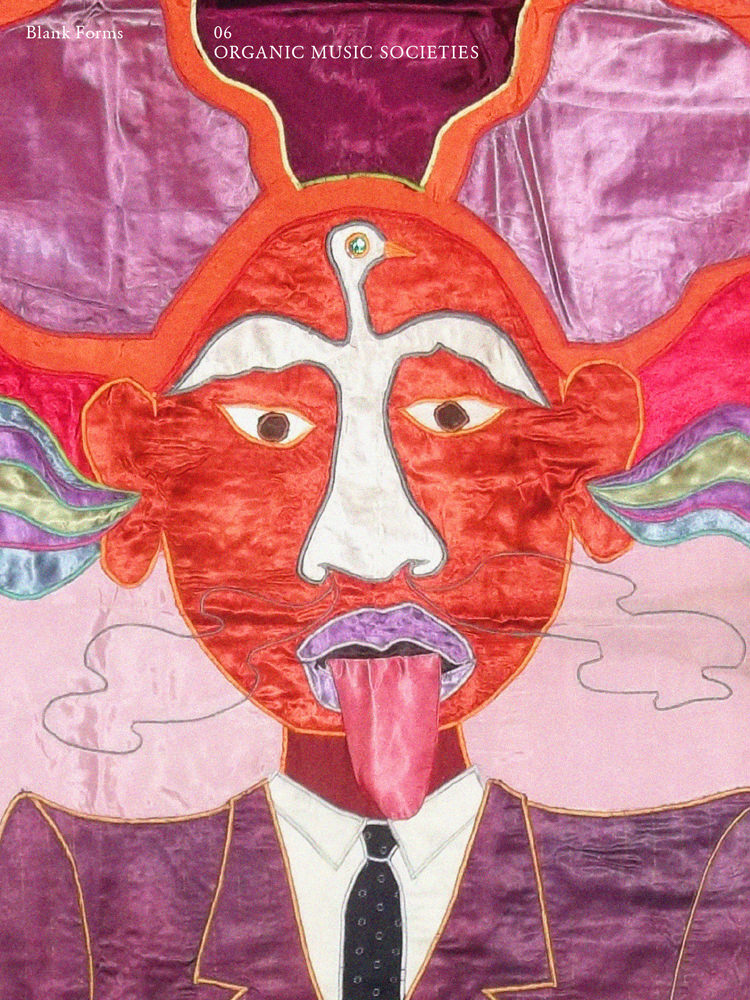
If that wasn’t enough, arcing around an incredible 138 color and 86 black and white images - the majority of which have never been widely available - Organic Music Societies also presents two selections of Moki’s unpublished writings, consisting of autobiography, observations, illustrations, and diary entries, as well as poetry and aphorisms, framed by tributes from her daughter Neneh Cherry and grand-daughter Naima Karlsson, and full color reproductions of Moki’s vivid tapestries, paintings, and sculptures, which were used as performance environments by Don’s ensembles during the Sweden years and beyond.
Needless to say, Blank Forms has completely outdone themselves with Organic Music Societies. If it wasn’t assured before, they’ve cemented their importance in the global landscape of music with a single stroke.
Originally published by Soundohm.