“Thankfully, Vinyl-On-Demand has been leading the charge to bring them back into the light with a stunning series of vinyl reissues focused on the seminal imprints Vanity Records and Fifth Column.”
It's an exciting moment for reissues of historic Japanese underground music from the 1970s and 80s. Often originally housed within tiny cassette and CD editions produced by highly localized imprints, the vast majority of these artefacts have remained virtually unobtainable for decades, allowing their remarkable accomplishments to remain masked in shadow and mystery. Thankfully, Vinyl-On-Demand has been leading the charge to bring them back into the light with a stunning series of vinyl reissues focused on the seminal imprints Vanity Records and Fifth Column.
Vanity Records was founded in Osaka in 1978 by the singer, publisher, producer and writer, Yuzuru Agi, during the period when he was the music critic and editor of ROCK MAGAZINE. Always seeking forward thinking realizations of contemporary music, the imprint was inspired by the DIY ethos of Punk, producing only 11 LPs, 3 singles, 12 flexis, and the 6-cassette box set - each in incredibly limited editions - until concluding its activities in 1982. Following on from their incredible reissue of the “Vanity Tape Box” back in 2020, Vinyl-On-Demand has plunged into the imprint's vinyl output, compiling 9 of the imprint's LPs, all of their singles, and a plethora of previously unreleased material over 4 deluxe releases.
Tolerance - Vanity (4LP+1x7" Box)
Tolerance was the short-lived moniker used by the Tokyo based keyboardist and vocalist, Junko Tange, who released 2 lone LPs - 1979's Anonym and 1981's Divin - for Vanity, as well as a single-sided flexi-disc issued in "Rock Magazine", before disappearing from view. VOD's Tolerance Vanity box reissues all of this material - pressing the flexi-disc onto a 7" for the first time - as well as expanding her available output by 2 full LPs of previously unreleased material recently discovered in Agi Yuzuru's archives.
The first 2 LPs in VOD's Tolerance Vanity box are faithful reissues of the project's 1979 debut, Anonym - the album from which Nurse With Wound's Steve Stapleton drew the title of his 1980 album To the Quiet Men From a Tiny Girl, and which led to the project's inclusion on his legendary NWW list - and their second, and final album, Divin, released 3 years later in 1981. On the former, Tange's electric piano, synthesizer, and simple electronics, along with whispering poetics, are joined by noisy slide guitar interventions by Masami Yoshikawa, collectively swirling into a haunting, monotone expanse of abstract sound, while the latter heavily favors the sounds of drum machine and electronics over the guitar, sculpting a stunning sense of atmosphere that sprawls across the album's length and radically expands the perceptions of what is possible via lo-fi DIY.
While the completion of their two full-length LPs and lone single represented the end of Tolerance's activities in 1981, VOD's set doesn't end there, offering a full 2 LPs of material recently discovered in the archives of Vanity boss Agi Yuzuru. The first, Dose, falls somewhere in between Anonym and Divin in temperament, sensibility, and musicality, embracing a startlingly open form, while the second, simply called Demo, emerges as the sounding of desolate and peaceful sonorous expanses that float and disappear like the dream from which they appeared.
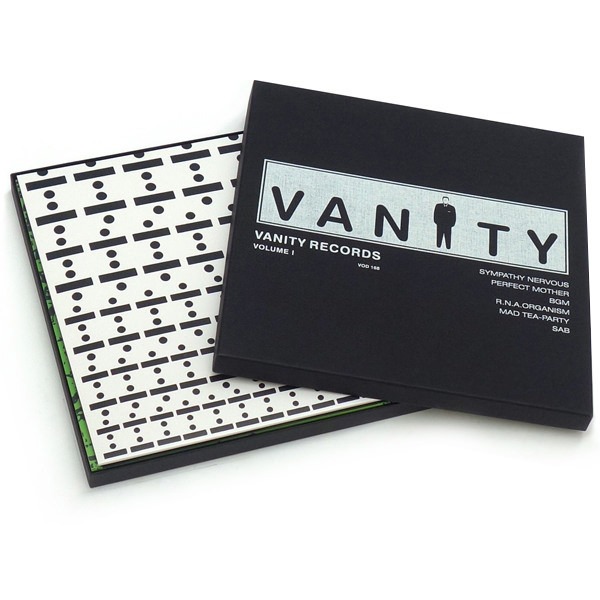
The Vanity Box Vol.1 (5LP Box)
The Vanity Box Vol. 1 is an anthology that comprises 4 of the rare 11 LPs released by Vanity during the late '70s and early '80s - R.N.A. Organism's R.N.A. Organism Meets P.O.P.O., BGM's Back Ground Music, Sympathy Nervous' Sympathy Nervous, and Sab's Crystallization - as well as a full extra LP that collects the label's only 3 7"s.
VOD's Vanity Box Vol.1 covers a vast amount of ground over the course of its 5 LPs, a fact that is unsurprising when considering the ethos and spirit that steered the label. Launching with R.N.A. Organism's dub tinged and brilliantly experimental take on bedroom synth-pop, the set carries forward with BGM's Back Ground Music, the lone outing led by a 17 year old Takayuki Shiraishi - joined by Harunobu Kawashima and others - that rides an incredibly thrilling line between experimental music, post punk, funk, disco, dub, and industrial.
The third disc on VOD's Vanity Box Vol.1 is given over to Sympathy Nervous' self-titled debut, in which the duo of Yoshihumi Niinuma and Tatsuya Chiba weave a stunning hybrid form from a self-built computer system generating proto-techno and noise guitar. From here the collection takes a stunning turn with one of the most striking releases in Vanity's output, Sab's Crystallization, originally released in 1978. Created as a solo project that overdubbed numerous synthesizers, electronics and guitar parts, with a small number of additions by others on sitar and flute, the album features an oscillating sound that bridges the realms of psychedelic and progressive rock with heavy meditational, ambient, new age vibes.
Rounding out the set is a full LP that collects Vanity's output on 7", Sympathy Nervous' Polaroid, Mad Tea Party's Hide and Seek, and Perfect Mother's You'll No So Wit. An immersion that draws the ear toward the label's sweeter and more playful side, across the album's sides we hear incredibly singular realizations of vocoder-sung pop, edgy post-punk pop with dub effects, and left-field electronic pop that conclude this deep dive into Vanity's output in the most wonderful ways.
Vanity Box Vol. 2 (4LP Box)
The Vanity Box Vol. 2 is an anthology that comprises 3 of the rare 11 LPs released by Vanity during the late '70s and early '80s - Dada's Jyo, Agata Morio's Norimonozukan, and Normal Brain's Lady Maid - as well as a full, previously unreleased LP of material from R.N.A. Organism.
Like its predecessor, Vanity Box Vol. 2 covers a vast amount of ground over the course of its 4 LPs. Beginning with the ambient wonder Jyo, created by the electronics and guitar duo of Dada in 1978, the set eases in with striking lyricism and improvisation that moves at a glacial pace, before joyously launching with Agata Morio's Norimonozukan. Radically different from his previous work as a folk singer, the album's post punk / techno pop sound - complete with a Joy Division rip - is as playful and infectious as experimental DIY pop could possibly come.
The Vanity Box Vol. 2's third LP is offered over to Normal Brain's 1980 LP Lady Maid, the debut LP of Yukio Fujimoto who created a brilliant network of analog synthesizers, rhythm machines, Speak & Spell toys, and English language learning tapes - and using each instrument's intuitive simplicity and quality - to create an astounding form of DIY electronic music that foreshadows countless gestures that would emerge across the globe over the course of the following 2 decades. Not to be outdone, the set's final LP - Unaffected Mixes - gathers a stunning body of never before heard or released recordings by R.N.A. Organism that newly doubles the project's output with more dub tinged and brilliantly experimental bedroomy synth-pop.
Vanity Records 'Demos' (2LP)
Diving deep into Vanity founder Agi Yuzuru's archives, the double LP set, 'Demos' draws on numerous previously unreleased recordings that further illuminate crucial elements of the label and the legendary Japanese scene around which it formed.
The first LP of 'Demos' - P' - gathers an unreleased body of recordings by Den Sei Kwan, whose only other available release - Pocket Planetaria - is housed within the seminal Vanity Records Tape Box. Beautifully expanding our understanding of the artist by delving further into his singular universe of DIY, industrial noise, the LP drives forward with even more compositional power than anything previously heard from Kwan, and feels as though it were yesterday, rather than lying in the archives for nearly 40 years.
Diving even further into the archives, the second LP in 'Demos' unearths more astounding artefacts from the murky world of Vanity. The LP gathers further unreleased recordings by Salaried Man Club, whose only other recordings appeared in the Vanity Records Tape Box under the title Gray Cross, Onnyk, the moniker of artist, guitar improvisor, and Fifth Column records founder, Yoshiaki Kinno, who never released an album on Vanity, and Den Sei Kwan, as well as an excerpt from the HMN (Homemade Noise) Session. Weaving stunning expanses of sound and sonic mayhem, it's a thrilling journey back in time with some of the most singular artists to have ever emerged from Japan.
In addition to Vanity records, one of the most fascinating imprints working in Japan at the end of the 70s and early 80s was Fifth Column. Founded by Yoshiaki Kinno, a talented guitar improviser who worked under numerous monikers and later founded Allelopathy - a label that brought out his striking collaborations with Evan Parker, Barry Guy, Ken'ichi Takeda, Fred Frith, John Zorn, and Toyozumi Yoshisaburo - the catalog of Fifth Column opens an unparalleled immersion within the country's underground and free improvisation community of the era. VOD's first foray into the incredible bodies of work produced for the imprint focuses its attention on ICE 9, one of Kinno's many noteworthy projects that emerged during that period.
Between 1981 and 1983, Yoshiaki Kinno, masquerading under the moniker of Onnyk, helmed ICE 9, a collective of ambiguous membership that produced two cassettes - 1981 and P.F.L.P. - during their run, both of which are collected by VOD's The Fifth Column Years. Formed in a cohesive and seamless body of sound, the 18 individual works that stretch across the collection trace their way through numerous touchstones - full throttle noise, pulsing electronics, and forward-thinking free improvisation, peppered with elements of post-punk and industrial - that produce a gripping expanse of riveting sonority that has few parallels before or since.
Vibrant, wholly alive, and visionary from start to finish, VOD's The Fifth Column Years draws the long-overlooked collective, ICE 9, to the forefront of the consciousness and will likely leave them rattling there for a good long time to come. Hugely important on historical terms, the collection casts much needed attention onto one of the most important scenes and labels to have worked at the margins of the Japanese underground.
Originally published by Soundohm.