“Bridging the contexts of installation, sound art, sound poetry, and experimental music / noise, its stunning two sides open a visionary creative universe, too long hidden by history's weight.”
Building upon a standing commitment to the work of artists who worked in international obscurity under the shadow of 1960s and 70s fascist Spain, Alga Marghen returns with "El Artilugio”, a never before issued body of work by Manuel Calvo. Bridging the contexts of installation, sound art, sound poetry, and experimental music / noise, its stunning two sides open a visionary creative universe, too long hidden by history's weight.
Over their decades of activity, the Italian imprint, Alga Marghen, has illuminated a near countless number of historical artefacts at the juncture of visual art, sound-art, experimental music, and avant-garde deployments of language, helping to radically reshape our understanding of 20th century creative practice. Embedded within their ever-growing discography lies a small window, via releases by José Luis Castillejo, Juan Hidalgo, and Zaj, into the avant-garde happening occurring in Spain during the 60s and 70s, while the country lay under the final decades of fascist rule.
Born in 1934, during the 1950s and 60s Manuel Calvo emerged as a forerunner and a protagonist of geometric abstract painting in Spain, working against the odds attempting to freely express within the context of fascist rule in Spain that had taken hold during the early years of his life. During his early career, he was closely aligned with groups like Equipo 57 and Grupo Parpalló, artists who were active around Valencia and held strong connections to the rest of Europe, developing the principles of an analytical art in opposition to the main currents of informal art and lyrical abstraction.
This restless questioning increasingly led to more radical tendencies in his work, a period spent in Paris and then Brazil, before returning to Spain in 1966 where he fell into contact with artists like Juan Hidalgo and Walter Marchetti, who had founded the Zaj group in Madrid in 1964, and begun creating some of the most subversive means of aesthetic communication encountered in Spain during that period.
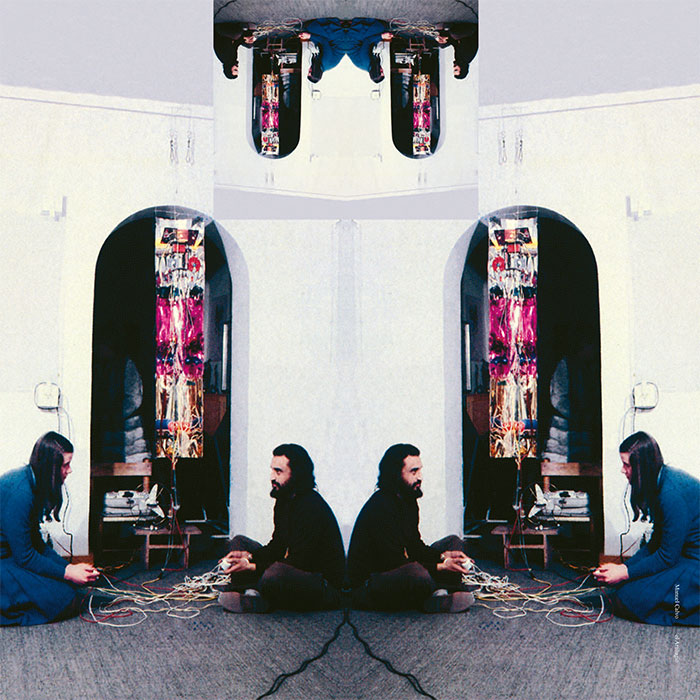
Calvo’s new phase of radicalism, embarked upon between 1966 and 1967, centered around his transformation of his studio into a laboratory where he could hold a permanent exhibition of his works, opening it to the public with no temporal limits, in the hope to reverse the standing perceptions of what an exhibition was. Within this space, Calvo created El artilugio, a participatory installation where the effects of light variations were randomly activated through simple buttons by the audience, opening the potential for open structures of unlimited possibilities for random variation. In addition to this, through a process similar to that applied to the light, Calvo introduced a reel-to-reel recording machine and a pre-recorded magnetic tape as a sonic element, recording the parasitic noises of an old electric engine that were then introduced into the installation via the reel-to-reel. It is this sound component of the installation that makes up the first side of Alga Marghen’s incredible LP, “El artilugio”, opening long overdue access to this singular creative world.
El artilugio comprised two side long tracks. The first encounters the brilliant, randomized sonic universe that accompanied the installation of the same name, appearing somewhere between sound collage - split and juxtaposed by the participant’s push-button activated manipulation - and a microscopic journey across the surface and generative possibilities of the machine whose sounds it captures, rattling, clicking, scratching, droning, and buzzing as it goes, before fading out in a glissando after nearly half an hour.
As a fascinating juxtaposition, the second side of “El artilugio” features a never before issued work created with an Austrian soprano singer reading out phonemes, alliterations of single words, tongue twisters, and texts in different languages, repeated obsessively into states of abstraction that offer a stunning counterpoint to other forms of sound poetry being created during this period across the globe.
With “El artilugio”, Alga Marghen has offered yet another triumphant window into the incredible world of singular artists working against the odds within fascist Spain, expanding their long-standing commitment to illuminating under-celebrated artefacts from the 20th century, and changing history as they go.
Originally published by Soundohm.