“Whether approached individually or as a whole, these are some of the most striking and fascinating gestures of free jazz to have ever hit the scene.”
Holidays Records is turning up the heat. They just hit us with a batch of killer LPs by Cairo Free Jazz Ensemble, Akira Sakata & Giovanni Di Domenico, and Mette Rasmussen & Pak Yan Lau, and now they're back with one of their most ambitious ventures to date, a vinyl reissue initiative focused on the back catalog of Ictus Records, one of the most important platforms for improvised music to emerge from Italy during the 1970s and 80s. Starting it all off are four beautiful albums, Steve Lacy and Andrea Centazzo’s “Clangs”, originally issued in 1976, Derek Bailey and Andrea Centazzo’s “Drops”, originally issued in 1977, Steve Lacy, Andrea Centazzo, and Kent Carter’s “Trio Live” also from 1977, and John Zorn, Andrea Centazzo, Eugene Chadbourne, Tom Cora, Toshinori Kondo, and Polly Bradfield’s “Environment for Sextet”, originally issued in 1979. Whether approached individually or as a whole, these are some of the most striking and fascinating gestures of free jazz to have ever hit the scene.
From its inception during the late 1950s, as it remains today, freely improvised music has been a global revolution through sound; a means through which diverse voices could meet and commune, sculpting alternate terms through which individuals could organise, listen, and create. Increasingly radical and ahead of their time, by the 1970s these artists - abandoned or let down by live venues and mainstream imprints - began to form their own networks, found performance spaces, and start labels, laying crucial groundwork for subsequent generations who would define their contexts through the ethos of DIY. While the activities of artist run labels from the United States and Britain - Anima, Survival, Strata East, Incus, etc. - have long dominated the consciousness, there were countless others that sprang up in cities around the world. Among the most notable and interesting was the Italian imprint, Ictus, founded in 1976 by percussionist and composer, Andrea Centazzo, and his wife Carla Lugli. Running for just under a decade, until relaunching during the mid-2000s, the label produced a couple of dozen highly celebrated releases, largely falling within the idiom of free jazz.
Holidays’ Ictus Records reissue initiative fittingly begins with “Clangs”, the first LP issued by the label in 1976. Recorded by Steve Lacy on soprano saxophone, bird calls, and pocket synthesizer ("Crack Box”), with Andrea Centazzo on Drums, various forms of percussion, whistle, and vocals, the album is the culmination of two weeks that the two artists spent together while Lacy was touring Italy during that year.
“Clangs” encounters Lacy - one of the giants of American free jazz - already 2 decades into a career defined by brilliant collaborations with Cecil Taylor, Don Cherry, and Thelonious Monk, among others, as well as a sprawling body of visionary work as a leader. Like so much of his work leading into this period, it draws upon the saxophonist’s belief that an artist should ‘play what you feel’, a position that Centazzo - roughly 15 years Lacy’s junior - recalls as having torn down the curtain that separated his technique from his creativity.
Comprising a series of duets that investigate timbral relationships, the fragmentation of melody, and abrasive, provocative noise - shifting from the sparse, airy, and restrained, to dance clusters of interplay and back again - “Clangs”, for all its radicalism and forward-thinking gestures, rests firmly within the historic structures of jazz, deploying the idiom of theme/ solo/ theme. Lacy’s playing is at the top of his form - fluttering and dancing with a primal touch - met by Centazzo’s rattle and patter of percussive interventions, the notes and polyrhythms of each respective player being the product of careful listening, response, and raising the bar.
70s free jazz at its best - sophisticated, refined, and charged with a latent social and political power - more than four decades after it first appeared “Clangs” is long overdue for a return to the world, retaining every bit of potency and power as the day it was laid to tape.
In the history of free improvised music, there has been arguably no greater advocate for the idiom’s power and potential than the English guitarist Derek Bailey. Fiercely principled, between his emergence during the 1960s and his death in 2005, he cut a wide path, positioning this music as the height of creativity, transpiring in real time, and a means through which people from diverse background could come together, express, and commune. For Bailey, “playing is about playing with other people.. improvisation is a process that gets relationships sorted out”
Among many great examples of this within Bailey’s sprawling discography, a stand out is his 1977 duo LP “Drops” - originally issued as the third album on Ictus - recorded with the Italian percussionist / drummer Andrea Centazzo. Capturing the guitarist during one of his most prolific and creatively visionary periods - overflowing with explosive clarity, dialogic energy, and imagination - he clearly found a perfect foil in Centazzo, who recalls of the sessions “The kaleidoscopic quality of “Drops” was created by this restraint of performing limits, i.e. the choice of instrumental timbres, dynamics and metronome speeds to suit each piece. We explored some aspects of our improvisational art, gleaned the best elements from our baggage of music memories and exposed them clearly and confidently.”
Comprising 9 individual improvisations, “Drops” encounters each of its players at their best, finding a strange middle ground between the intuitive logics of their instruments; Bailey’s tones taking on decidedly percussive approaches, while Centazzo’s fractured polyrhythms and beats often veer toward the presence of a notable tonality. Remarkably expressive and diverse in the approach of each piece, “Drops” presents creative interplay at its most striking and challenging, rethinking the terms of musicality and collaboration every step of the way. Flurries of rattle back and forth, sculpting barbed and pointillistic landscapes of texture, stripped of reference and precedent, and abstract as real time organised sound comes.
Brilliant, highly engaging, fully immersive, “Drops” is both one of the best and least acknowledged artefacts in Derek Bailey’s incredible body of recorded work from the 1970s. It’s impossible, after decades out on vinyl, to express how grateful we are to Holidays for bringing it back into the world.
Originally issued in 1977 as the 5th entry in the Ictus catalog, “Trio Live” was recorded in 1976, only a handful of days after Steve Lacy and Andrea Centazzo’s “Clangs” was laid to tape, presumably capturing another moment on the same two-week tour that had rendered the recordings for its brilliant predecessor. This time, the pair - Lacy and Centazzo - is joined by the American bassist, Kent Carter, a sinfully under-appreciated artist who had worked extensively in Steve Lacy's group, played on the two Jazz Composer's Orchestra LPs, and toured in the bands of Don Cherry, Alan Silva, Mal Waldron, Bobby Bradford, Max Roach, Roswell Rudd, Derek Bailey, John Stevens, Trevor Watts, Steve McCall and many others, leading into this era. The previous year, he had also delivered the stellar LP, Kent Carter Solo With Claude Bernard, as Ictus’ second LP, allowing “Trio Live” to be understood as a narrowing of an already tight circle, despite its slightly expanded ensemble.
Arguably best defining the first two entries in Holidays’ Ictus reissue series - “Clangs” and “Drops” - is a sense of rigor and artistry. While no less present across the length of “Trio Live”, what takes the forward charge throughout its 5 tracks is a sense of joy and pure pleasure in playing together. The sounds and structural interventions are locked in and tight, feeling at ease and intuitively responsive in the ways that players with a history of collaboration are only able to produce.
From swinging and chugging to stepped back and sparse combinations of rhythm and tone - moving from the lingering sensibilities of straight-ahead jazz to radically out hard blow fire - “Trio Live” is a cornucopia of brilliant artistry and improvised music at its highest form. A total revelation, reemerging after decades of neglect, “Trio Live” is a stunning thing to behold.
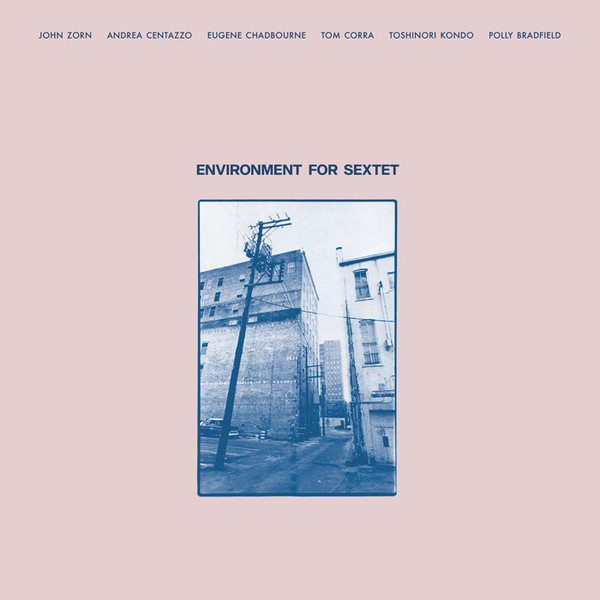
Recorded live at WKCR Radio in New York City in 1978 and issued by Ictus the following year, “Environment for Sextet” is easily among the most fascinating of the LPs in this batch. Encountering John Zorn at the earliest stages of his career, resting within a sextet of a new generation of stunning improvisers emerging at the tail end of the 70s who would go on to define a vast swath of the 80s sound - Polly Bradfield on violin, Andrea Centazzo on percussion, Eugene Chadbourne on guitar, Tom Cora on cello, and Toshinori Kondo on trumpet - it roughly builds on the series of collaborations that had featured on Centazzo’s 1978 Ictus LP “U.S.A. Concerts”.
Launching from a total wall of sound - full throttle fire on the boundaries of outright noise - “Environment for Sextet” takes the listener on an endlessly surprising journey through its players’ inner world, shifting between airy open passages that feature endless combinations of one or more players, to furious moments of sonorous lashings where the group falls in together in brilliant dialogical periods of conversant texture and tonal intervention.
An engrossing and relentless listen from the first moment to the last - featuring two works built from two of Andrea Centazzo’s earliest graphic scores - “Environment for Sextet” is an absolutely stunning body of improvised work by what were then among the most important rising stars on the free music scene. Once heard, there’s little question why copies of the original pressing are among the most hotly pursued artefacts from the Ictus catalog. This is one of those rare records that set the pace for an entire decade to come, and still manages to do the same today.
Originally published by Soundohm.