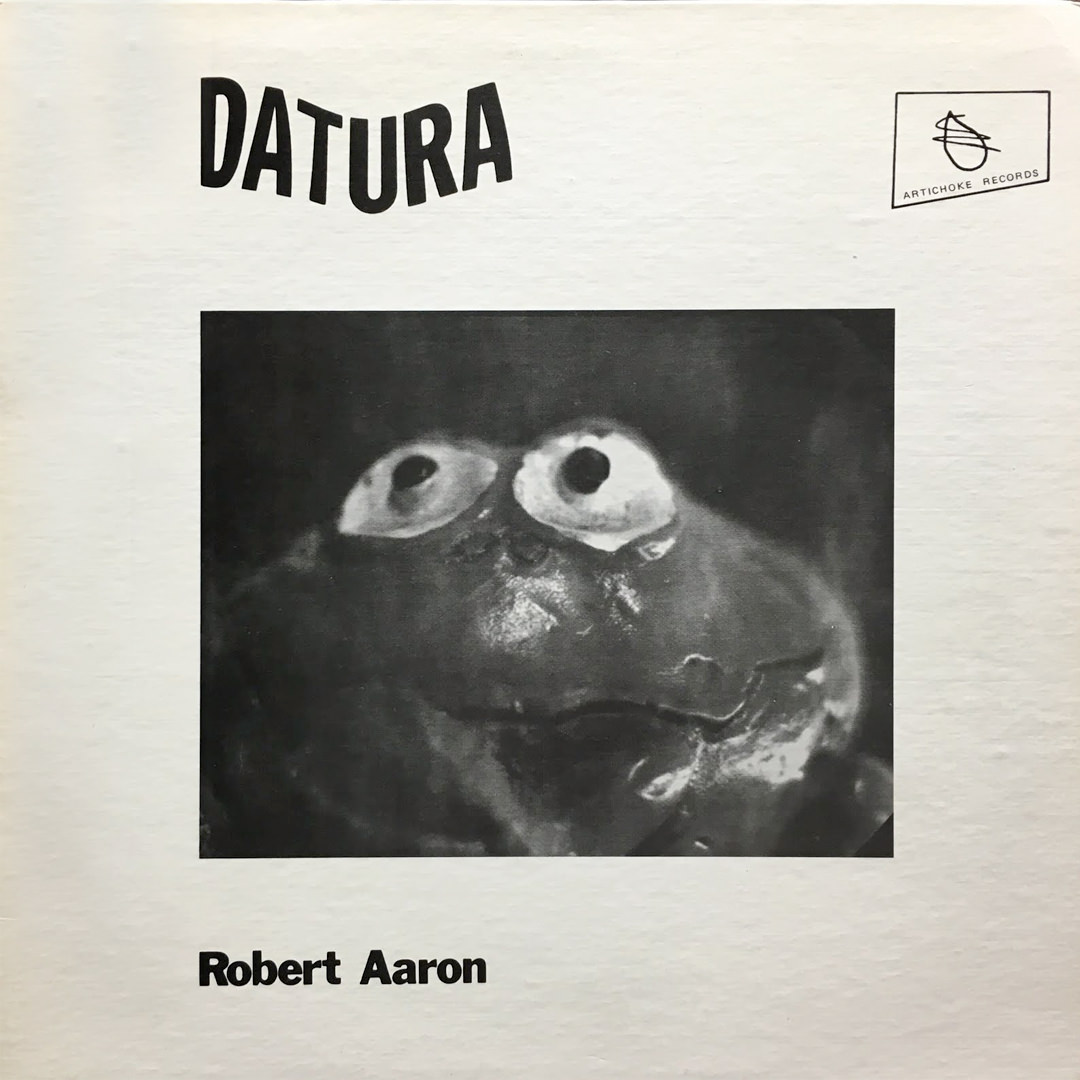
“A wild excursion into synth drenched abstraction - radical avant-gardism and free improvisation, permeated by the energy and spirit of punk - there’s almost nothing like it from its moment and place in time.”
The New York No Wave scene of the late 1970’s and early 80’s produced its share of boundary blurring artefacts, but few are as surprising and unexpected as Robert Aaron’s “Datura”, self-released on his own imprint, Artichoke Records, in 1981. A wild excursion into synth drenched abstraction - radical avant-gardism and free improvisation, permeated by the energy and spirit of punk - there’s almost nothing like it from its moment and place in time.
Few musical paths are as rich and strange as the one traversed by Robert Aaron. Raised in Montreal, Canada, during the 1970s he moved to NY and immersed himself in the downtown scene, forming his own band and joining James Chance’s legendary groups, The Contortions and James White and the Blacks, during the early 80s. Gifted with a rare versatility - playing saxophone, flute, clarinet, piano, bassoon, guitar, French horn, and other instruments - over the years he’s worked with a mind-blowing array of artists, including The B-52's, Blondie, Chic, David Bowie, Eric Andersen, Wyclef Jean, Mick Jagger, Amy Winehouse, Afrika Bambaataa, RZA, and Wu-Tang Clan, to name only a few. He also gained infamy in 2014, when he was arrested for selling the heroin that caused the overdose death of the actor Philip Seymour Hoffman. For all his highs and lows, his 1981 album “Datura” stands on its own. It might just be the best thing he’s ever done.
Some will remember “Datura” from its inclusion in the legendary Creel Pone series, a carefully curated gathering of some of the greatest electronic obscurities ever recorded. The presence of Robert Aaron’s first solo outing within that catalog makes perfect sense, not only for its singular creative vision, but for the sinful lack of recognition it has received within broad historical terms. An unadulterated slab of pure avant-gardism, “Datura” is a hybrid of wildly abstract electronic synthesis, noise, and free improvisation bred within the downtown incubator of punk. Deploying a large ensemble playing acoustic instruments and numerous synthesizers, the album unfolds in a fascinating arc, beginning with the first track, “Crystal and Infrared”, which is a predominantly synth based excursion - flirting with the harsher edges exhibited during electronic music’s earliest years - before slowly allowing instrumental interventions to find equal footing with the electronic as it moves into “Networks in Shade”. Like its predecessor, “Agent Grapefruit”, which launches the album’s second side, is a work that balances wild acoustic free improvisation with equally intense electronic sounds, building bridges between sonic territories that all too often remain disparate and apart. The album’s final work, “Jungle”, takes a final, surprising turn, mostly setting the synths within for a long-form work of noise / improv shenanigans by the ensemble, calling to mind early John Zorn, as well as the less restrained non-idiomatic improvisations of Gruppo di Improvvisazione Nuova Consonanza, Musica Elettronica Viva, AMM, Company, and ICP.
Internalizing elements of "Loft Jazz", punk anarchism, and the "anything goes" ethos of the New York experimental music scene of the 80s, Robert Aaron’s “Datura” is a lost gem that illuminates whole swaths of creative practice occurring during its moment that have remained largely overlooked.
Originally published by Soundohm.