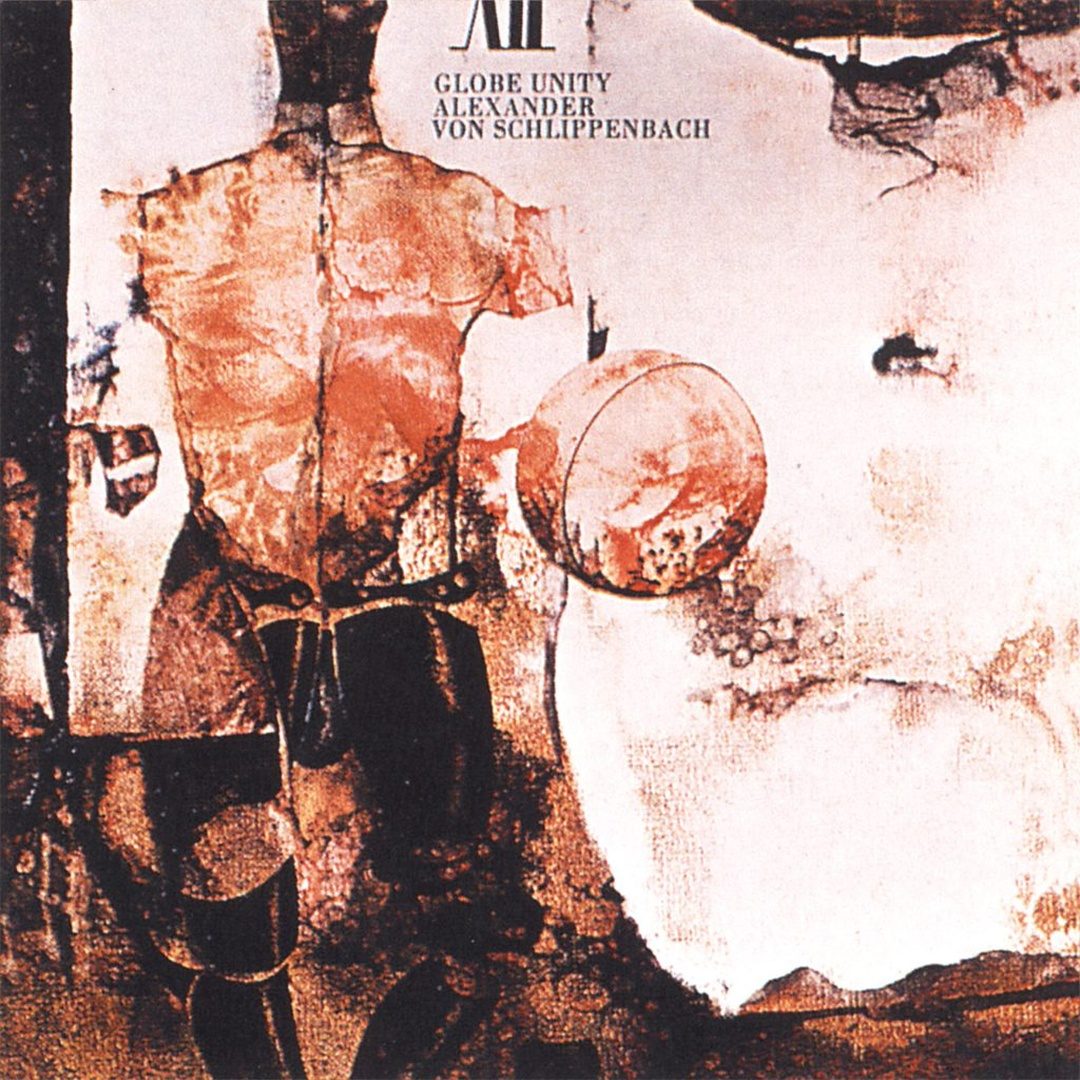
“A foundational effort in European free improvisation, rooted in both the free jazz and avant-garde classical traditions, it stands as one of the first large ensemble recordings in the idiom”
The Chicago based imprint, Corbett vs Dempsey - run by one of our favorite writers, John Corbett, and Jim Dempsey - return with an absolute banger, the long awaited reissue of Alexander von Schlippenbach’s “Globe Unity”, recorded in 1966, and sinfully out of print for decades. A foundational effort in European free improvisation, rooted in both the free jazz and avant-garde classical traditions, it stands as one of the first large ensemble recordings in the idiom, encountering a band of 14 of the most important players on the emerging German scene, including the 25-year-old saxophonist Peter Brötzmann. A howling, sonorous storm of rare sophistication, 50 years on it feels as groundbreaking and relevant as when it was made. A monumental achievement by all involved, we owe CvsD great thanks for bringing this one back into the world.
Springing from the fertile ground of be-bop during the late 1950s and early 60s and given wings by its innovators Ornette Coleman, Cecil Taylor, John Coltrane, and Albert Ayler, free jazz stands as one of the most original and vital forms of creativity to have emerged during the 20th century. Like all iterations of jazz before it, the movement began with African American communities, but its spirit - sparking ferment within increasingly socially and politically turbulent times - rapidly caught the imaginations of fans and other musicians in nearly every corner of the globe, giving seed to new geographically and culturally specific scenes and forms of this music. Among the most fascinating of these developed in Germany during the early to mid 60s in the hands of soon to be seminal players like Joachim Kühn, Albert Mangelsdorff, Manfred Schoof, Paul Lovens, Günter Sommer, Gunter Hampel, Willem Breuker, Peter Kowald, Peter Brötzmann, and dozens of others. Charged with a furious energy and a deep sense of political purpose, like an existential catharsis manifesting in sound, what they created was arguably the closest jazz ever got to punk. The Chicago based imprint, Corbett vs Dempsey - hot on the heels of some incredible releases from Hans Reichel, Joe McPhee, Cecil Taylor, Okkyung Lee, Peter Brötzmann, Sun Ra, ICP Tentet, and numerous others over the last year or so - returns with one of their most hotly anticipated reissues to date, Alexander von Schlippenbach’s “Globe Unity”, recorded in 1966 and originally released the following year on SABA. Effectively ground zero of the German free jazz scene and among its earliest documents, it represents the emergence of the Globe Unity Orchestra, which would rapidly become a force of transnational collaboration within Europe, enlisting players from across Europe, the United States, and Asia. An astounding accomplishment - howling, dancing, and crying - not only does it contain some of the earliest recorded encounters with Schlippenbach, Peter Kowald, Willem Breuker, and Manfred Schoof, but it’s the first time we hear a then 25-year-old saxophonist named Peter Brötzmann.
Anyone immersed in the world of European free jazz knows and likely adores the name Alexander von Schlippenbach. He has remained, since its earliest days, one of the most important contributors to the German scene. Born in 1938, Schlippenbach represents a fairly unique link, among his immediate peers, between the classical avant-garde and jazz, a factor that has defined the singularity of his playing and composing over the course of his career. Beginning his piano studies at the age of eight, he studied avant-garde music at the Staatliche Hochschule für Musik in Cologne under the composers Bernd Alois Zimmermann and Rudolf Petzold. It was roughly during this period that he encountered and befriended Manfred Schoof and was encouraged to join the trumpeter’s quintet with Gerd Dudek, Buschi Niebergall, and Jaki Liebezeit, among the earliest groups to play free jazz in Germany. The stage was set and Schlippenbach’s course was altered. In 1966 he stepped out as a band leader and assembled a cast of players - 14 deep - that contained many of his most talented peers, creating the foundations of the band, Globe Unity Orchestra, that would rise to become one of the most powerful and striking forces on the European scene.
Released on SABA in 1967, and then again on MPS a handful of years later before going out of print indefinitely, Schlippenbach’s debut, “Globe Unity”, is historically important on numerous levels. While free jazz had been bubbling from the United States for a number of years, it represents one of the earliest documents of an indigenous European form of this music, only predated slightly by albums by French counterparts like François Tusques and Barney Wilen, and running roughly concurrent with the activities of members of the Dutch scene like Han Bennink, Misha Mengelberg, and Willem Breuker. Perhaps even more notable, is the scale of the band. With the exception of Sun Ra’s Arkestra, The Jazz Composer's Orchestra, the band assembled to record Coltrane’s Ascension, the latter two both founded the year prior to “Globe Unity’s” recording, free jazz, like be-bop before it, had largely been limited to small scale bands. Schlippenbach’s project is the first of its kind in Europe - a logical extension of his roots in large ensemble avant-garde classical music - and laid some of the crucial groundwork for ensembles like Instant Composers Pool, Company, and Spontaneous Music Ensemble, that would come to help define the sound of free jazz over the coming decades.
The 14 strong band that came together to record “Globe Unity” in late 1966 comprised some of the most singular and talented voices on the emerging German scene: Peter Kowald, Claude Deron, Peter Brötzmann, Willi Lietzmann, Gunter Hampel, Schlippenbach, Willem Breuker, Buschi Niebergall, Manfred Schoof, Karlhanns Berger, Gerd Dudek, and Kris Wanders. Equally interesting is the fact that the album’s two drummers, Mani Neumeier and Jaki Liebezeit, would shortly after exit the world of jazz and make waves in the Krautrock scene, the former with Guru Guru and the latter with Can. The album comprises two side-long compositions - “Globe Unity” and “Sun” - each as visionary and groundbreaking as the next. The leading title track, building from the loose structure outlined by Schlippenbach's written score, is a furious cascade of hard blown fire, clinical rhythms, and the pianist’s unrelenting lines - taking momentary breaths in the eye of Mingus-like marches, before returning to what can only be described as a sonic storm. Unlike anything easily called to mind that predates it, this piece arguably sets the pace for countless realisations of large ensemble free jazz that followed in its wake, particularly those rooted in Northern Europe.
“Globe Unity’s” second side, “Sun”, takes a markedly different approach. Considerably more restrained and imbued with space, sculpting a potent sense of arching atmosphere through the intersections of its sonorous elements, it presents a clear vision of the connection between avant-garde classical music and jazz that defines Schlippenbach’s work as a leader. Rather than the writhing storm that encountered every member of the ensemble playing simultaneously at full force on the previous side, here we hear single players stepping into the light, stitching complex tonal arrangements against the scattered interventions of the ensemble. While the horns and piano remain out front, lighting the way, with a closer listen the driving force of “Sun” is unquestionably the stellar drumming by Mani Neumeier and Jaki Liebezeit, serving as fracturing foil to the work’s tonal structures, a fact which comes fully into the consciousness in the piece’s final movement as it evolves into a hypnotic, percussion led passage that spins everything on its head.
Needless to say, with all this in hand, it’s hard to cite a more groundbreaking or creatively vibrant record in the entire history of European free jazz. This is the seed from which so many incredible things sprang, and remains, more than half a century on, ahead of the pack. The first recorded utterance of the band that would soon grow to also include the membership of Anthony Braxton, Albert Mangelsdorff, Toshinori Kondo, Steve Lacy, Paul Lovens, Paul Lytton, Evan Parker, Paul Rutherford, Kenny Wheeler, and numerous others, changing history as they went. Absolutely engrossing from its first sounding to the last, Corbett vs Dempsey’s much needed reissue brings the true importance and artistic singularity of Alexander von Schlippenbach’s “Globe Unity” into central focus.
Originally published by Soundohm.