“It’s hard to call to mind another work quite like it in the entire history of 20th century avant-garde sound.”
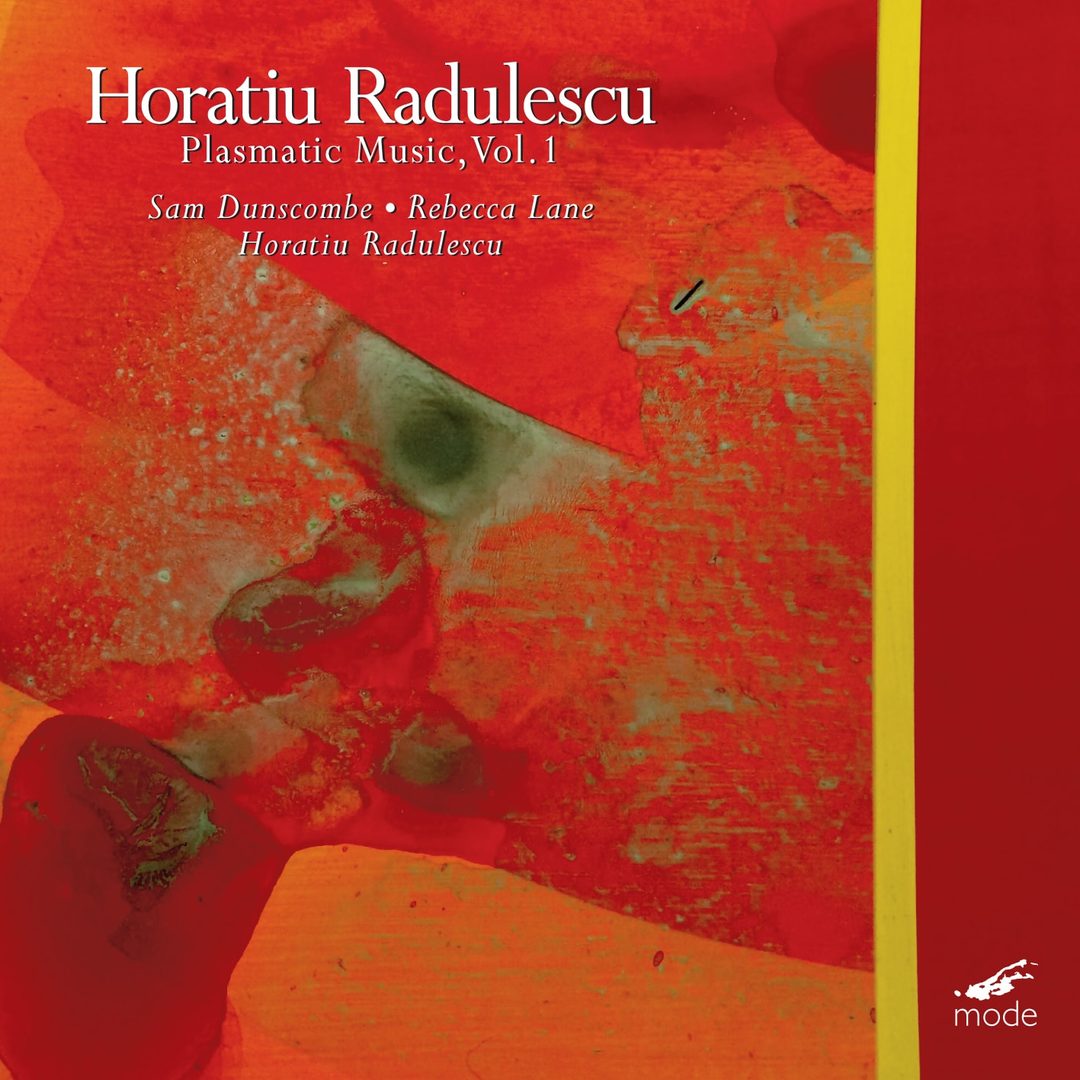
Mode returns with an absolutely stunning new volume in their dedicated series to the spectralist composer, Horatiu Radulescu, with "Plasmatic Music, Vol. 1". Gathering three never before released works created between 1972 and 1983, newly realized by Sam Dunscombe and Rebecca Lane, it's an overwhelming immersion into a neglected thread of sonic radicalism emerging in Europe during the second half of the 20th century from a truly maverick creative mind. An absolute revelation and joy in listening that can't be missed.
Back in 2016, the long-standing New York based imprint, Mode, began an in-depth exploration of the work of the Romanian-French composer Horatiu Radulescu. Over the years since this endeavor has continued to expand, revealing a truly singular voice in 20th century musical avant-garde. Now Mode returns with their 4th instalment in the series, "Plasmatic Music, Vol. 1", comprising three works that explore different aspects of the composer’s theory of Sound Plasma which evolved over the 1970s. Brought to life for the first time by Sam Dunscombe and Rebecca Lane, each is an astounding gesture of electroacoustic composition that entirely destabilized the standard narratives of history surrounding this territory of sound.
Born in Bucharest, Horatiu Radulescu (1942-2008) was raised behind the Iron Curtain, and began to play the violin at a young age, before eventually studying composition at the Bucharest Academy of Music under Stefan Niculescu, Tiberiu Olah, and Aurel Stroë, some of the leading figures within the Romanian avant-garde. Upon graduating in 1969 he fled his home country for Paris, becoming a French citizen in 1974. He attended classes given by John Cage, György Ligeti, Karlheinz Stockhausen, and Iannis Xenakis at the Darmstadt, and by Luc Ferrari and Mauricio Kagel in Cologne, in addition to presenting his own compositions in Olivier Messiaen's classes at the Paris Conservatoire, where the elder composer referred to him as "one of the most original young musicians of our time”.
Always singular and standing slightly apart from the pack, during the 1970s he began to develop spectral techniques, attempting to bypass the historical categories of monophony, polyphony, and heterophony, pursuing musical textures in a total state of continuous flux, based around harmonic relationships based on these spectra and on the phenomena of sum and difference tones. It is this remarkable world of sonority that Sam Dunscombe and Rebecca Lane have set out to illuminate across the length of “Plasmatic Music, Vol. 1”.
In addition to holding a doctorate focused on the work of Horatiu Radulescu, and working as the archivist to his estate, Sam Dunscombe - a performer-composer in her own right, specializing in the use of clarinets, computers, and microphones - has produced numerous recordings of note over the last few years, including “Observing Objects” with Eva-Maria Houben and Rebecca Lane, for Edition Wandelweiser in 2017, and “Outside Ludlow / Desert Disco”, for Black Truffle last year, as well as being a member of Golden Fur with Judith Hamann and James Rushford. An Australian flutist based in Berlin, Germany, Rebecca Lane has also been slowly building a striking career over the last few years, collaborating with Catherine Lamb and Sarah Davachi, as well as being a member of the all-star Harmonic Space Orchestra. This is both Dunscombe and Lane’s first outing realizing the work of Radulescu for Mode’s series dedicated to the composer.
“Plasmatic Music, Vol. 1” comprises three works by Horatiu Radulescu, “Capricorn’s Nostalgic Crickets” (1972), “Small Infinities’ Togetherness” (1972), and “In Opus 42: Inner Time / Outer Time” (1980-83), each exploring a different aspect of the composer’s theory of Sound Plasma. The first work in the collection, “Capricorn’s Nostalgic Crickets”, while deeply echoing the timbres and textures of electronic music, was composed for seven clarinetists, presenting spectrally dense sound events - fluttering with complex harmonics and atonalities - that were described by the composer as a “PULSE-TIDE of MUSIC and SILENCE”, asking the players to transcend their instrumental selves, and collectively evoke the sounds of the natural world.
The collection’s second work, “Small Infinities’ Togetherness”, is a shimmering articulation of a single sound spectrum that shifts between harmonicity and inharmonicity, from spectral narrowness to spectral width. The new version presented on “Plasmatic Music, Vol. 1” features two archival recordings of Radulescu playing organ and synthesizer, which have been augmented with two sound groups recorded in the period between 2018–21, one of electronics (analogue and digital synthesis together with tape manipulation) and one of acoustic instruments (a set of Radulescu’s original Romanian folk wooden flutes, and a specially tuned sound icon), resulting in a work of profound density and tension, that immerses the entire being of the listener in its remarkable depths for nearly 20 minutes.
The final work, “In Opus 42: Inner Time / Outer Time”, rounding out this survey of Radulescu’s stunning mid-career period, comprises two paired compositions, presented together here for the first time, and draws upon a spectrum of odd number harmonics that are deconstructed and rebuilt by overlaid flutes and clarinets, the instruments’ natural variations of pitch causing the total sonic mass to seethe and boil over the work’s nearly half hour length. Much like “Capricorn’s Nostalgic Crickets”, acoustic instruments are played against each other to produce a music that sounds almost entirely electronic and synthetic (vs acoustic), infusing the totality with an inner dynamism that gives an extra sense of temporality, growth, and evolution, not to mention a harmonic richness and complexity of towering singularity. It’s hard to call to mind another work quite like it in the entire history of 20th century avant-garde sound.
Nothing short of a revelation, illuminating a remarkable talent that has never received his full rightful due, “Plasmatic Music, Vol. 1” is a joyously immersive listen of deep historical importance, brilliantly executed by Sam Dunscombe and Rebecca Lane. We can’t thank Mode enough for bringing this one into the world.
Originally published by Soundohm.