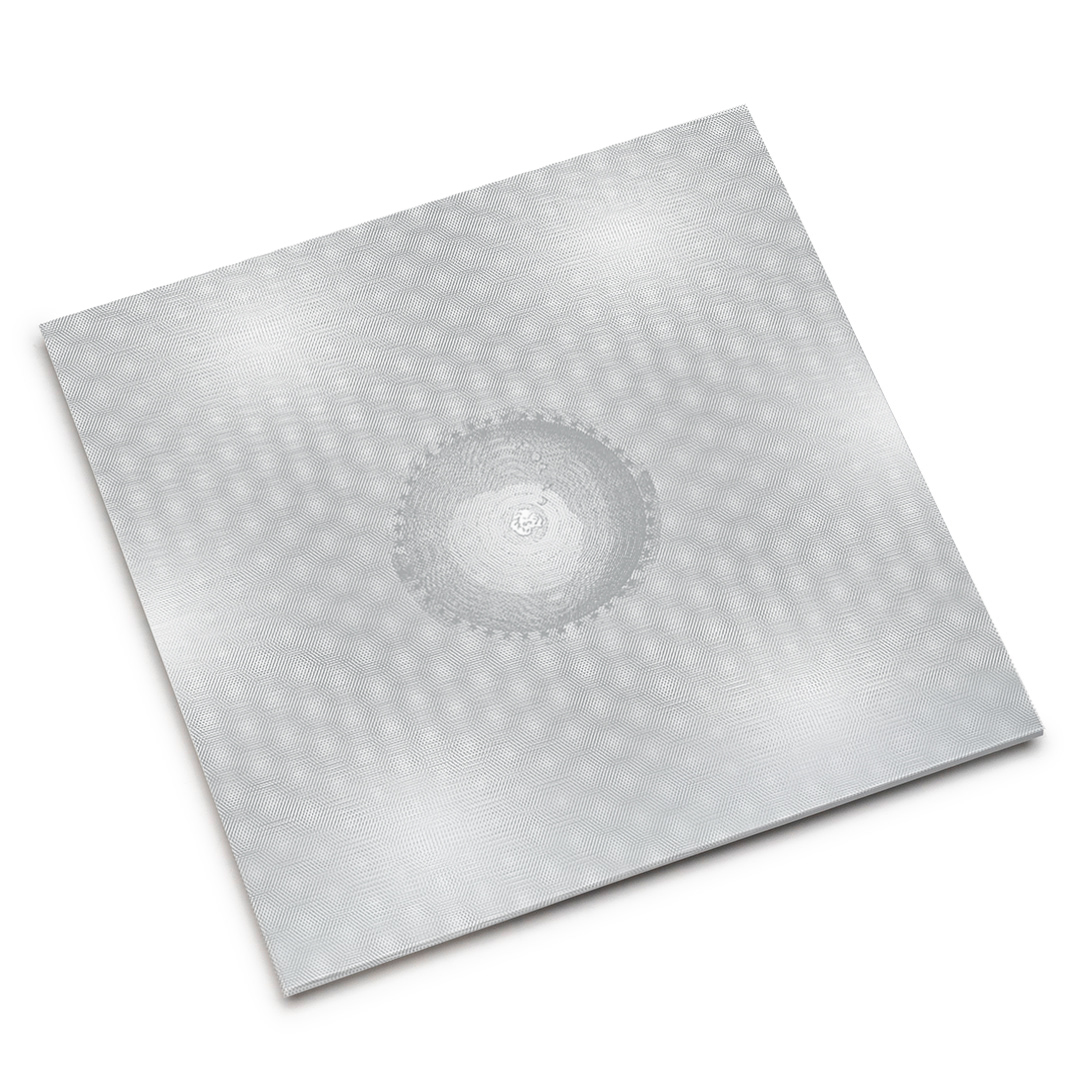
“The result is delicate, subtle, and utterly captivating, cultivating sprawling ambiences pregnant with pointillistic detail and rich harmonic interplay.”
With some pretty stellar releases by Mattias Petersson, Matthias Puech, and Elisabeth Klinck already behind them this year, the venerable imprint, Hallow Ground, returns with one of their most captivating albums to date, ‘Seven Common Ways of Disappearing’, the debut outing by Armenian-Lithuanian artist, Andrius Arutiunian. Composed for specially tuned grand piano and electronics, and drawing on the ideas and teachings of G.I. Gurdjieff, it’s a truly astounding piece that deftly bridges the gap between the “artist record”, Minimalism, contemporary electroacoustic practice, and spiritualism.
Over the last ten years, the Swiss imprint, Hallow Ground, has quietly carved their own path across the landscape of experimental music, issuing singular albums by artists like Kali Malone, Marja Ahti, FUJI||||||||||TA, Andrew Liles, and Colin Potter, among dozens of others. The label describes itself as “a platform for Music and Art that leads to Visions”, implying a mystical or cosmic modus operandi rumbling below its activities. This is certainly the case for their latest LP, ‘Seven Common Ways of Disappearing’, the debut outing by Armenian-Lithuanian artist, Andrius Arutiunian, which transforms the esoteric philosophies of Armenian-Greek mystic and composer G.I. Gurdjieff into a vibrant body of electroacoustic sound. Immersive, mind-altering, stunningly beautiful, it’s been a while since we’ve heard a debut that’s captured our hearts, minds, and ears like this.
Since his death in 1949, the philosopher, mystic, spiritual teacher, and composer, George Ivanovich Gurdjieff, has remained a point of curiosity and inspiration for fans of avant-garde and experimental music. This largely rests with a substantial body of piano pieces, mostly composed during the 1920s in collaboration with Thomas De Hartmann, and improvised harmonium music composed in Paris between the 1930s and 40s. Drawing on Caucasian and Central Asian folk and religious music, and Russian Orthodox liturgical music, these mystical compositions evoke meditative states and complex moods. When Gurdjieff’s piano and harmonium works began to appear during the 1950s in recorded form, they quickly inspired new generations of fans and prompted numerous new renderings over the following decades by a wide range of artists, including Alain Kremski and Keith Jarrett.
To this end, Andrius Arutiunian has followed a singular and fascinating path, using Gurdjieff’s ideas as a departure point, rather than his music itself. Arutiunian is an artist and composer who uses hybrid forms of music, focusing on sonic vernaculars, hypnotic musical forms, and aural cosmologies, who has primarily constructed installations, sound objects, and time-based collaborations with ensembles and performers. Like his works that precede it, 'Seven Common Ways of Disappearing' began its life in the realm of visual / fine-art, having been commissioned by Rewire, Venice Biennale 2022 and Armenia Pavillion, as an installation. In its original staging, Arutiunian played a vinyl recording - now issued as a wide release by Hallow Ground - on a record player between two custom-made speakers, with the performance recorded both forwards and backwards, set to rewind automatically when it reached the end.
When composing 'Seven Common Ways of Disappearing', Arutiunian drew upon Gurdjieff’s writings on the world ordering and musical tuning, as well as the enneagram - a model of the human psyche and a typology of nine interconnected personality types, influenced by the early work of George Gurdjieff and his “Fourth Way tradition” - and its nine-pointed symbol as the basis of its score, to organise the piece’s musical and structural matter. Written for two musicians on retuned grand piano and analogue electronics, the score - allowing for an infinite number of permutations - dictates that the piece be realised from its score in a different configuration each time it is played. Hallow Ground’s LP captures one realisation of this mystical composition, guided by its musicians and internal logic. The result is aesthetically and spiritually intoxicating, echoing elements of Minimalism and free improvisation within its electroacoustic form.
Like its initial rendering at the Venice Biennale in 2022, the LP version of 'Seven Common Ways of Disappearing' is divided into two sections, the first rendering of the score forwards, with the second encountering it in reverse, with its two players working in tandem at a grand piano, tuned to Gurdjieff's specifications, while Arutiunian weaves electronic drones, interference, and processing into the glacial blanket of tones. The result is delicate, subtle, and utterly captivating, cultivating sprawling ambiences pregnant with pointillistic detail and rich harmonic interplay.
Simultaneously conceptually rich and emotively spiritual, Andrius Arutiunian’s 'Seven Common Ways of Disappearing' feels incredibly rare and special in today’s landscape of experimental music.
Originally published by Soundohm.