“Truly monumental on historical, creative, and musical terms.”
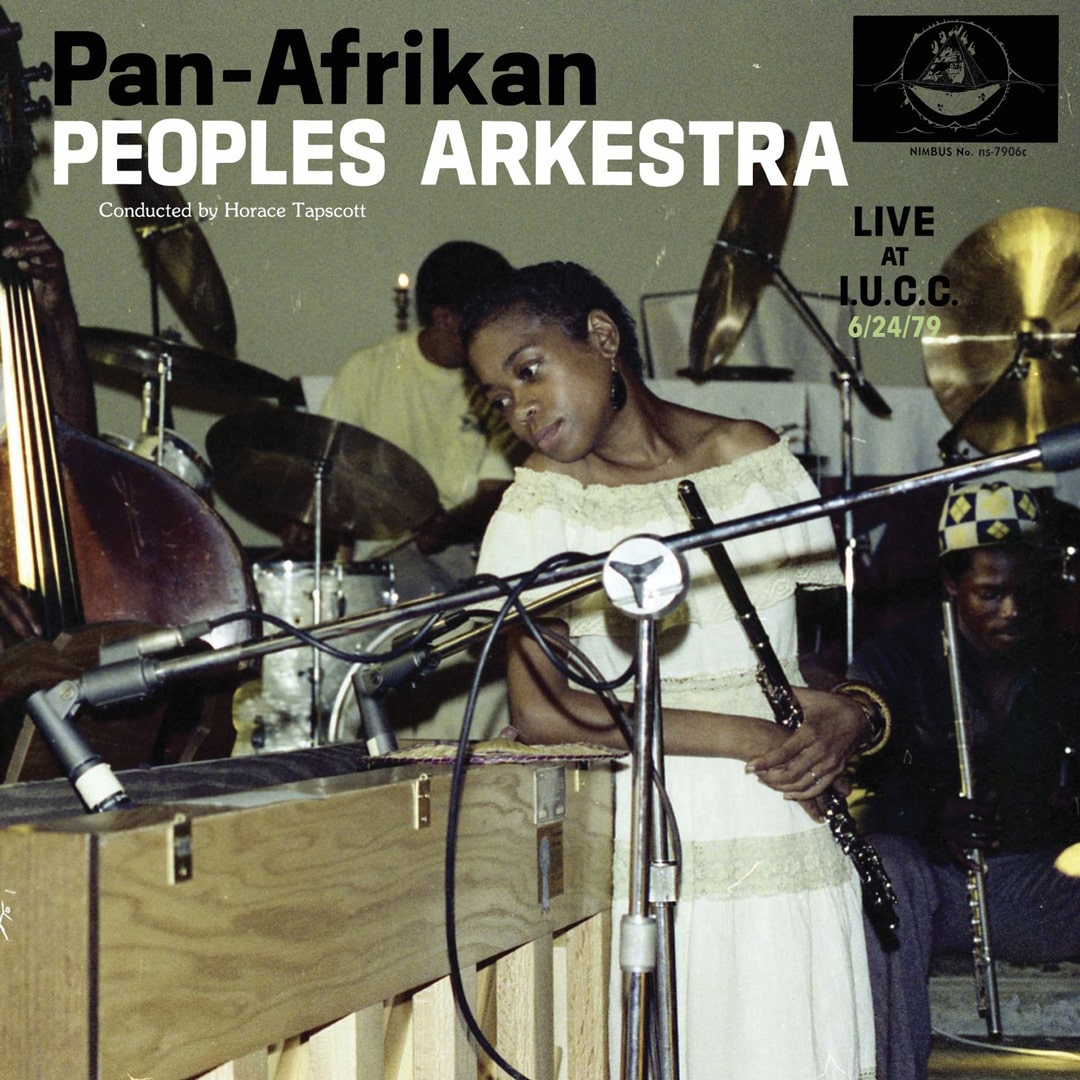
One of the great depositories of West Coast avant-garde jazz, Nimbus returns with the latest two instalments of their Pan Afrikan Peoples Arkestra series, Pan Afrikan Peoples Arkestra’s ‘Live at IUCC 2/25/79’ and ‘Live at IUCC 6/24/79’. Encountering what was arguably the greatest band in the West Coast American scene of spiritual and free jazz on their home turf - the Immanuel United Church of Christ (I.U.C.C.) in Los Angeles - both are absolute scorchers.
Back in 2021, the legendary imprint, Nimbus West, relaunched with its first new release in years, the astounding triple LP, “Live at Century City Playhouse 9/9/79”, by Horace Tapscott & the Pan-Afrikan Peoples Arkestra. Building on that momentum, they’re back with two more truly incredible releases from the vaults, featuring long lost recordings by the PAPA from the same period. Truly monumental on historical, creative, and musical terms.
Pan Afrikan Peoples Arkestra - ‘Live at IUCC 6/24/79’
The Los Angeles based pianist, band leader, and composer, Horace Tapscott (1934-1999), always stood apart from the pack. A true visionary who was fiercely principled and independent, across the 1960s, 70s, 80s, and 90s, leading his legendary Pan Afrikan Peoples Arkestra, he produced a tour de force of sound, seeded by social, political, and community-based action.
Tapscott began his career as a trombonist before switching to piano, playing with Frank Morgan, Don Cherry, and Billy Higgins while still in his teens, before hitting the road with Lionel Hampton during the late 50s and early 60s, an experience formative enough to push him down his own path as a band leader. For most of his career, Tapscott remained one of the unsung giants of jazz; a gifted composer, arranger, and educator, as well as a remarkably original pianist and bandleader. In 1961 he founded the Underground Musicians Association (UGMA) - which morphed into the Pan-Afrikan Peoples Arkestra roughly a decade later, a project which, despite Tapscott’s untimely passing in 1999, continues to send ripples across the world of improvised music to this day, both through its own activities and through the individual gestures - past and present - of the hundreds of talented voices who have passed through its ranks (Arthur Blythe, Azar Lawrence, Jimmy Woods, John Carter, Bobby Bradford, Sonny Criss, Ndugu Chancler, Nate Morgan, Jesse Sharps, Adele Sebastian, Dadisi Komolafe, Gary Bias, to mention only a few).
While Tapscott recorded in numerous configurations (almost always as a leader) and solo over the many years of his activity, from its inception UGMA / the Pan-Afrikan Peoples Arkestra remained Tapscott’s central focus. A radical band, creating revolutionary music that channeled Afrocentric and self-determinist philosophies, it was a community band that lived communally. In Tapscott’s own words, the project hoped to act as ‘a cultural safe house for the music.’ - an Ark, stating, “This is your music. This is black music,… a panorama of the whole thing right here”. Playing fundraisers, organizing teach-ins and workshops for young and old, all the while integrating their efforts with radical theatre groups and poets, political revolutionaries, Black separatists, community groups and churches, it drew on its own culture and the immediate community from surrounding Los Angeles neighborhoods for talent and creative inspiration, producing a totality of sound and action that has few equivalents in the history of American music.
For the entirety of their run together, Tapscott and his Arkestra were among the most important groups working in the United States. They also remain among the most under-appreciated. Thankfully, the last few years have brought a number of reissues and archival releases by Tapscott, the Arkestra, and many of its members and associates like Linda Hill, Jesse Sharps, Adele Sebastian, Nate Morgan, Curtis Clark, and others, allowing the sprawling scope and astounding merit of their accomplishments to come into view for a broader audience. Now, we have yet another from Nimbus West - the imprint founded in 1979 by Tom Albach to support Tapscott and the Arkestra’s activities - Pan Afrikan Peoples Arkestra’s ‘Live at IUCC 6/24/79’ - an astounding double CD documenting a never before issued concert recording at their main rehearsal and concert space, the Immanuel United Church of Christ (I.U.C.C.) on 85th St and Holmes Ave, where the band played every second Sunday, developing their sound and hipping new audiences to their vision.
Featuring a sprawling series of five tunes that stretch across the album’s two CDs, including the longest recorded version of the Arkestra composition, ‘Village Dance’, as well as a fantastic version of ‘Many Nights Ago’, featuring Linda Hill on vocals, and a new remaster of ‘Noissusprahs’ that reveals new levels of depth and spaciousness, Live at IUCC 6/24/79 is a landmark in West Coast spiritual and free jazz - locked in, energetic, and wide open - offering further proof that the Pan Afrikan Peoples Arkestra was one of the greatest bands of the 1970s.
Absolutely incredible and engrossing from the first sounding to the last, the Pan Afrikan Peoples Arkestra’s ‘Live at IUCC 6/24/79’ is a truly essential musical statement that will call you back time and time again.
Pan Afrikan Peoples Arkestra - ‘Live at I.U.C.C. 2/25/79’
Like Sun Ra, from whom he borrowed when naming his own Arkestra, and Kelan Phil Cohran working during the same period in Chicago, Horace Tapscott showed deep dedication to the possibilities and inclusiveness presented by working in large ensembles. Attempting to remain free from the restrictions of the white run music industry, the Pan-Afrikan Peoples Arkestra only began to document their efforts toward the end of the 1970s - always placing community work and political consciousness at the heart of the project, preferring to play in the street, parks and coffee houses, over traditional venues.
This ethos extended into the centre of the Arkestra itself. Early on Tapscott enthusiastically turned over the reins to young members of the band, first to Arthur Blythe, and then most notably to the saxophonist, Jesse Sharps, who led the band for much of the 70s.
Born in Los Angeles in 1953, Sharps spent his childhood in Watts, and encountered Horace Tapscott when he was still at high school. He was asked by the pianist to join Arkestra rehearsals soon after. Leaving to study under Cecil Taylor at university, upon returning to LA he rejoined the band on flute and reeds, ultimately becoming the group’s leader when Arthur Blythe departed.
Sharps led the Arkestra like a well oiled machine during the incredible period which gave way to “Flight 17”, “Live At IUCC”, and “The Call”, and was recalled by Tapscott as “hardcore... They’d all be quiet and listen to him when he talked.” - a power of personality only trumped by the life his playing breathed into each work. It is the Arkestra under his guidance, albeit in his final days as its bandleader, that we encounter across the length of ‘Live at I.U.C.C. 2/25/79’, a now legendary concert that was part of the same series of eleven recorded concerts from the Immanuel United Church of Christ to which ‘Live at IUCC 6/24/79’ also belongs, and the last known recording of Jesse Sharps as the Arkestra’s bandleader before he left for the Army.
Capturing a truly incredible afternoon of music that stands the test of time as a fitting “departure” for Sharps, the band launches into pure unbridled fire with blistering solos by Sharps, Session, and a very special reading by Kamau Daaood, as well as an amazing take of Stanley Cowell’s “Departure” that harnesses all of the radicalism and spirited fury that rested in the band and its larger project within the community.
Featuring five amazing compositions that capture the band during one of their most creatively rich and prolific periods, saying goodbye to a leader whose spirit carried them well into the future, it doesn’t get much better than Pan Afrikan Peoples Arkestra’s ‘Live at I.U.C.C. 2/25/79’. Like its companion, it’s a true monument of west coast spiritual and free jazz.
Originally published by Soundohm.