
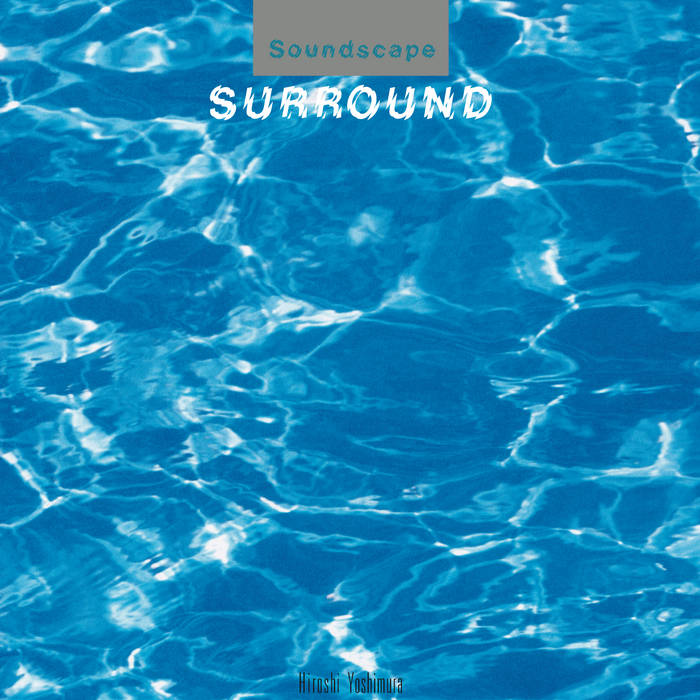
“Within rippling ambiences culled from long tones, across the stunning length of “Surround” Yoshimura weaves a sprawling world, punctuated by microscopic details.”
The Los Angeles based imprint, Temporal Drift, returns with what is unquestionably one of the most exciting and hotly anticipated releases of the year, the first ever vinyl reissue of Hiroshi Yoshimura's iconic, and until now virtually unobtainable, 1986 album Soundscape 1: Surround. Originally issued as an accompaniment to architecture - the first of a two-part series that also includes Yutaka Hirose’s equally legendary Soundscape 2: Nova - and regarded as the yin to the yang of Yoshimura's “Green”, which was recorded almost concurrently, Surround stands among the most remarkable and sought after albums in the genre of kankyō ongaku (environment music) and Japanese ambient music from the 1980s: immersive and truly incredible, returning to our ears after nearly 40 years out of print.
Of all the remarkable composers to emerge from Japan during the second half of the 20th Century, few have been as celebrated and beloved as Hiroshi Yoshimura. One of the great pioneers of ambient music, his albums from the 1980s - "Music For Nine Post Cards", “Pier & Loft”, “A・I・R (Air In Resort)”, and “Green” - have long retained holy grail status for collectors. While the majority of Yoshimura’s most celebrated works have received the reissue treatment in recent years, there’s been a conspicuous absence among them, the composer’s widely celebrated “Soundscape 1: Surround”, issued in 1986 - the same year of his legendary LP “Green” - on Misawa Home, as the first part of their Soundscape series, which also includes Yutaka Hirose’s equally legendary Soundscape 2: Nova (reissued by WRWTFWW in 2018). Now, in a momentous event, after remaining out of print for nearly 40 years, the Los Angeles based imprint, Temporal Drift, has done the great service of bringing it back with the first-ever official reissue of this pioneering ambient work.
Born in Yokohama, Kanagawa, Hiroshi Yoshimura (1940-2003) was one of the great figures in 20th Century Japanese music. Taught the piano from age of 5, his early influences were among the avant-garde, including the work of Fluxus, Harry Partch, and Erik Satie. While Yoshimura’s earliest known endeavors were within "Anonyme”, a computer music group he founded in 1972, the first entry in his discography - “Continuous Performance No. 3 - 24.3.1977” - which documents one of his early “environmental” performances, alongside works by Akio Suzuki, Takehisa Kosugi, and Riri Shimada, captures what is arguably the clearest line between the composer’s (often overlooked, but incredibly important) roots in experimental music, and his development of ambient music, roughly concurrent to Brian Eno and others.
Over the course of his decades long career, Yoshimura maintained a remarkably diverse practice, including improvisational music, performances of environmental music containing graphic design and sound design, and visual poetry, as well as music for galleries, museums, building spaces and train stations. Despite this, it is his ambient music - loosely categorized within the minimalist genre of kankyō ongaku (environment music) within which electronic melodies are infused with the sounds of nature (bubbling brooks, steady rain, birds, etc.) - produced during the 80s and 90s that has made him a legend. Created during roughly the same period as his legendary LPs "Music For Nine Post Cards", “Pier & Loft”, and “Green”, “Soundscape 1: Surround”, originally released in 1986 by Misawa Home, is among the most sought after and celebrated of the albums of this era in his output.
Originally released in January 1986, “Surround” belongs to Yoshimura’s works that operated in connection with the field of design, similar to 1984’s “A・I・R (Air In Resort)” which was created to accompany a perfume by Shiseido. The album was recorded as a commission from home builder Misawa Homes, intended to function as an “amenity” designed to enhance the company’s newly built living spaces. Speaking of it, the composer stated “Surround can be listened to as music that’s as close to air itself, allowing us to enter each listener’s sound scenery, or as something that exists within a new perspective, expanding the middle ground between sound and music, and transforming it into a comfortable space, it would be much appreciated.”
In clear relation to John Cage’s ideas of chance and acknowledging the value and musicality of sounds drawn from everyday life, in his original notes for the album, Yoshimura recommended that Surround be placed in the same family of sounds “as the vibration of footsteps, the hum of an air conditioner, or the clanging of a spoon inside a coffee cup.” And, as he suggests, “with the addition of city noise from outside the window,” so that the album might be heard in numerous and completely new ways.
Comprising six discrete compositions - “Time After Time”, “Surround”, “Something Blue”, “Time Forest”, “Water Planet”, and “Green Shower” - “Surround” stands slightly outside of Yoshimura’s works from this period because of the absence of environmental sounds, preferring, as he stated above, to allow the environmental interactions with his music to be introduced and controlled by the listener. Often referred to as the yin to the yang of “Green”, recorded almost concurrently, “Surround” while undeniably intoxicating and engrossing in its use of tonality and ambience, also, through the structures of a number of its compositions, displays a subtle complexity that nods toward the composer’s roots in experimental and avant-garde music.
Within rippling ambiences culled from long tones, across the stunning length of “Surround” Yoshimura weaves a sprawling world, punctuated by microscopic details. Composed with a startling amount of restraint - pushing notions of minimalism to their extreme - the harmonics of carefully placed tones, within each piece explore their own natural potential, dancing and punctuating the sonorous spaces in ways that continuously brings the very conception of ambient music to new heights.
An absolute masterpiece of Japanese minimalism and ambient music that’s remained inexplicably out of print for nearly 40 years - subsequently commanding towering prices on the secondary market - Temporal Drift has certainly done the work of the gods by bringing this long-lost gem back into the world.
Originally published by Soundohm.