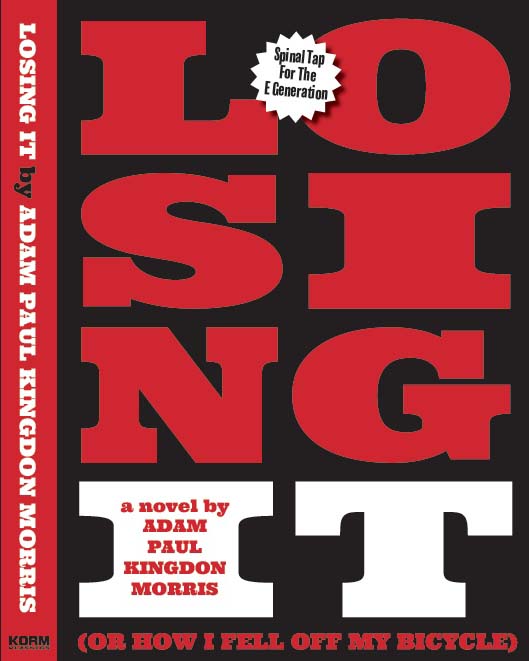
“Adam Morris’ “Losing It” is a fantastic read that lays the 80s music scene bare, told by someone who rested in the belly of the beast for the entire decade.”
Since their relaunch in 2019 as (primarily) a publisher of books, the legendary Dutch imprint, Korm Plastics - founded in 1984 by Frans de Waard - has been blowing our minds with incredible volumes roughly attendings the music scenes to which they belong. Two of their latest - The Annual 2023 and Adam Morris' "Losing It" - take this momentum up a notch. Taking markedly different approaches to the history of music, the former takes the form of an annual, anthology 196 page magazine, comprising contributions by numerous authors that includes a history of turntablism, a 1985 interview with Roger and Brian Eno, a report on the Groningen punk scene in the late 1970s and early 1980s, Kubus Kasssettes, vinyl hunting in Trinidad, Willem de Ridder’s Radiola Improvisation Salon, Gary Scott on meeting Florian Fricke, Killing Joke, and Joy Division, and a great deal more, while the latter a brilliant, fictional account of the author’s experiences working in the recording industry, featuring thinly veiled and often scathing portraits of some major names.
The 1980s was a particularly remarkable period for underground music. Emboldened by the spirit of the first waves of punk and post-punk, and the ethos of DIY that came with it, countless scenes appeared in various corners of the globe, propelled by small, independent labels and publishing ventures that often embraced experimental tactics and the radicalism of the avant-garde. Among the most noteworthy of these was the Dutch imprint, Korm Plastics, founded in 1984 by Frans de Waard as cassette label, which ran continuously until 2015 across various formats, before relaunching in 2019 as a vehicle predominately focused on publishing books related to music connected to the scenes to which it belongs.
There is a time of making and doing at the cutting edge, and there is a time for the writing of histories and the shoring up of legacies. Remarkably, for just over 20 years, the Dutch imprint, Korm Plastics, managed the former. Founded in 1984 by Frans de Waard, until 2015 it pushed the boundaries of music, from early DIY cassette releases by underground projects like Psychic TV, Asmus Tietchens, Kapotte Muziek, Nails Øv Christ, Comando Bruno, and Narzisse, to its eventual, sprawling and ambitious catalog that would include important works of artists like Stephan Mathieu, Steve Roden, Toshiya Tsunoda, Johannes Frisch, Giuseppe Ielasi, Peter Rehberg, Thurston Moore, Z'EV, Audrey Chen, Jim O'Rourke, Lasse Marhaug, The Hafler Trio, and dozens of others. After a brief, four year hiatus, in 2019 de Waard relaunched the imprint in service of the latter, via a series of books that illuminate various aspects of the scene to which it contributed and belonged. First came a re-issue of de Waard’s memoir of working for the legendary imprint Staalplaat, “This Is Supposed To Be A Record Label”, the success of which led to the publication of new books, including anthologies of fanzines, “Vital, De Nederlandse Cassette Catalogus” and “BOH, Neumusik, Nul Nul”, an English translation of a book about punk in the Netherlands (1976-1982), a book about The Legendary Pink Dots’ first ten years, a collection of letters between Coil’s John Balance and Anthony Blokdijk, Freek Kinkelaar’s musings on music, and others. Korm Plastics’ latest, “The Annual”, follows this trajectory down another path, taking the form of an incredible 196 page annual magazine that plumbs the depths of history with incredible archival texts.
Harnessing a longstanding mutual desire to found a magazine on the part of its two editors, Frans de Waard and Alfred Boland, like so much of what Korm Plastics has produced, “The Annual” slightly defies the natural expectation of what one might expect of its form. Rather than focussing on the present, the editors invited a group of authors from the past and present to contribute an article, culminating as an anthology publication, with a series of fascinating articles covering a wide range of topics, ranging from a history of turntablism, a 1985 interview with Roger and Brian Eno, a report on the Groningen punk scene in the late 1970s and early 1980s, Truus de Groot about her formative years, Kubus Kasssettes, vinyl hunting in Trinidad, the Perversita festival in 1989, concerts that ended in riots, Willem de Ridder’s Radiola Improvisation Salon, Ultra in Eindhoven, Gary Scott meeting Florian Fricke, Killing Joke/Joy Division, The Slits, contributions by GW Sok and Harold Schellinx and more. Illustrations by Miss.Printed, short interludes by Freek Kinkelaar and Frits Jonker, plus a comic strip by Bertin.
Unified by the spirit of the counterculture and underground music, de Waard and Boland’s “The Annual” is an utterly engrossing time capsule, marking the end of 2023 with a journey through incredible artefacts of the past. Few contemporary magazines we can think of are as engrossing as this.
Adam Morris has a long and storied history in music. In 1979, alongside a handful of likeminded friends,, he co-founded the DIY label Malicious Damage Records, releasing post-punk classics by Killing Joke, who he also tour managed for two years, as well as the John Peel favourite, "Agent Orange" by Ski Patrol. Following a stint as the tour manager for Lee "Scratch" Perry, he went into distribution for labels like Beggars Banquet, 4AD and Alternative Tentacles, On-U Sound, and represented Big Black and Sub Pop Records in Europe. In 1988 he founded Mr Modo Records, which collaborated with a new generation of electronic acts like Coldcut, 808 State and A Guy Called Gerald, as well as forming the alliance WAU! Mr Modo with Youth and Dr LX Paterson and becoming manager of The Orb.
Despite these remarkable heights at the centre of it all, Morris’ career in music came to a screeching halt in 1994, when, entering his 40th year, he was seemingly kicked out of the music industry and given the cold shoulder. Having experienced such highs and lows and been privy to so much first hand, he decided to tell the tale and embarked upon writing the first draft of "Losing It," a fictional account of some of his working experiences inspired by novels like "Spinal Tap" and "Trainspotting”, which he completed in 1996. It would take another twenty six years before he found someone - Korm Plastics’ Frans de Waard - brave enough to publish it.
While it is impossible to fully know where fact and fiction begin and end, by most accounts the bulk of ”Losing It" is rooted in truth, with only the names changed. Identities are thinly veiled, bringing the underbelly of the 80s music scene to life with often scathing portraits of Harry Viderci, Laquerhead Records, The Pederasti, Jeremy Fingers, and The Orb (encountered here as Cloud Bass), tracing through wild extremes of behaviour and drugs, and told with the maximum of profanity, that makes the entire journey - a wild trip toward oblivion - engrossing and extremely entertaining.
While it took nearly three decades since Morris began to tell the tale to see the light of day, it was well worth the wait. Adam Morris’ “Losing It” is a fantastic read that lays the 80s music scene bare, told by someone who rested in the belly of the beast for the entire decade.
Originally published by Soundohm.