“Utterly fearless and exuberant - simultaneously embracing the playful and contentiously pointed - it’s hard to think of a better distillation of Conrad’s spirit.”
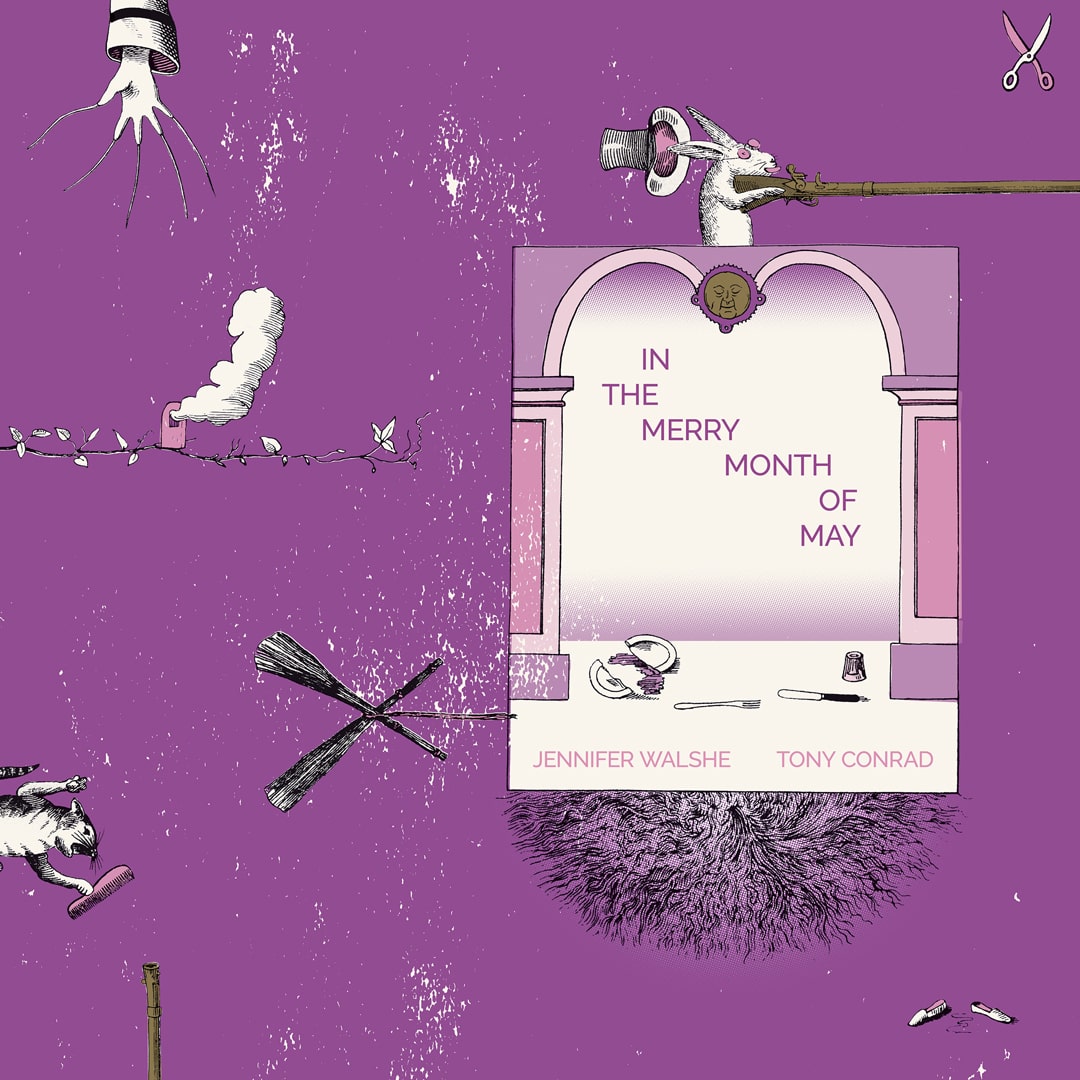
From David Grubbs' always brilliant Blue Chopsticks imprint, comes the first ever release of "In the Merry Month of May", the final studio album of the late, great Tony Conrad, made in collaboration with the Irish composer and vocalist, Jennifer Walshe - the first to document their duo - before his passing in 2016. Wild and boundary pushing as we could always expect from Conrad, it's a perfect distillation of his spirit - locked in one of the most important creative partnerships during the last decade of his life - while sounding not quite like any other release that’s borne his name.
One of the most noteworthy features of 1990s underground and independent music was a prevailing sense of solidarity and mutual support. Famous figures like Kurt Cobain and Thurston Moore, alongside slightly lesser known peers like Jim O’Rourke, Alan Licht, Steve Albini, and numerous others, consistently went out of their way to point their fans toward other artists that they loved. This spirit was equally embraced by many of the era’s most noteworthy labels - Touch & Go, K, Kill Rock Stars, Thrill Jockey, Drag City, Matador, Merge, etc. - each pointedly putting community, friendship, and great art above profit motive. Over the decades since, this legacy has been carried into the future by numerous labels, founded and run by artists who were fostered by that context, including O’Rourke’s Moikai, Moore’s Ecstatic Peace!, and Peter Rehberg's Editions Mego. Among the more noteworthy of these is Blue Chopsticks, the label founded and run by O’Rourke’s former Gastr del Sol bandmate David Grubbs. A true labor of love, since the late 90s, the imprint has slowly assembled a striking discography that not only includes many of Grubbs’ more ambitious solo and collaborative efforts, but equally seminal releases by Luc Ferrari, Derek Bailey, Workshop, Van Oehlen, Circle X, and others.
Trained at Harvard as a mathematician, before moving to New York City during the early sixties with his friend Henry Flynt, where he became a founding member of Fluxus, within a short handful of years Tony Conrad helped lay the roots of conceptual art; musical Minimalism via groundbreaking works like “Four Violins” (1964), as well as within the original incarnation of La Monte Young’s Theatre Of Eternal Music, alongside Young, John Cale, and Marian Zazeela; and Structuralist film via groundbreaking works like “The Flicker” (1966). Fascinatingly, despite his incredible early efforts and influence, following his departure from New York during the 1970s to teach and explore various forms of radical art making, Conrad became almost entirely forgotten. For decades, with the exception of his legendary 1973 LP, “Outside The Dream Syndicate”, made with Faust, almost nothing survived or was heard of his musical practice, until he returned to the scene during the 1990s and relaunched his career, building a remarkable body of work, the legacy of which still ripples around us today.
As much as Conrad is known as a solo artist, he was a consummate collaborator, believing fiercely in the creative possibilities that it activated. During the last two decades of his life, he worked on equal billing with artists as varied as Tony Oursler, Jim O'Rourke, David Grubbs, Charlemagne Palestine, MV Carbon, C. Spencer Yeh, Genesis P-Orridge, and Arnold Dreyblatt, among numerous others. Among the most important of Conrad’s later collaborators was the Irish composer and vocalist, Jennifer Walshe, since widely celebrated for her 2020 release, "A Late Anthology Of Early Music Vol. 1 Ancient To Renaissance”, which used AI to rework canonical works from early Western music history, and was named as an album of the year by The Irish Times, The Wire, and The Quietus.
When exactly Walshe and Tony Conrad began working together is unclear. The duo played a small number of gigs under the heading of “Ma la Pert” in New York in 2009 and 2010, using a broad sonic palette drawn from vocals, violins, viola, bass, autoharps, keyboards, various objects and “words, parts of words, stories, chanting, jigs, broken drum skins, green furry outfits, breastplates, wire, bird call, and old lady dresses.” Typical of Conrad’s evasive humour and dislike of orthodox mythologies, their artist statement proclaims that “Walshe and Conrad first began working together after they ran from service as household slaves of King Pepy I at the end of Old Kingdom Egypt. They were subsequently monks in Carolingean Gaul during the period roughly 820 to 850, Venetian courtesans at Pope Eugene’s court during the mid 15th century, and prisoners on Reunion Island in 1738, where Walshe tried to secure Conrad’s escape using “remote viewing” techniques. The unfortunate outcome of the latter incident resulted in Conrad’s work as a medicine man in Australia in the 19th century, where in 1834, trying to quell a cattle riot, they both accidentally ingested leprosy vectors and subsequently lost three legs and two arms between them.”
Comprising nine pieces over its two sides, “In the Merry Month of May” is a raucous, irreverent window into Conrad and Walshe’s creative universe. Driven by Walshe’s radical vocalisations, shifting between phonic utterances, spoken language, fractured flirtations with song - ranging from the heavily processed to clean - each work writhes and shifts with energy and clattering improvisation rendered via a near countless number of instrumental and non-instrumental sound sources, culminating collectively as an unadulterated sonic onslaught of intricate and layered microscopic detail. Utterly fearless and exuberant - simultaneously embracing the playful and contentiously pointed - it’s hard to think of a better distillation of Conrad’s spirit.
Originally published by Soundohm.