“Even four and a half decades after its initial release, the album feels revolutionary and stunningly fresh.”
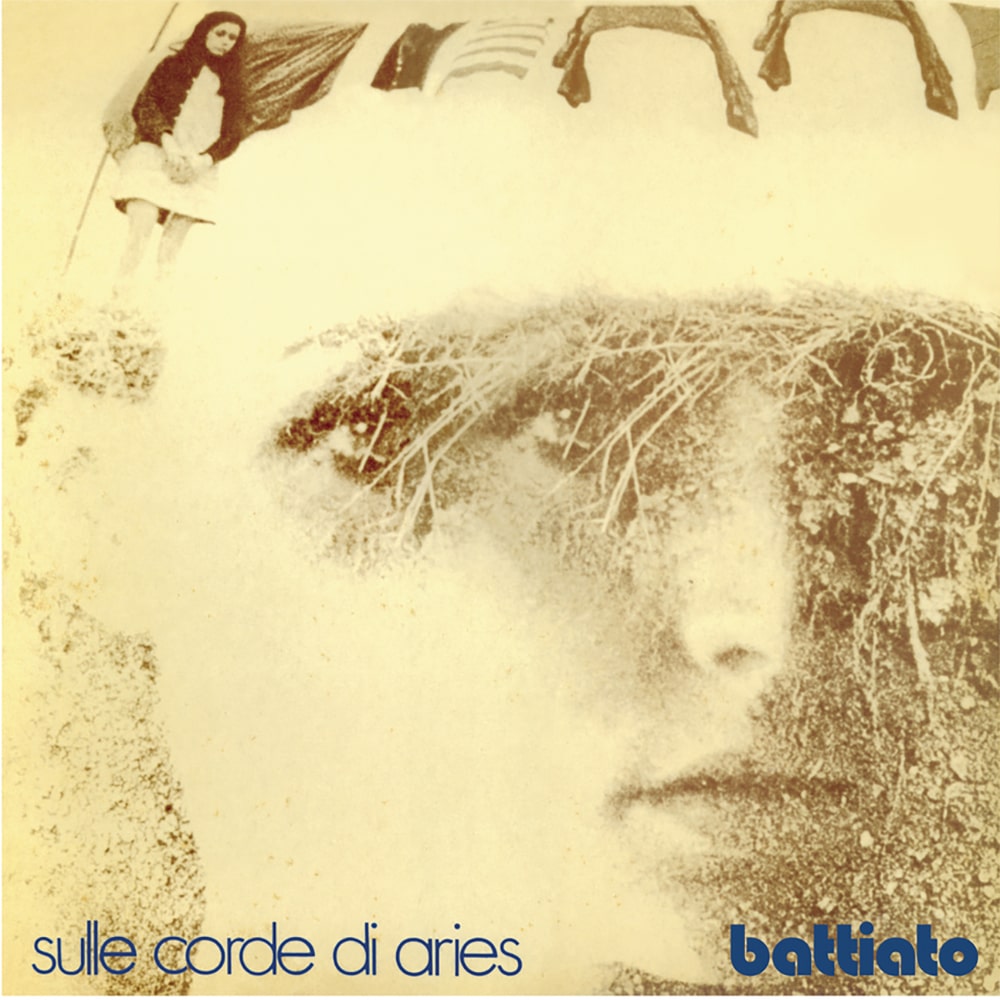
In a rare opportunity to acquire one of the great grails of 1970s Italian music, Saifam drops a stunningly beautiful perfect replica reissue of Franco Battiato’s towering 1973 experimental prog masterpiece “Sulle Corde Di Aries”. The final chapter in a triptych of albums that began with “Fetus” (1972) and “Pollution” (1972), and arguably the most ambitious and captivating of the three, it’s easily among the greatest albums ever produced within the realms of pop - heard by almost no-one at the time - that renders the startling revelation that Battiato was leaps and bounds ahead of almost everyone in his field.
For the better part of the last twenty years, there have been whispers gathering toward a storm of recognition surrounding a singular movement of musical minimalism that unfolded in Italy during the 1970s, 80s, and 90s. Entirely unheard of at the time beyond the borders of its native country, and barely acknowledged within, this movement, made up of a loose collection of artists like Luciano Cilio, Roberto Cacciapaglia, Giusto Pio, Arturo Stalteri, Riccardo Sinigaglia, Lino Capra Vaccina, Walter Maioli, Roberto Laneri, Juri Camisasca, and projects like Prima Materia and Futuro Antico, gained some of its distinct sound from the fact that the majority of its members began their careers in the realms of popular music - notably rock, prog, and folk - rather than within avant-garde classical music like most of their American and European peers. There was arguably no better emblem of this cultural position than Franco Battiato (1945-2021), who reached the heights of popular stardom with three brilliant albums of prog wizardry, issued by Bla Bla during the early 1970’s - “Fetus” (1972), “Pollution” (1972), and “Sulle Corde Di Aries” (1973) - each more radical and experimental than the last, before cultivating his own brand of minimalism during the second half of the decade. While Battiato’s five minimalist marvels issued between 1974 and 1978 - “Clic”, “M.elle Le "Gladiator", “Franco Battiato”, “Juke Box”, and “L’Egitto Prima Delle Sabbie” - have long been heralded by connoisseurs of the avant-garde, the wonders of their astounding predecessors have never entirely gotten the attention they deserve.
Born and raised in Sicily before moving to Milan around 1965, Franco Battiato began his career as a singer, producing a handful of singles across the second half of the 60s that failed to find chart success. It wasn’t until the beginning of the following decade, when he began working with fledgling independent label Bla Bla, that he truly found his feet, laying the groundwork for a legendary five decade long career that captivated and challenged audiences every step of the way. Begun in 1971, and released the following year, Battiato’s true creative emergence is marked by the appearance of “Fetus”, a towering gesture of progressive music interwoven around the sounds of the VCS3 synthesizer, which is credited as being among the first electronic albums created in Italy. This was followed later in 1972 by the even more ambitious LP “Pollution” and then by “Sulle Corde Di Aries” in 1973.
Battiato has often been referred to as Italy's answer to Brian Eno. While the parallels are not without good reason - alluding to the levels of creative ambition, melding of synthesis, avant-garde sensibilities with Pop, and subsequent sculpting of minimalist ambience that were embraced by both artists during the 1970s - there is a reasonable argument that Eno was in fact following in Battiato’s shadow every step of the way. “Fetus” was released a full year before Roxy Music’s first album, and two before Eno’s solo debut, “Here Come The Warm Jets”, which appeared just as Battiato was preparing to exit the realms of pop with “Sulle Corde Di Aries”. Similarly, Battiato’s subsequent shift toward avant-garde instrumental music preceded Eno’s by a year or two. While his work was heard by few outside of Italy at the time, when framed in its own multilayered context, Battiato suddenly appears as one of the most ambitious and forward thinking artists of the later 20th century.
“Sulle Corde Di Aries” is Battiato's final effort of wild eccentric Pop music before he ventured toward explicitly avant-garde realms of musicality. It is the culmination of the entirely singular form of music that he developed during a small handful of years at the beginning of the 1970s and arguably the most ambitious and remarkable of the cycle of albums which began with “Fetus”, before being pushed further by “Pollution”. Filled with remarkable energy and creative brilliance - a truly towering piece of work that entirely stands on its own in the history of music - “Sulle Corde Di Aries” equally doubles as a hint at what was to come, the laboratory in which Battiato's wild mutant seeds were planted. It is a true masterpiece on every count, yet, for those aware of his early work, the most inexplicably overlooked and neglected of the triptych to which it belongs.
“Sulle Corde Di Aries”, far more cohesive than its predecessors, is an evolving cycle of four electroacoustic suites - each drenched in structural challenge and shimmering tone, flirting with the minimalism of Terry Riley and the rhythmic brilliance of Can, while managing to sound like nothing else of its day. Though the album features similar vocal treatments to those on “Fetus” and “Pollution”, binding them together as a conceptual body, “Sulle Corde Di Aries” is marked by long extended instrumental passages, as abstract and challenging as anything in the experimental music world, pregnant with allusions to folk traditions, while still penetrating and pushing the potential of Pop. The result is overwhelming. Even four and a half decades after its initial release, the album feels revolutionary and stunningly fresh. A tangent in sound, which few others have ever reached.
Overwhelmingly beautiful and creatively brilliant, “Sulle Corde Di Aries” - the final chapter in Battiato's intervention in the realm of Pop music, before his return at the end of the decade - binds unparalleled emotiveness within a body of sonority that has no equal anywhere before or since: a truly experiential music that inexplicably manages to be both challenging and remediably inviting and listenable.
Originally published by Soundohm.