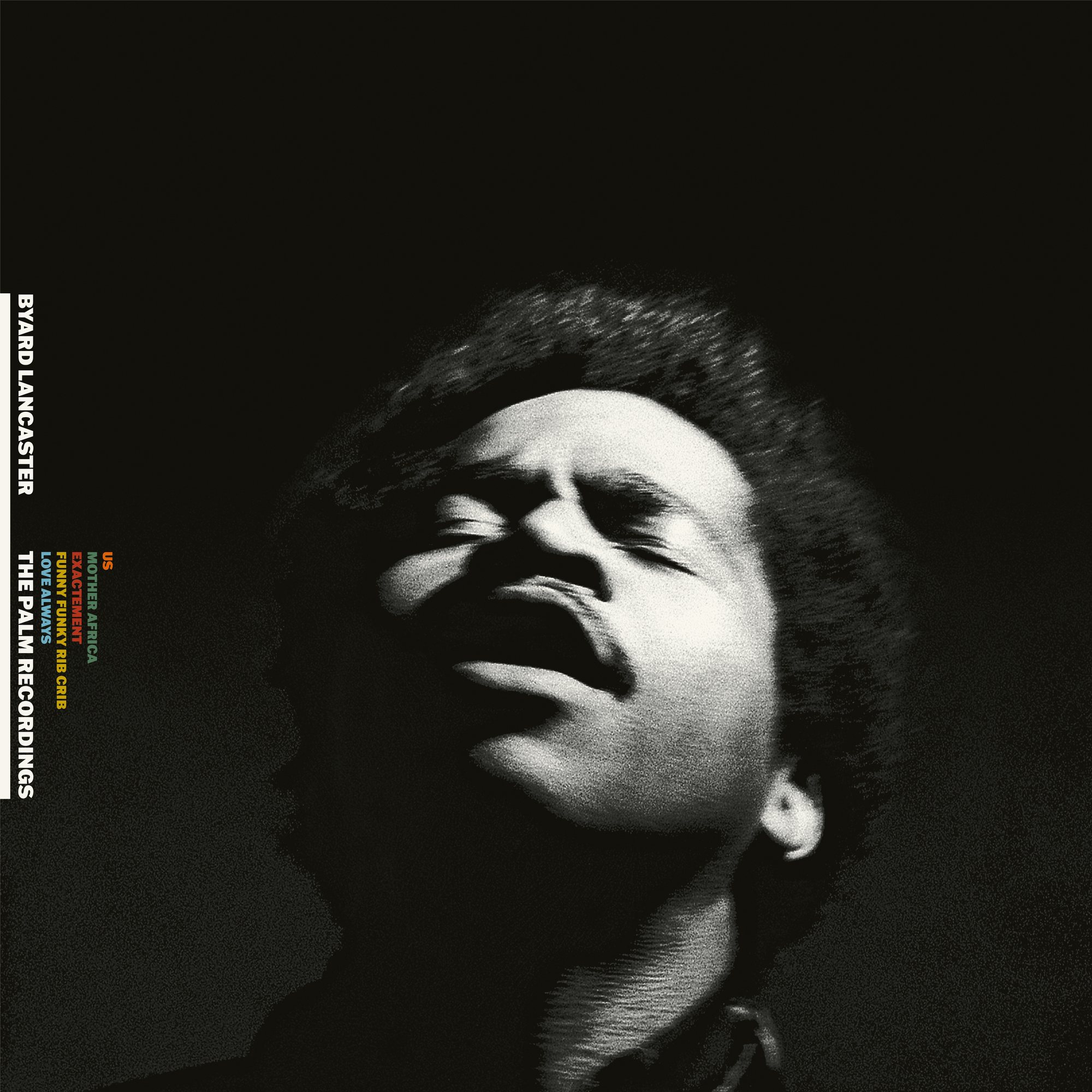
“Nothing short of a towering achievement, Souffle Continu’s “The Complete Palm Recordings 1973-1974” brings the astounding talents and legacy of Byard Lancaster into full view”
From the venerable Souffle Continu comes arguably their most ambitious and important release to date: The Complete Palm Recordings 1973-1974, a towering, x7 LP box set comprising the entire output of the seminal American saxophonist and flutist, Byard Lancaster, for Jef Gilson's legendary Palm imprint, originally issued between 1974 and 1979. Easily some of the most compelling and creatively brilliant music ever laid to tape in France, over the course of these recordings the ear dances through the wildest reaches of free jazz, the deepest realms of spiritual and modal jazz, not to mention some of the most infectiously funky moments we can call to mind.
Since their humble launch in 2014, the Paris based imprint, Souffle Continu, has assembled a discography that is second to none, bringing together some of the most important gestures of the historic French avant-garde. Offering a central focus to efforts of free improvisation that sprang from the country across the 1960s and 70s - notably artefacts from the vaults of legendary imprints like Futura, Saravah, Un-Deux-Trois, and Palm - broadly speaking, Souffle Continu’s releases have tended to focus on the work of important French artists, but their latest - easily their most ambitious effort to date - the towering X7 LP deluxe box set, Byard Lancaster’s “The Complete Palm Recordings 1973-1974”, illuminates the important contributions of American voices to the French jazz scene during the 1960s and 70s. Comprising the entire output of the seminal saxophonist’s long out of print output for Jef Gilson’s Palm imprint - “Us”, “Mother Africa”, “Exactement” and “Funny Funky Rib Crib” - originally released between 1974 and 1979, as well as the first ever standalone edition of “Love Always”, a fifteen minute modal jazz wonder, it’s easily among the most historically important and artistically striking releases we’re likely to encounter in 2024. Each of these LPs represents the heights of 1970s spiritual and free jazz, woven toward a rare singularity by one of the most important, but sinfully uncelebrated figures of that moment.
Hailing from Philadelphia and trained at the Berklee College of Music in Boston, Byard Lancaster was among the most noteworthy saxophonists among the generation that followed in the wake of John Coltrane’s early innovations. Following his studies, he relocated to New York during the mid sixties where he played with luminaries like Archie Shepp and Elvin Jones, and recorded with Sunny Murray, Bill Dixon, Larry Young, Burton Greene, and Marzette Watts, among others. Following the release of his towering solo debut - 1968’s “It's Not Up To Us” (reissued by Superior Viaduct last year) - he departed for France as a member of Sunny Murray’s band for the legendary Parisian Actuel festival in 1969 where he contributed to the drummer’s iconic LP “An Even Break (Never Give A Sucker)”. It would prove to be a busy and prolific period for the saxophonist. In addition to contributing to Byron & Gerald’s legendary classic, “Unity” and The Sounds Of Liberation’s “New Horizons”, and playing with Sun Ra and Khan Jamal, he would return to France in 1971 with Murray, and then again in 1973, when he met Jef Gilson who encouraged him to record under his own name again, leading to the release of four of the most important and striking records in his catalog, issued by Gilson’s legendary Palm imprint across the coming decade: “Us”, “Mother Africa”, “Exactement” and “Funny Funky Rib Crib”.
Lancaster was a player of rare talent and vision. While wholly dedicated to the furthest reaches of free improvisation, there’s a dimension to his playing that is fairly singular within his generation of peers: a lyricism and soul that often traces into the realms of spiritual jazz, imbued with a striking gift for hook and groove. It is precisely this range that is fluidly integrated across the length of “Us”, his first LP with Palm, originally issued in 1974.
Recorded by the trio of Lancaster on saxophone and flute, Sylvain Marc on electric bass, and AACM cofounder Steve McCall on drums, “Us” is a tour de force of virtuosity across its two full-length sides, with an added two pieces that overflow onto an accompanying 7”. Comprising five compositions in total, the album opens with the sprawling side-long “Mc Call All”, a work of stunning mid-paced free improvisational abstraction within which each member dances with the interventions of the next, retaining an unexpected sense of creative autonomy within the fully integrated whole. This is followed, launching the second side, by “Flore” - a brilliantly lyrical, glacial gesture of spiritual jazz with Lancaster on flute - and “John III”, an absolute stunner for free improv solo saxophone that singlehandedly illuminates the power and range of Lancaster as a player and real-time creator. And then, just when you thought you knew where things stood, the band throws a killer wrench in the cogs with the album’s title track, “Us”, fascinatingly saved for the accompanying 7”, and "Just-Test”. Both tracks take it to another level and would be welcome in nearly any DJ’s bag: Funky and soulful as hell, driven by McCall’s drums and Marc’s bassline, Lancaster soars through melodic, modal lines that culminate as two of the most infectious works of jazz of its era.
A few months after recording “Us”, Lancaster reentered the studio with the trumpeter Clint Jackson III - known for his work with Khan Jamal or Noah Howard - backed by Jean-François Catoir on bass, Keno Speller on percussion and Jonathan Dickinson on drums. The resulting two, long-form pieces - “We The Blessed”, penned by Jackson, and “Mother Africa (In 3 Parts)”, penned by Jef Gilson - would make up the saxophonist's second LP for Palm, "Mother Africa" issued later in 1974. An unquestionably brilliant band, the opener, “We The Blessed”, is absolutely stunning and defies expectation every step of the way. Beginning as full blast free jazz, at points along the way the group locks into driving grooves and a forceful rhythmic sensibility that makes the body sway, before breaking it apart into writhing seas of texture again. The title track, gracing the second side, on the other hand, somehow manages to distil the entire history of jazz into its twenty minutes of length, shifting fluidly from flirtations with bop, laced with funky percussion and traces of free jazz sensibility, before breaking apart into a fully abstracted form of slow motion swing that goes full free improv by the end, cumulatively making "Mother Africa" one of the most creatively striking and endlessly surprising records of its era.
Quite possibly the most ambitious release of his entire career, Lancaster’s third LP for Palm, “Exactement”, required two sessions - the first in February of 1974 and the second in May of the same year - culminating as an absolutely overwhelming double LP worth of material. Jointly billed with the percussionist Keno Speller, who had worked with the saxophonist on his debut LP, “It's Not Up To Us”, Byron & Gerald’s “Unity”, and “Mother Africa”, what is particularly striking is that Speller only appears on two of the album’s eight tracks, leaving the rest to Lancaster to work solo magic. In addition to the many astounding tracks featuring Lancaster’s fiery and virtuosic sax playing, particularly noteworthy is the brilliantly atmospheric work for piano "Sweet Evil Miss Kisianga”, which at times borders on ripping minimalism in the vein of Charlemagne Palestine; “Virginia”, an engrossing effort for solo flute; "Dr. Oliver W. Lancaster”, a piece in which the sound of Lancaster’s sax is transformed toward new dimensions by an octavoice, and the driving tribalism of the two pieces with Speller, each laden with a stunning amount of risk and vision. While not entirely solo, “Exactement” unquestionably takes the free jazz challenge of solo improvisation into new realms and makes you wonder why Lancaster’s legacy and regard has never been elevated to the heights it clearly deserves.
While “Us”, “Mother Africa”, and “Exactement” were all recorded and released in relatively close succession between 1973 and 1974, belonging to a broader prolific period for Lancaster, his fourth and final LP for Palm, 1979’s “Funny Funky Rib Crib”, comes at the end of a slightly more restrained period of releases during the second half of the 1970s, making it an incredibly welcome appearance. Also recorded during the same period in France as its predecessors - during mid-1974 - but remaining unreleased for five years, it’s an absolutely incredible gesture of jazz laced with funk and soul. Falling closer to some of the funk laced, hard driving jazz by artists like Donald Byrd, Duke Pearson, and Hank Mobley that appeared on Blue Note, rather than the fusion of Miles Davis and Herbie Hancock, the album’s six tracks feature a fairly sprawling band of Francois Nyombo on guitar, Eric Denfert and Lancaster on sax, Zizi Japhet and Sylvain Marc on bass, Frank Raholison and Steve McCall on drums, Francois Tusques and Del Rabenja on piano, Joseph Traindl on trombone, and Clint Jackson on trumpet, and expand on the territory explored by the two final tracks on his first LP for Palm - “Us” and "Just-Test” - marking a thrilling end of his relationship with the label. Creatively stunning and funky as hell, it’s easily among the most noteworthy moments of avant-garde music dancing with the popular realms ever laid to tape.
As a final, very special addition to Souffle Continu’s “The Complete Palm Recordings 1973-1974” is the magnificent “Love Always”, originally released on the fourth and final volume of the Jef Gilson Anthology series, released in 1975, and now appearing in its first ever stand alone edition, exclusively available within the set. Recorded on 8th March 1974, with Jean-François Catoire on bass, Jonathan Dickinson and Keno Speller on percussion, Gilson on piano, and Clint Jackson III on trumpet, it’s a towering effort of modal spiritual jazz, and easily one of the most compelling pieces that Lancaster ever laid to tape. A throbbing dirge of pure emotive power and collective energy, like so much of what the saxophonist did, it straddles an inexplicable territory of pure, real time creativity and an infectious engrossingly listenable music that defies expectation every step of the way.
Nothing short of a towering achievement, Souffle Continu’s “The Complete Palm Recordings 1973-1974” brings the astounding talents and legacy of Byard Lancaster into full view, offering some of his most important recordings - out of print and virtually unavailable for decades - to new generations of listeners, young and old.
Originally published by Soundohm.