
“it’s overflowing with truly engrossing, revelatory sounds, cracking the window onto a lost moment in time”
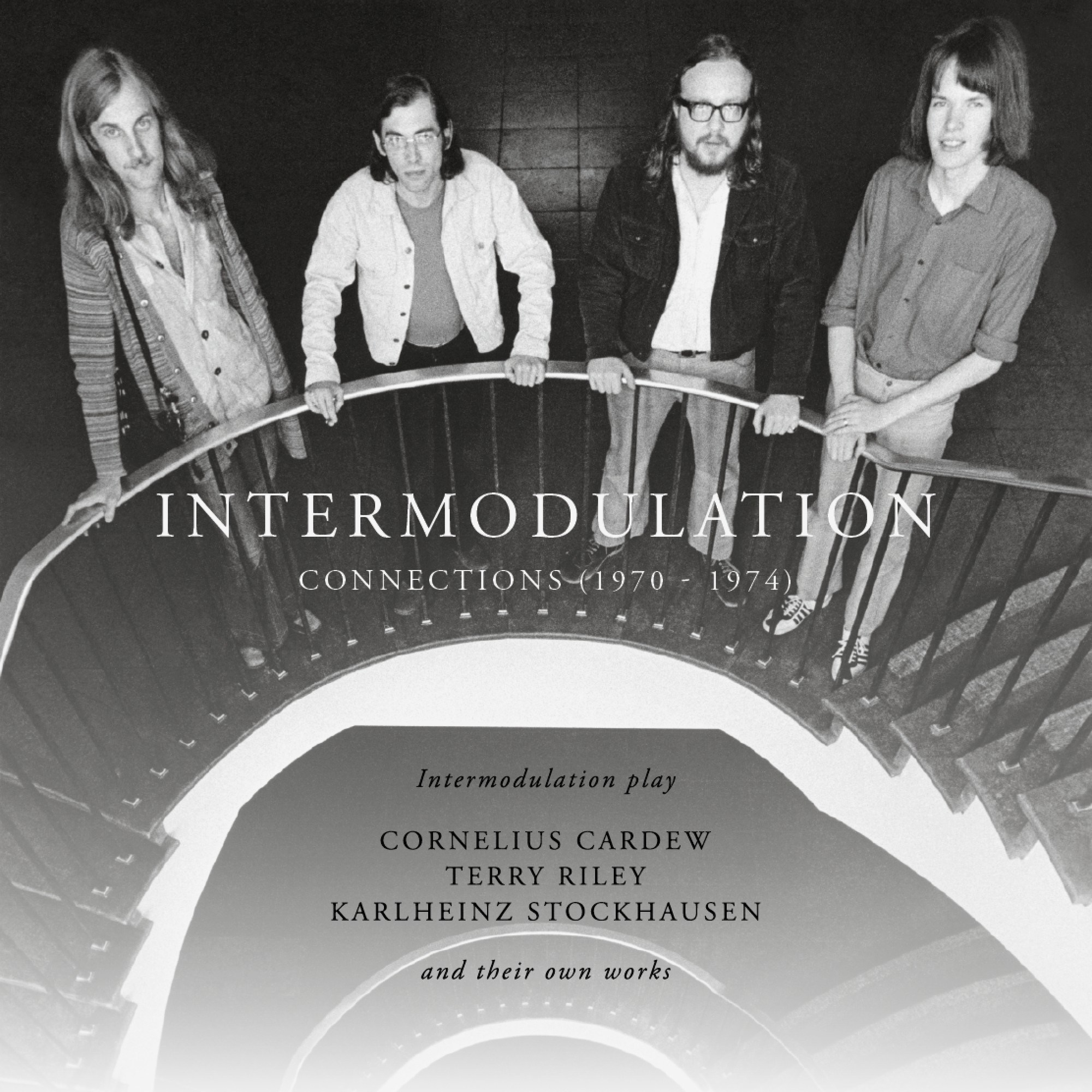
Rounding out the year with one of their most ambitious releases to date, Paradigm Discs returns with “Connections (1970 - 1974)”, the first ever dedicated survey - sprawling across an incredible X4 CDs - offered to the seminal British electroacoustic collective Intermodulation. Offering a broad range of their formerly impossible to hear activities, including stunning renderings of works by Terry Riley, Cornelius Cardew, and Karlheinz Stockhausen, in addition to their own, it’s overflowing with truly engrossing, revelatory sounds, cracking the window onto a lost moment in time.
Founded during the mid 1990s, over the decades the London based imprint, Paradigm Discs, has displayed a deep dedication to the under celebrated shadows of experimental and avant-garde music, issuing a slow, carefully constructed trickle of archival releases and reissues by Hugh Davies, Pauline Oliveros, Daphne Oram, Max Eastley, Trevor Wishart, Gentle Fire, and a great many more. It was only a moment ago that we celebrated their release of Anthony Moore’s astounding “Mare's Tail”, and now they’re back with another absolute stunner and what is likely to be their most ambitious release of 2024: “Connections (1970 - 1974)”, a towering 4CD box dedicated to the seminal, but sinfully under celebrated British collective Intermodulation.
Formed in 1969 in Cambridge by Tim Souster and Roger Smalley, Intermodulation was a hugely important project within the 1960s and 70s British context of experimental music, which has, most probably due to a lack of available recordings, become increasingly obscure since its dissolution in 1976. Initially a four piece collective comprising of Souster, Robin Thompson, Andrew Powell, and Smalley, before the latter departed to join an early formation of Henry Cow and was replaced by Peter Britton - becoming its enduring line up - between 1969 and 1976, the group performed and toured extensively in the UK and Europe, realising works by composers like Stockhausen, Cardew, Riley, Rzewski, Wolff and others, as well as pieces written for the group by its members. Drawing inspiration from encounters with everything from Soft Machine, AMM, Sonic Arts Union, and numerous other radical groups of the period, in the words of Souster: “Intermodulation was formed with the intention of developing techniques of integration and intercommunication in the field of live-electronics, in which instruments of a more or less conventional nature are extended and transformed by electronic means in a real-time concert situation”.
Paradigm Discs’ release of the sprawling X4 CD box, “Connections (1970 - 1974)” - the first release wholly dedicated to Intermodulation - takes huge leaps toward cultivating consciousness regarding the project’s important contribution to the context of British and experimental music during this period, placing them rightfully alongside Gentle Fire (who were similarly attended to by Paradigm Discs’ stellar “Explorations (1970 - 1973)” back in 2020), a group that covered similar ground to their own, appeared at the same European festivals, shared a similar repertoire, and appeared together on Stockhausen’s legendary “Sternklang”, issued by Deutsche Grammophon in 1976, as well as travelling together with the composer to Iran. Like Gentle Fire, Intermodulation belongs to a fascinating shift within electroacoustic music emerging during this period. While the lion’s share of the idiom had historically focused on processing and manipulation of acoustic sounds via electronic means, the project simultaneously combined both electronic and acoustic instruments within the same frameworks of composition, becoming among the first to use the VCS3 synthesisers, immediately following its development by Peter Zinovieff’s EMS, as well as using early Hugh Davies designed and built electronics.
Dedicated to real time interplaying and improvisation, and rooted in the percussion work of Peter Britton, Robin Thompson’s bassoon and soprano sax playing, and shared use of VCS3 synths and electric keyboards, etc, “Connections (1970 - 1974)” endeavours to offer the widest possible survey of Intermodulation’s activities during the four years that it covers. The first disc contains the entirety of their 1971 concert at Ely Cathedral (a 6 minute excerpt of which appeared on the 2CD ‘Not Necessarily English Music’ compiled by David Toop), including stellar renderings of Terry Riley’s “Dorian Mix”; the collective’s own composition, “Performants”, Cornelius Cardew’s “Material”, and Karlheinz Stockhausen’s “Aufwärts”. Ensconced in the natural reverberance of the Cathedral, the rendering of all four pieces is intoxicating, drawing the ear toward a clear awareness of the group’s sensitivity and range, traversing the minimalist droning harmonics of the first two, as effortlessly as the complex textures, structures, and dissonance of the following.
The second disc of “Connections (1970 - 1974)” focuses on Intermodulation’s BBC recordings, including excerpts from 2 Prom performances, one of which is the famous 1970 Prom which had Soft Machine taking the stage in the second half. Featuring a stunning version of Terry Riley’s Keyboard Study No.2, for organs, which is markedly different than the roughly concurrent version recorded by Germ and released by BYG as Actuel 27; fantastic renderings of Stockhausen’s “Expo for 3” and “Über die Grenze”, both of which are scarcely encountered pieces by the composer in recorded form, as well as Tim Souster’s “Zorna”, composed for the collective, which threads a fascinating needle between minimalism, drone, and free jazz.
From here, “Connections (1970 - 1974)” delves into material unearthed from the archives of 3 German radio stations (Souster moved to Cologne in 1971 to become Stockhausen’s teaching assistant, and then to Berlin in 1973), and features equally engrossing renderings of Stockhausen’s “Wellen” and “Abwärts” - imbued with a sense of intimacy and touch that is often absent from recordings of the composer’s works - as well as Roger Smalley’s brilliantly playful “Melody Study I” and the collective group composition “Freies Zusammenspiel”, a pulsing wonder that sprawls to more than 20 minutes in length, before moving onto Tim Souster’s “World Music” - commissioned by West German Radio, Cologne, where he made the tape part - a 72 minute opus written for the four players plus tape, that takes up the entirety of the final disc. An astounding work that covers a startling amount of ground over its duration - from passages of atmospheric ambience, to tense timbral improvisation and flirtations with free jazz and prog - it’s a fitting conclusion into the vastitude of range and accomplishment that Intermodulation was over its short run.
Originally published by Soundohm.