“Sonanze” is a monumental work of minimalism that flips the form of the sonata on its head within the sprawling realms of kosmische.”
Over the last decade, Superior Viaduct has become synonymous with making the improbable and impossible real. One after another, spanning nearly every idiom of ambitious music, they’ve reissued some of the greatest holy grails in the history of sound. Now they’re back with two more, this time returning to their deep dedication to Italian Minimalism, with beautifully produced vinyl reissues of two of the movement’s most important artefacts: the seminal composer Roberto Cacciapaglia’s 1975 debut, "Sonanze" and 1979’s “Sei Note In Logica”, arguably one of the most singular and important records ever laid to tape.
Historically sitting aside from other similar movements in Europe and the United States, Italian realisations of minimalist music are remarkably diverse, hybridic, and difficult to define - radically expanding the understanding of what the minimal can be. In recent years, after decades lingering in the shadows, a slow trickle of reissues has brought the work of the loose and often divergent constellation of remarkable and singular artists who made up this movement - Luciano Cilio, Giusto Pio, Futuro Antico, Lino Capra Vaccina, Arturo Stalteri, Riccardo Sinigaglia, Walter Maioli, Tiziano Popoli, Roberto Musci, Giovanni Venosta, Pier Luigi Andreoni, Francesco Paladino, and a great deal more - into the centre of the global consciousness for the first time, and reached wide acclaim among a growing number of fans. Within this broad initiative, Superior Viaduct - an imprint we can’t sing enough praises for - has played a crucial role, reissuing some of the best of the best that Italian Minimalism had to offer, notably in the cases of Raul Lovisoni / Francesco Messina, Prima Materia, and Franco Battiato. While markedly different in temperament and approach, each entirely rethink the terms of what both Minimalism and experimental music might be.
An early and regular collaborator of Franco Battiato’s, the Italian composer and pianist, Roberto Cacciapaglia, was trained under Bruno Bettinelli at the Giuseppe Verdi Conservatory of Milan, as well as applying a special focus to electronic music, followed by work at RAI’s Studio of Musical Phonology, and collaborations with the National Research Council (CNR) of Pisa, studying computer music. Slightly distinct within his generation of Italian minimalists who largely began within the field of popular music and slowly moved toward increasingly experimental forms, Cacciapaglia began in the classical tradition and steadily moved toward more electronic and experimental forms that flirted with the forefront of popular music of the 1970s.
This was certainly the case with “Sonanze”, issued in 1975 by the Italian arm of the German imprint Die Kosmischen Kuriere - the successor to the legendary kosmische label, Ohr, run by Rolf-Ulrich Kaiser - and gained a certain amount of note as the first quadraphonic LP ever released in Italy. Recorded in Milan between 1972 and 1974, before being mixed in Cologne, the album’s production brought Cacciapaglia into contact with groups like Popol Vuh and Tangerine Dream, which offers some form of insight into its general aesthetic proximity. “Sonanze” is a monumental work of minimalism that flips the form of the sonata on its head within the sprawling realms of kosmische.
Comprising ten free flowing movements across its two sides, played by an all-star cast of instrumentalists, while the suite begins with nods to 20th century orchestral avant-gardism, Cacciapaglia quickly pushes into uncharted ground by intertwining rippling piano lines, the sounds of harpsichord, vocals, strings, brass and analog synths into a series of distinct, but interconnected works at the borders of ambient music and kosmische. Ranging from expansive and dreamlike, to the tonally tense and complex, in effect the totality of “Sonanze” encounters Cacciapaglia achieving a new form of classicism within the popular realm that his German peers like Popol Vuh and Tangerine Dream were attempting to achieve during roughly the same moment, but never fully accomplished with this degree of sophistication and depth, with each movement exploring the possibilities of hypnotic rhythms, intuitive arrangement, musique concrète, and pure psychedelic awakenings.
As the composer writes in the original sleeve notes, "I am aware, unfortunately, that I am a few millennia late in how I would like music to be understood, which today I find diluted in its primary powers, in an era that is destructive of essential values. Precisely for this reason, I want to search for it in depth and not on the surface, perhaps alternating the knob of a synthesizer with a marranzano (mouth harp)."
Absolutely amazing and profoundly ambitious on every count, this much needed vinyl reissue of Roberto Cacciapaglia’s debut LP, “Sonanze” - a rare bridge between the German movement of kosmische and Italian Minimalism - brings this seminal gesture out from beneath the shadow of its more widely celebrated follow up - “Sei Note In Logica” - allowing it to be fully appreciated in all its glory.
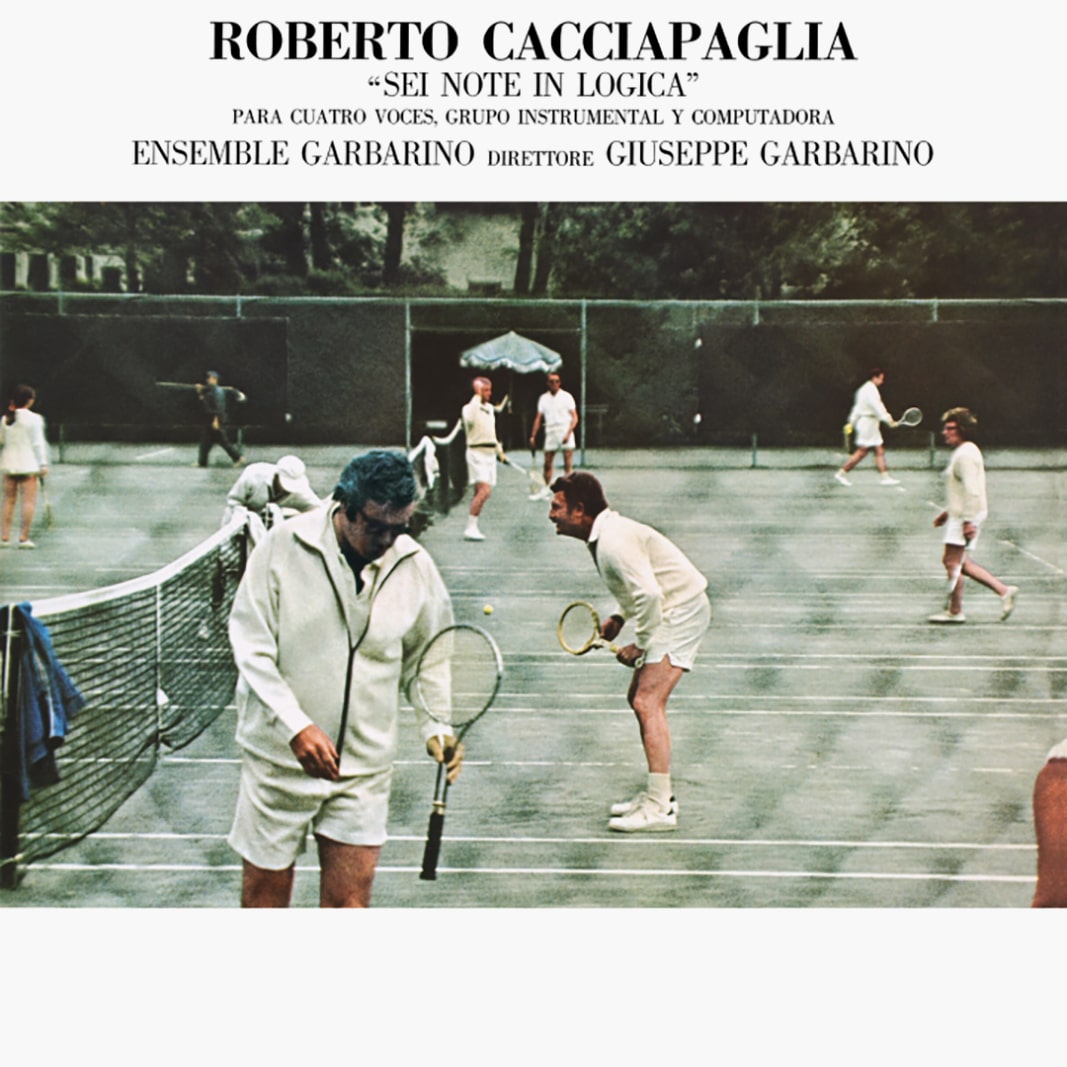
Originally released in 1979 by Philips, Roberto Cacciapaglia’s second full-length, “Sei Note In Logica”, is regarded by many as one of the most distinct, stand-out, and important gestures in the entire canon of Italian Minimalism. For fans of the movement discovering it outside of Italy decades later, it offered an entry point following Jim O’Rourke singing its praises and drawing attention to it for a new generation of American and European fans.
While approached with the same level of rigour and ambition as its predecessor, 1975’s “Sonanze”, “Sei Note In Logica” (Six Notes In Logic), couldn’t be more different in its aesthetic and approach. In fact, it’s hard to think of any other record in the history of recorded music that sounds anything like it. Begun as an inspired study in Minimalism and concluded as a single, endlessly evolving work of towering proportions, “Sei Note In Logica” is based on a finite set of musical notes fed into a sprawling series of possible combinations and timbral possibilities, rendered by synthesiser, marimbas, strings, reeds, and human voice.
A further example of Cacciapaglia’s distinction from his peers within the generation of Italian minimalists to which he belonged, “Sei Note In Logica” also stands apart from the pack of Italian Minimalism in its relatively close proximity to the work of the movement’s American peers, most notably Steve Reich, Terry Riley, and Philip Glass (to varying degrees). The piece is a joyous experiment of constant variation, where non-repeating patterns are exquisitely layered within a field of electro-acoustic signals, textures, and pulsing tones.
Profoundly beautiful, completely hypnotic, and utterly captivating on creative terms, “Sei Note In Logica” works from a brilliant conceptual framework, deeply resonant with more prominent works of minimalism like Steve Reich's “Music For 18 Musicians”, but somehow manages to subtly throw the sense of balance off kilter, becoming less predictable and more challenging, and subsequently, and at least arguably, even more captivating and engaging.
Unquestionably one of the most important, ambitious, and accomplished works in the entire canon of Italian Minimalism (not to mention Minimalism at large) Roberto Cacciapaglia’s second full-length, “Sei Note In Logica”, is nothing short of a masterpiece of the highest order. Records, quite simply, don’t get better than this!
Originally published by Soundohm.