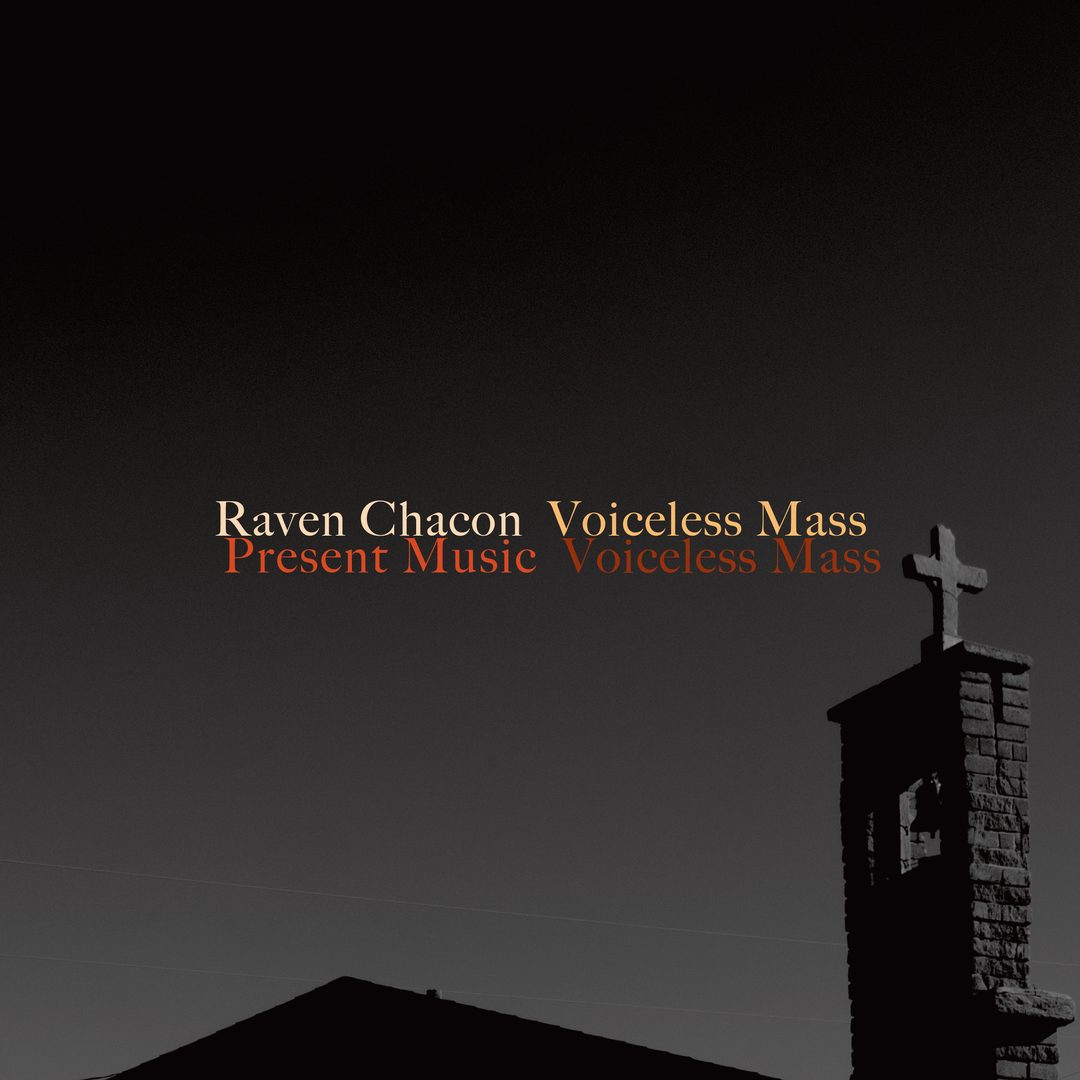
“Deeply introspective, Chacon’s work rests at the root meaning and intention of experimental practice.”
The venerable New World Records returns with what is easily among the most important and creatively striking records we’re likely to encounter this year: the long-overdue and much needed release of Raven Chacon’s “Voiceless Mass”, comprising the first ever release of the work for which he was awarded the Pulitzer Prize, alongside two other, previously unreleased, important works by the composer, “Biyán” and “Owl Song”. Rigorous and profound, weaving startling hybrids from chamber music, noise, and Native American history and culture, whether viewed as individual pieces or for their totality, this brilliant body of work offers further proof of Chacon’s truly singular contribution to the contemporary landscape of radical sound.
Despite having been active and prolific in the contexts of underground and experimental music for decades, it’s only in the last few years that the New Mexico based performer, improvisor, composer, and sound artist, Raven Chacon, has been offered the level of respect and attention he’s always deserved. Not only has he won the prestigious Pulitzer Prize for music and been named a MacArthur Fellow, but his vastly diverse body of work has been included in the Whitney Biennial, documenta, the Sydney Biennale, and numerous other museums and arts institutions, all received with resounding praise. Remarkably, despite all the accolades and attention that Chacon has received, his recent discography remains relatively small, especially considering his firm rooting within the realms of sound.
Raised in Fort Defiance, Navajo Nation, Arizona, and a student of James Tenney, Morton Subotnick, Michael Pisaro and Wadada Leo Smith at CalArts, for more than 20 years Raven Chacon has bridged the creative realms of chamber music, noise, site specific installation, and performance, building a body of singular solo efforts, as well as critically heralded collaborative works within the collective Postcommodity.
Deeply introspective, Chacon’s work rests at the root meaning and intention of experimental practice. In his hands, sound is a raw, searching, and democratic material, with a near infinite number of possibilities and sources - sometimes found and encountered, others self-generated - reformed into an image that refracts the notion of humanity and being outside of itself. Like many artists of his generation and context, Chacon’s roots lay within underground cultures of music, notably metal and noise, but as his career has progressed he has slowly begun to incorporate deeply conceptual elements that take form through scores - noted, text based, and graphic elements - ‘Voiceless Mass’, the work for which he received the Pulitzer, being one such case.
Composed for pipe organ and large ensemble, ‘Voiceless Mass’ was commissioned by WI Conference of the United Church of Christ, Plymouth Church UCC, and the Milwaukee based Present Music, one of the United State’s leading ensembles specializing in new music. Created specifically for the Nichols & Simpson organ at The Cathedral of St. John the Evangelist in Milwaukee, Wisconsin, the commission and its context opened up the opportunity for Chacon to address the Catholic Church’s historical atrocities committed against Indigenous peoples; particularly the residential schools, forced assimilation, and abuse of Indigenous youth, stating: “This work considers the spaces in which we gather, the history of access of these spaces, and the land upon which these buildings sit.”
A brooding, slow paced work of tense tonal arrangements, ‘Voiceless Mass’ belongs to a pointedly contemporary, 21st Century manifestation of the tradition established by composers like Krzysztof Penderecki and Frederic Rzewski, who famously defied the orthodoxies of the 20th century musical avant-garde by focussing on social and political themes, while also tapping a deep sense of emotiveness within their work. Yet, while the evocative nature of both the sonorities and themes of the work operate on a profound level on their own, Chacon takes the conceptual possibilities and framework of ‘Voiceless Mass’ even further with the use of linguistic play and musical elements, or absence thereof, embedded within the work itself, alluding to a choral form through the work’s title, while utilising no vocal parts and no audible singing, explaining: “In exploiting the architecture of the cathedral ‘Voiceless Mass’ considers the futility of giving voice to the voiceless, when ceding space is never an option for those in power.”
Sitting alongside ‘Voiceless Mass’, offering counterpoint, are two other brilliant works by Chacon. The first, ‘Biyán’, drawing its title from the Navajo word for “song”, was composed in 2011 for flute, clarinet, violin, cello, and percussion, and operates as a deeply personal reflection on the part of the composer upon the function of singing in Navajo ceremonies, where repetition can continue throughout the night. The work’s three movements, played without pause, are organized in a block structure of repeating patterns, allowing listeners time to dwell in the mesmerizing soundscape and focus on the constantly changing micro-acoustic details. A startlingly tense work, utilising a strong presence of both timbral and tonal elements, it stands among Chacon’s most noteworthy works of chamber music, drawing upon his long history within underground contexts of noise, as well as Navajo tradition, weaving a deeply moving cultural hybrid that bridges these often seemingly divergent worlds.
New World’s edition of ‘Voiceless Mass’ then concludes with a more recent work, ‘Owl Song’, composed in 2021 for sinfonietta and voice. Chacon explains, the piece “is an acknowledgment of the nocturnal hunting bird, considered by some to have the ability of shapeshifting. ‘Owl Song’ asks its instrumentalists to cycle through a variety of timbres on their instruments, often with individual speeds to traverse the composition. They are sometimes guided by a voice, her distance unmeasurable from themselves, and must call out not to locate her position, but to see if she is still with them.” Arguably the most tangibly hybridic of the three works across the full length, with audible echoes of both Native American and European derived traditions of music working in states of harmony and disharmony, it remains one of those rare works that leaves us with the rare impression of needing years to fully unravel the mysteries and truths within.
Originally published by Soundohm.