“Given the power and presence of her delivery, it’s hard to conceive of the eighteen songs that make up the LP as being “shaky”.”
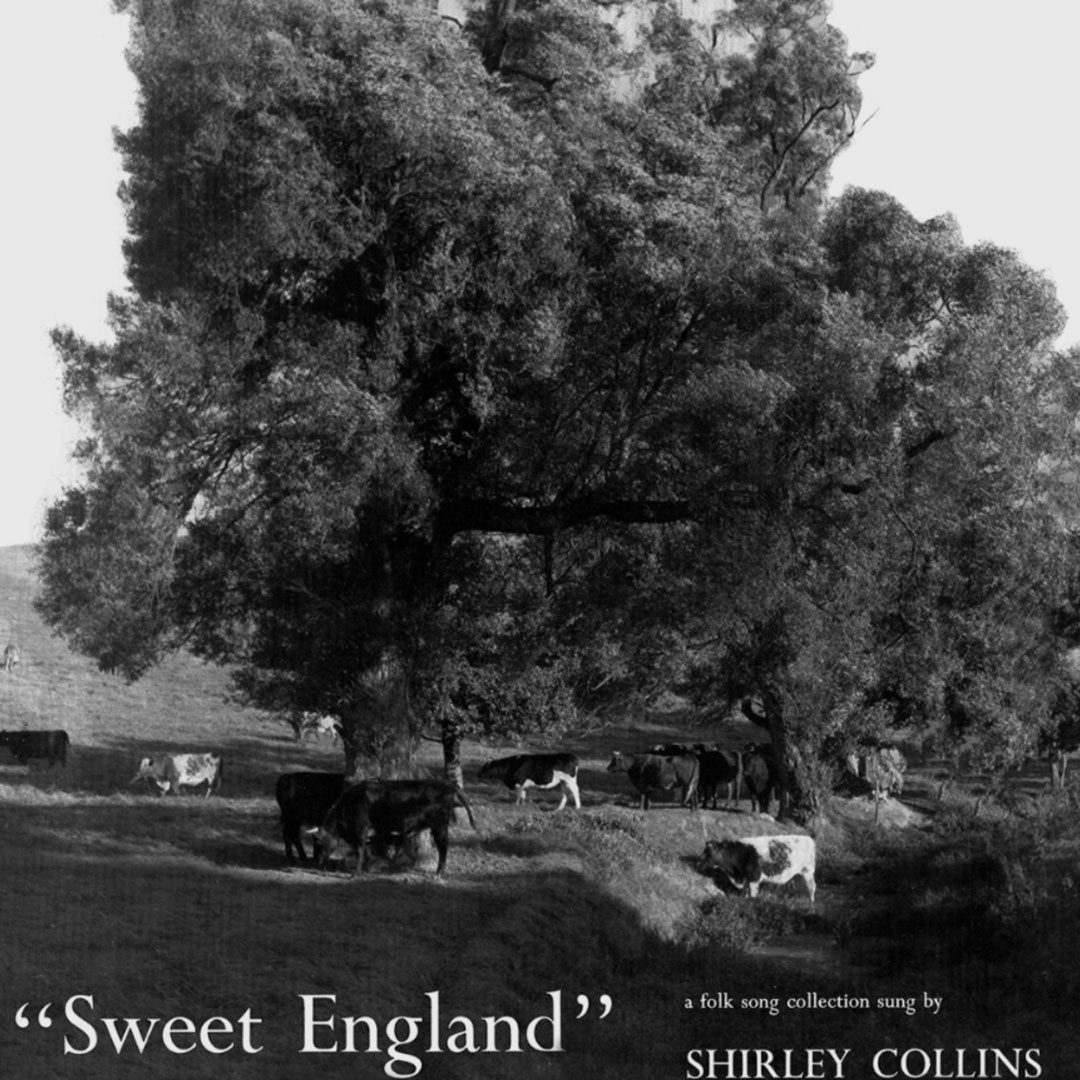
Building on their incredible, recent momentum, Moved By Sound returns with a much needed and long overdue vinyl reissue of Shirley Collins’ groundbreaking, 1959 debut ‘Sweet England’. One of the great landmarks of the 1950’s folk revival by one of its most important and beloved figures - imbued with subtle politics of the left that remain strikingly potent today - timed to celebrate Collins’ 90th year, it's hard to think of a more beautiful or compelling full-length ever laid to tape.
Over the last few years, the imprint, Moved By Sound, has emerged from the mists of the English countryside and delivered some of the most noteworthy, unexpected, and beautifully produced reissues to have appeared during that period. First came one of the great holy-grails of 1970 private press free jazz, Jeanne Lee’s ‘Conspiracy’. Then there was Sirone’s ‘Artistry’ and Malik's Emerging Force Art Trio’s ‘Time & Condition’, both of which blew our mind, followed by Plastic People Of The Universe’s ‘Egon Bondy's Happy Hearts Club Band’ and Reet Hendrikson ‘Reet’, each radically expanding our perceptions of the label’s modus operandi. Then, last year, they dropped the first ever reissue of Children Of The Sun’s incredible, lone LP, ‘Ofamfa’, from 1971, only to raise their game again a few months ago with first ever vinyl pressing of the guitarist Michael Gregory Jackson’s ‘Frequency Equilibrium Koan’.
Emerging during the years following the Second World War in both England and the United States, the 1950’s folk revival, despite how it might seem from the distances of today, was one of the most radical creative movements of the 20th century. Deeply entrenched in left-wing politics and ideas connected to thinkers like William Morris and Cecil Sharp, who, in different ways, challenged notions of industrialisation and progress connected to capitalism, members of this generation pointed toward the possibility of an older, more egalitarian, and collective place of the arts in daily life. Among them, Shirley Collins was among the most important and compelling voices, not only laying crucial groundwork and inspiration for other members of her generation, but equally for a second wave of artists who emerged during the 1960s and 70s, including the members of bands like The Incredible String Band, Fairport Convention, Pentangle, Comus, The Albion Band, Trees, and countless others.
Born in 1935 and raised within an environment deeply connected to the traditions of English folk music - learning many of its songs during her youth - following her move to London toward the end of her teens, Collins quickly fell into the circle of radical folk musicians that orbited around Ewan MacColl, recording her debut appearance for the 1955 compilation ‘Folk Song Today’. It was through Maccoll that she met the American ethnomusicologist, Alan Lomax, with whom she traveled across the American South assisting in every manner of 1959’s “Southern Journey”: regarded as one of the most important bodies of ethnomusicological recording ever produced. It was also Lomax, alongside Peter Kennedy, who recorded, the previous year under humble circumstances, Collins’ seminal debut, ‘Sweet England’, issued by Argo in 1959.
When navigating the recorded output of Collins, it’s hard to pick favorites or point to any one as being more important than the next. Such is the scale of her impact and the endurance of her artistry. There is ‘False True Lovers’ - the companion of ‘Sweet England’ that, via its release on Folkways, introduced her to American audiences. There is ‘Folk Roots, New Routes’, her monumental collaboration with Davy Graham, and 1968’s ‘The Power Of The True Love Knot’, which firmly entrenched her within the consciousness of musical counterculture of that era. And then, there are all of the truly astounding albums that she made with her sister Dolly. None of this even begins to scratch the surface. But, when speaking of power, singularity, and influence, it certainly is impossible to ignore ‘Sweet England’, her groundbreaking debut.
Comprising “A Collection Of Love Songs And Ballads From Southern England”, ‘Sweet England’, was largely recorded by Collins accompanying herself on banjo, with light, occasional instrumental accompaniments by a handful of other musicians. While incredibly noteworthy as one of the first notable transmissions of the English Folk tradition, via interpretation, on a large cultural scale - bringing them to the ears of a new generation of young listeners, many of the songs included on the LP lay at the root of numerous American folk idioms, having been brought there by British migrants during the country’s early years. As such, much like her close social relationships to key members of the parallel American folk revival of this period, both ‘Sweet England’, alongside its companion, ‘False True Lovers’, construct an important aural bridge between these two historic, as well as newly emerging, traditions.
In Collins’ own words: “English traditional music, at its best, expresses and provides everything in song that I need and feel, both musically and emotionally. ‘Sweet England’ represents the first shaky steps of a journey that I have been on all my life, and that, happily, I still am." Given the power and presence of her delivery, it’s hard to conceive of the eighteen songs that make up the LP as being “shaky”. In her hands, the ages open up and time bends, bringing the experiences of other times and people into that present as well as our own, offering a potent proof that human experience is nearly always shared and relatable: however distant their creators may be to us now, their words and emotions remain relevant and provoke the same empathy and connection that they always have.
While this could be said to be true of all forms of folk and traditional music, across the length of ‘Sweet England’ it is the perfect harmony between the beauty of the songs themselves and Collins’ voice, that elevates them to the most compelling of heights. There is good reason why many regarded her as the most beautiful and accomplished singer that England has ever produced. Her voice compels, captures the deepest of essences, and wrenches the heart as she moves through these songs: narratives of love, loss, and daily life, proving at each step that what once was remains, and that however distant and perceptively distant we may seem, we as human beings share the most fundamental and deepest of things.
Unquestionably among the most important artefacts of the 1950s folk revival - imbued with subtle politics of the left that remain a potent encouragement toward the creation of a better world - ‘Sweet England’ is as timeless as the songs that it contains.
Originally published by Soundohm.