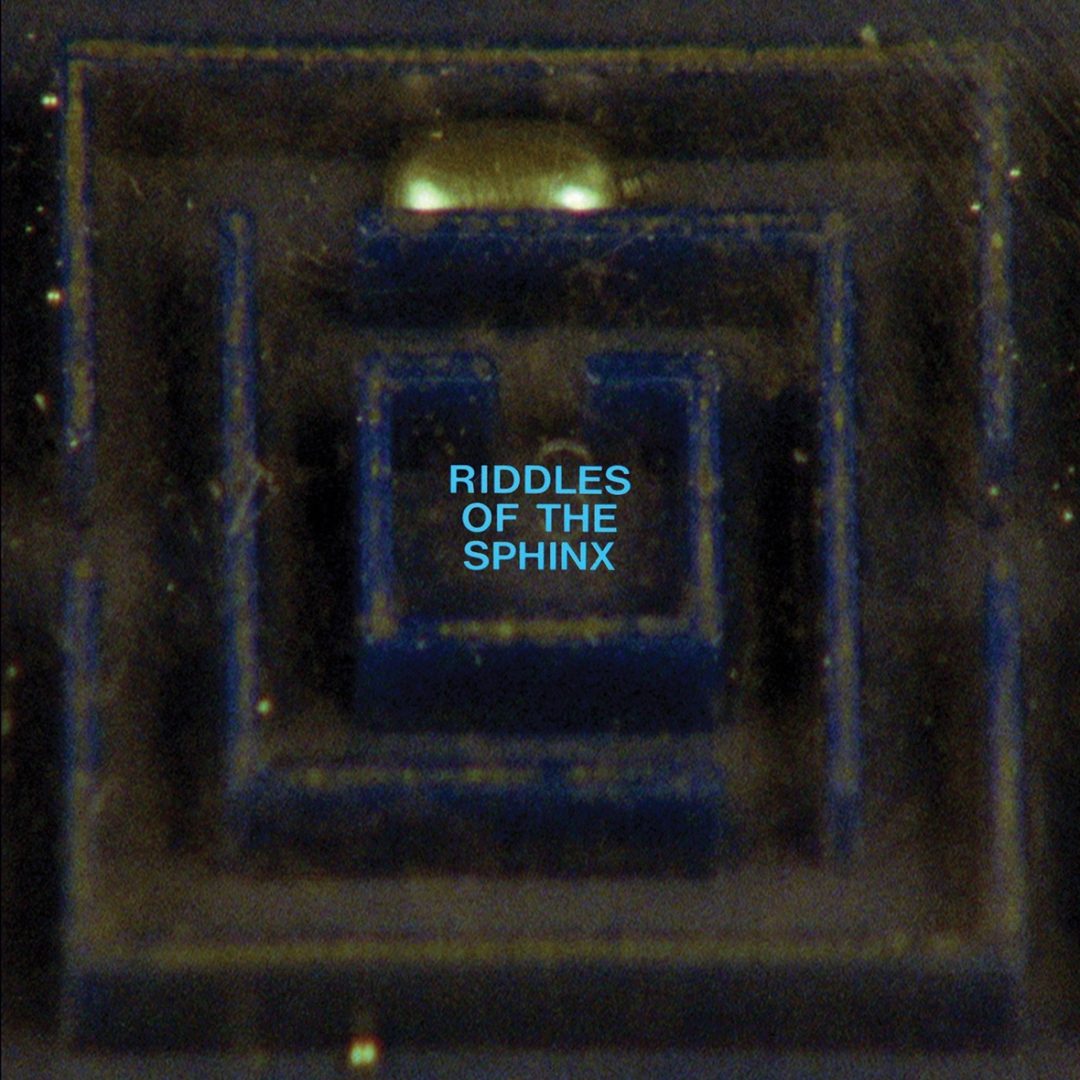
“Immersive and astounding, nearly half a century on 'Riddles of Sphinx' remains a mind-bending sonic odyssey and a crucial proof of film's important place as a vehicle for the 1970s sonic avant-garde.”
From the ashes of time comes a much needed, brand-new, highly limited vinyl pressing of Soft Machine founding member Mike Ratledge's astounding 1977 soundtrack for the avant-garde feminist film 'Riddles of Sphinx'. Harnessing an array of synths and sequencers, this experimental marvel unfurls as a stunning hybrid of hypnotic minimalism, ambient music, and radical synthesis, culminating as a free-standing marvel and lost treasure that remained unissued for decades, and remains Ratledge's only release as a solo artist. Immersive and astounding, nearly half a century on 'Riddles of Sphinx' remains a mind-bending sonic odyssey and a crucial proof of film's important place as a vehicle for the 1970s sonic avant-garde.
The 1960s and 70s represent a rare moment in history during which popular music embraced and internalized the tactics and sounds of the avant-garde. Initially percolating as early as the 1950s within the context of jazz, by the dawn of the psychedelic era at the end of the 1960s, free improvisation, tape music, and radical approaches to synthesis had fully taken seed across the global radio waves. While the trojan horse of pop provided a wildly unexpected vehicle for experimentation during this period, it was arguably within the context of film that the sonic avant-garde was able to have its greatest effect on the mass media scale. For decades the medium had already provided a platform for more radical approaches to composition. When made for visual accompaniment, it turns out, audiences seem far more willing to embrace ambitious and unfamiliar expressions of sound. Consequently, the 1960s and 70s represent a gold mine of experimental soundtracks.
One of the most important figures to emerge from the legendary English Canterbury scene, in 1966 Mike Ratledge joined his friends Robert Wyatt, Kevin Ayers, Daevid Allen and Larry Nowlin to form Soft Machine. Among the most singular and ambitious musical projects of the era, the band continuously broke ground by drawing on each member’s virtuosic skill as instrumentalists, a deep love for jazz and improvisation, and a fully realized embracing of countercultural ideas. Noted for their long, free form performances, the original line-up of Soft Machine only lasted a handful of months, with members slowly dropping off and being replaced over the band’s first five years. By 1970, only Ratledge and Wyatt remained of the original five, and with Wyatt’s departure the following year, Ratledge became the only original member active within the group, forging forward behind the keyboards, pursuing the outer reaches of an entirely instrumental vision of progressive rock.
While Ratledge did occasionally pursue other activities outside of Soft Machine during the early 1970s, including a live performance of Mike Oldfield's Tubular Bells for the BBC, by 1976 greener pastures beckoned and he too left the band to pursue a solo career. While it remained unreleased as a stand-alone LP until roughly a decade ago, the great artifact of Ratledge’s early solo career is his soundtrack for the 1977 British experimental film, ‘Riddles of the Sphinx’, written and directed by Laura Mulvey and Peter Wollen, and described by the BFI as “one of the most important avant-garde films to have emerged from Britain during the 1970s", and a classic of feminist avant-garde cinema.
When embarking upon the recording of ‘Riddles of the Sphinx’, Ratledge went all in; building a brand new studio, as well as a prototype synthesizer, with his friend Denys Irving (most well-known for his work in Lucifer), to work in conjunction with an array of synths - Moog, ARP and VCS-AKS - also used in its creation. The film consists of seven parts, for which Ratledge composed ten “Sequences”, each ranging between roughly two and ten minutes in duration. Beginning with passages of drones that slowly emerge and drift like dunes, cycling, repetitive arpeggiations are introduced to form the guiding motion of the first three “Sequences”, each threaded by rambling, warped keyboard lines. From the outset and throughout, Ratledge’s deep affinity for the avant-garde is difficult to ignore, displaying a deep resonance with Terry Riley’s work from roughly the same era (and prior), as he deploys his sequencer and synths in similar ways to Riley’s organ and tape loops.
As the soundtrack progresses, Ratledge steadily moves toward less predictable territories, interspersing the rising and falling tones with poetic lines, delivered by a female narrator (Laura Mulvey) taken from the film, to an incredibly compelling effect. While incredibly cohesive as a single work, notably the playfully bouncing pulsations of ‘Sequence 4’ and ‘Sequence 9’ - foreshadowing 8-bit video game soundtracks of the 1980s - the rich textures of ‘Sequence 5’, which present as an overdriven form of ambient music, threaded by dense environmental sounds, and “Sequence 10” which nods toward similar drifting realms to those explored by Popol Vuh and Tangerine Dream, all contribute to an incredibly varied sense of sonic creativity and ambition that remain deeply potent nearly half a century since they were laid to tape.
It seems that Ratledge’s ambitions for a post Soft Machine solo career never fully took off. The majority of his efforts over the ensuing decades were largely behind the scenes, working as a composer and musical producer for commercials and the theatre, leaving his soundtrack ‘Riddles of the Sphinx’ as a rare artifact of his incredible talents as a solo artist. While it remained unreleased as a stand-alone LP until the mid-2010s, when Mordant excavated it from the BFI’s print of the film - the original tapes were long lost - even late in the game it reached great critical acclaim amongst fans.
Originally published by Soundohm.