“His debut LP, 1973’s stunning electronic marvel, ‘The Last Question’, dates from both this period and context.”
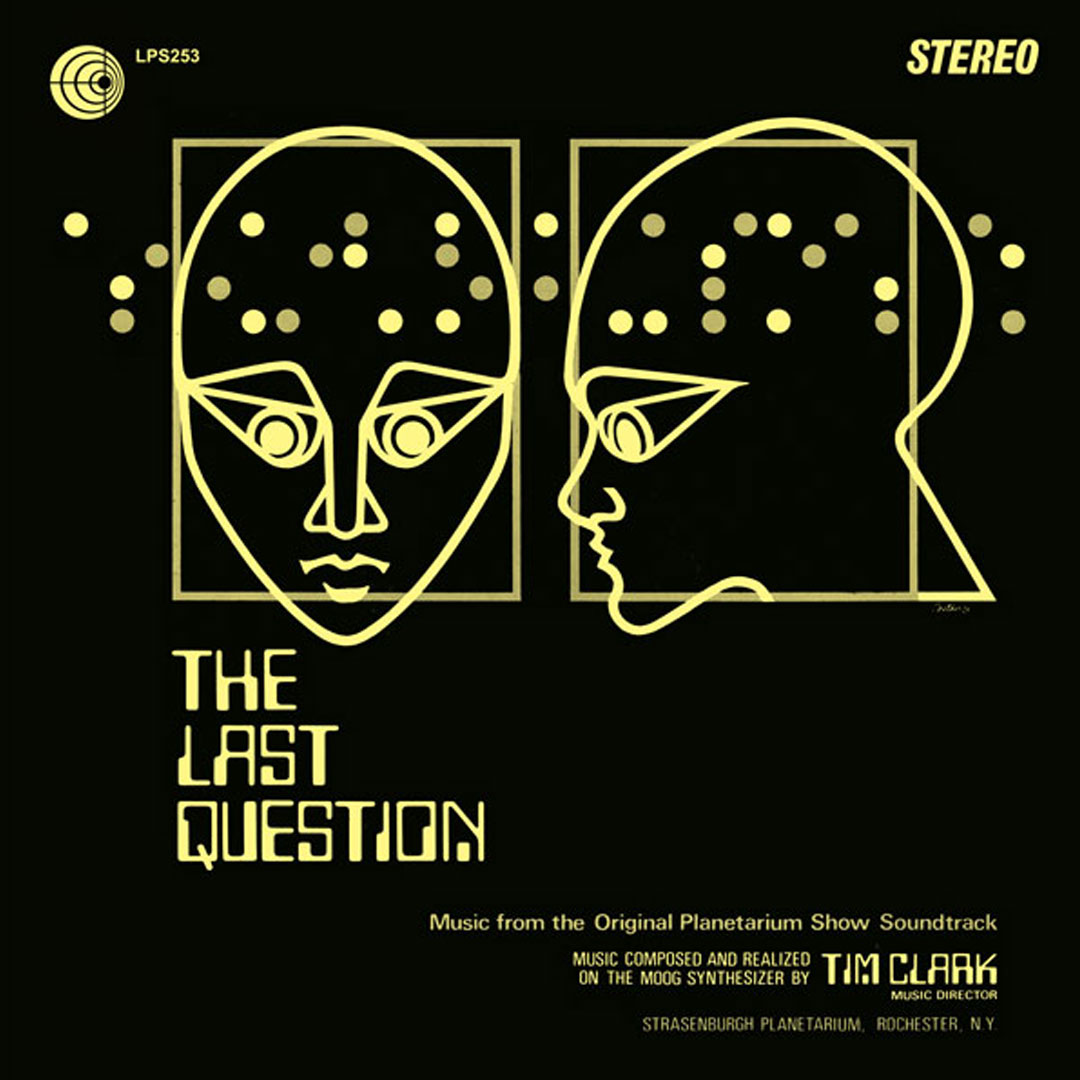
Like a shooting star from the shadows of history, Wah Wah returns with the first ever vinyl reissue of Tim Clark's astounding electronic marvel, 'The Last Question', originally privately released in 1973. Conceived as the soundtrack to a 1972 planetarium adaptation of Isaac Asimov’s short story of the same name, staged in upstate New York, recorded on three Ampex 440 tape machines, a Moog synthesizer, and a custom mixing board, it's a revelatory mind-altering bridge between abstract avant-gardism and ambient, new age electronics, that stitches connections between the inner consciousness and the outer cosmos through its remarkable structures, textures, and tones.
The true history of experimental electronic and electroacoustic music is a journey of unpredictable creative trajectories that often defy the narratives that we’ve largely come to accept surrounding these sounds. Originally conceived as a means to liberate “art music” from the iron grip of privilege and formal education, during its early years - due to the prohibitive cost of its technological tools - the majority of artists were forced to work within carefully gate-kept institutions that were capable of establishing purpose-built studios. This all changed between the mid-1960s and the early 1970s with the commercial introduction of more affordable tape machines and early, groundbreaking synthesizers like The Moog, the Buchla 100, the EMS Synthi, and the ARP 2500. It was these revolutionary developments that began to slowly place experimental electronic music into the hands of the people for which it was conceived, unleashing numerous generations of liberated composers capable of pushing toward wild new realms of sonority, subsequently leaving a treasure trove of recordings in their wake, ranging from major label releases to private press rarities. Among the most sought after within the latter canon is ‘The Last Question’, a stunning, private press marvel from 1973 by a little known composer named Tim Clark. Comprising completely engrossing Moog tones, pulses and structures, and guided by a hypnotic sense of abstraction, it was originally excavated into the 21st century underground consciousness by CD issues by both EM and Creel Pone, sending prices for its original pressing sky high.
Like many of his generation, Tim Clark began playing music at a young age, before developing a love affair with jazz during his teens. This passion led him to the Eastman School of Music in Rochester, New York, where he studied composition. More importantly, a year after his arrival, due to Robert Moog’s closer relationship with the school, an early Moog synthesizer was installed in the music department’s studio. Clark was immediately converted to the pursuit of electronic music. Following the completion of his studies, Clark was hired by the Strasenburgh Planetarium as composer in residence. For the next 15 years he would remain in the role, creating music for star shows. His debut LP, 1973’s stunning electronic marvel, ‘The Last Question’, dates from both this period and context.
Recorded using three Ampex 440 tape machines, a Moog synthesizer, and a custom mixing board, ‘The Last Question’ was composed by Clark as the soundtrack to a 1972 planetarium adaptation of Isaac Asimov’s short story of the same name, within a project conceived by Von Del Chamberlain - then-director of the Abrams Planetarium - and realized through a joint production between the Abrams and Strasenburgh planetariums. The resulting show quickly gained a reputation for its futuristic scope and sonic depth, leading to the private LP release of Clark’s music the following year.
Standing largely outside of tradition or genre, Clark’s ‘The Last Question’ is a fascinating bridge between the abstract sensibilities of explicit avant-gardism and the ambient, new age electronics that would begin to emerge over the coming decades, and which Clark himself would embrace, incorporating his studies of Indian Classical music, in subsequent releases. An immersive, slowly evolving sonic landscape of sprawling scope, built from percolating pulses, sweeping textures, cyclical rhythms, and rich drones, the entire piece evokes connections between the inner consciousness and the outer cosmos, culminating as a mind-altering journey that shifts between a tranquil sense of meditativeness and a creatively forward-thinking challenge to the ears: an exploration, through synthesis, of “the liminal spaces between waking and dreaming, self and universe.”
Originally published by Soundohm.