
“Bridging the avant-garde, underground counterculture, and cosmic spirituality, there’s nothing quite like it.”
Among the most forward-thinking and creatively captivating albums to have emerged from Germany during the 1970s, Esoteric Recordings drops two of the holiest of the holies, astoundingly produced, fully remastered vinyl editions of Popol Vuh’s career defining landmarks, ‘In Den Gärten Pharaos’ and ‘Hosianna Mantra’, originally issued in 1971 and 1972. Capturing the band’s movement from radical, electronic experimentalists to pioneers of acoustic ambient music, searching for higher meaning through sound, after remaining out of print on vinyl for years they return to offer their inner cosmic journeys to new and old generations of ears.
With the gift of hindsight, there’s little question that Germany, during the late 1960s and 70s, gifted the world one of the greatest bodies of revolutionary, 20th century sound. Broadly referred to as “krautrock” or “kosmische”, this movement was not a movement at all, but rather a creative zeitgeist, comprising a loose constellation of artists and bands - often working with little or no awareness of each other - that fused avant-garde approaches with elements of rock, prog, psychedelia, folk, jazz, electronic music, and any number of other touchstones, which culminated in remarkably unique forms of countercultural music. Since interest in krautrock and kosmische was reignited during the 1990s and early 2000s, much of the interest has swirled around more obscure projects, in addition to numerous reissue projects dedicated to seminal projects like Kraftwerk, Cluster, Can, Faust, Agitation Free, Amon Düül, Ash Ra Tempel, Neu!, Tangerine Dream, Guru Guru, Harmonia, and numerous others. Among the latter, more famed and enduring projects is unquestionably Popol Vuh, a band that continuously broke ground and set the pace for numerous subsequent movements over the course of its roughly three decade run. For years, Popol Vuh’s remarkable early catalog has lingered out of print on vinyl, often commanding eye watering prices on the secondary market. Now, thankfully, the longstanding British imprint, Esoteric Recordings, has turned their energies to remedying this sin, bringing out absolutely astounding, fully remastered vinyl editions - cut at Abbey Road Studios and replicating the original artwork - of the band’s towering, career defining landmarks, ‘In Den Gärten Pharaos’ and ‘Hosianna Mantra’, originally issued in 1971 and 1972, respectively. Drawing upon countless musical touchstones - from experimental music, folk, minimalism, and various traditions from across the globe - under the leadership of Florian Fricke, each laid the groundwork for ambient music, years before it emerged. Creatively brilliant and sonically engrossing - worlds entirely of their own - it’s impossible to understate how important these records are, or how overjoyed we are to have them resting in our hands.
Founded in 1969 by Florian Fricke - a conservatory trained pianist who, during his teens, became deeply engaged with the ideas and practices of the musical avant-garde - during its early years Popol Vuh was a pioneering project within experimental electronic music, with its sounds heavily guided by Fricke’s Moog synthesizer, alongside further electronic interventions by Frank Fiedler and the percussion of Holger Trülzsch. Deeply inspired by mystical ideas, Fricke’s own spiritual journey and his continuous quest for higher meaning through sound, even by the project’s second full-length, 1971’s ‘In Den Gärten Pharaos’, clear changes were afoot. The sounds of synthesizers were becoming subsumed within broader continuations of drifting acoustic sonorities and ambiences, sculpting a sense of immersive, meditative calm, before entirely committing to the entirely acoustic sound palette that would define the band’s trajectory until Fricke’s death in 2001, with 1972’s ‘Hosianna Mantra’.
Among the most singular and influential projects to emerge from Germany during the 1960s and 70s, Popol Vuh’s discography is overflowing with astounding masterpieces, from their 1969 debut, ‘Affenstunde’, to albums like 'Seligpreisung', 'Einsjäger & Siebenjäger', 'Die Nacht Der Seele', and 'Sei Still, Wisse Ich Bin', and 'Agape-Agape', not to mention their legendary soundtrack work with Werner Herzog - 'Aguirre', 'Herz Aus Glas', ‘Nosferatu’ - each departing into previously unknown territories of sonority, but among the greatest of them all are unquestionably ‘In Den Gärten Pharaos’ and ‘Hosianna Mantra’, the albums that laid the groundwork for everything that was to come for Popol Vuh and so many other artists that followed in their wake.
Originally released in 1971, ‘In Den Gärten Pharaos’ remains one of “the most successful fusions of experimental synthesizer work with ethnic percussion ever committed to vinyl”, and a “profound synthesis of technology and spirituality”, with Florian Fricke’s Moog guiding the way, one last time before his return to acoustic instrumentation. Comprising one long form piece on each of its two sides - ‘In Den Gärten Pharaos’ and ‘Vuh’ - the album is also arguably the most stripped down of the band’s output in terms of argument and personnel, primarily rooted in Fricke’s lines on Moog, organ, and Fender Rhodes, accompanied by Holger Trülzsch on percussion, with Frank Fiedler intervening with post-production. Perhaps most notably, what makes ‘In Den Gärten Pharaos’ so singular and unique - both within Popol Vuh’s output, and within the musical landscape of its moment - is its use of technology to pursue something elemental, ancient, and deeply human, rather than to indicate the possibility of advancement toward something yet to come.
Across the first side, the album’s title track unfolds as a tense meditation, with each of Fricke’s tones hanging in space and dancing in harmony with the next. Still markedly experimental, ranging from pastoral and dreamlike passages, to bristling and percolating textures and pulses, and even jazz infused electronic piano lines - all driven by Holger Trülzsch’s work on hand percussion - at each evolution and progression the piece feels like an immersive journey through the complexities of inner self: a sonic exploration, rooted in intuitive and organic process, where sequences emerge and dissolve, textures shift and transform, and rhythms appear and disappear.
While the title track of ‘In Den Gärten Pharaos’ is unquestionably radical in its structure and hybrid forms, the album’s second side, dedicated entirely to ‘Vuh’, is arguably even more strikingly groundbreaking for entirely different reasons. Across the piece’s roughly 20 minutes, Fricke unfurls a tense palette of complex configurations of long-tones, sculpting a singular expanse of deeply textural minimalist drone, swirling around the sounds of organ and choral heights. Beyond a brief moment of subdued pulses provided by Holger Trülzsch, almost the entire duration is a tonal immersion, roving in immersive waves, before the piece’s final few moments when Trülzsch returns with explosive cymbal work, providing astounding sheets of texture and rhythm that push ‘Vuh’ toward its truly groundbreaking and unprecedented total form.
Truly monumental on historical terms, and enduringly captivating as a creative gesture - still feeling radical and relevant more than a half century since its original release in 1971 - ‘In Den Gärten Pharaos’ is easily among the most important records to have appeared within the amorphous movement of “krautrock” or “kosmische”. Bridging the avant-garde, underground counterculture, and cosmic spirituality, there’s nothing quite like it. “This is electronic music as pathway to transcendence, as bridge between the temporal and the eternal.”
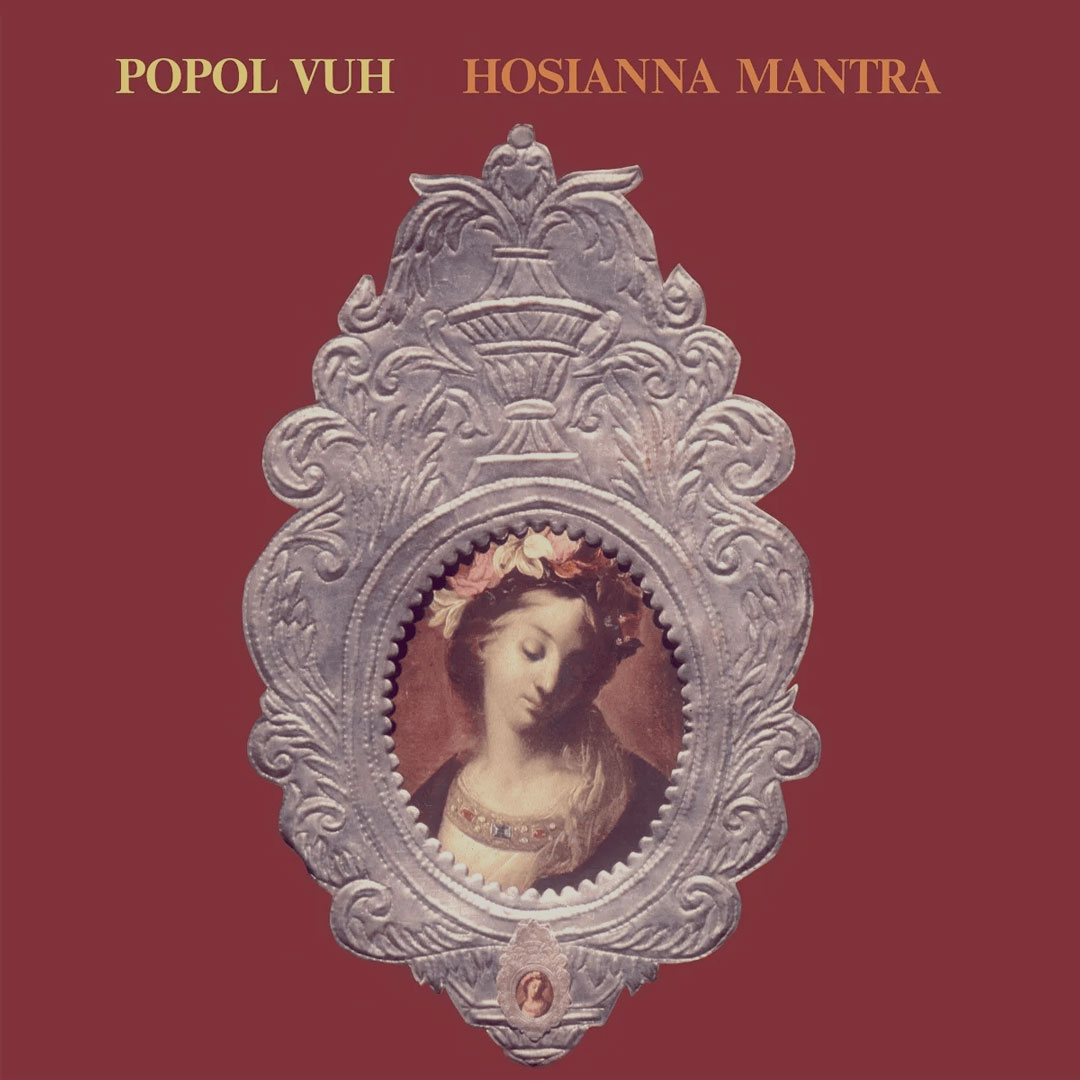
Popol Vuh’s 1972, ‘Hosianna Mantra’, is the full realization of the momentum that began across the length of ‘In Den Gärten Pharaos’, taken to its maximum, and the foundation for the evolving sound that would define the rest of the band’s decades long run. It is here that Fricke and his revolving collective of counterparts abandoned electronic instruments in favor of acoustic sonorities and fully departed into the exploration of "spiritual matters", inspired by both western and eastern religions, conveying a “mystical aura” through expansive ambiences and tones. Featuring Fricke on piano and harpsichord, Conny Veit on guitar, Klaus Wiese on tambura, Fritz Sonnleitner on violin, Robert Eliscu on oboe, and Djong Yun on vocals, not long after the album’s release, Veit - one of the band’s most enduring members - explained the spiritual component of the group's music: "I refrain from the classification 'church music', although I think it is entirely possible and appropriate that ‘Hosianna Mantra’ be used as music for church. I realized this record was actually about something else for me. With the means at my disposal, I wanted to grasp the original Christian being and feeling in order to convey the correctness of elementary truths in the Christian word. Not as a preacher, but as someone for whom archaic ways of life seem more valuable and right than our own contemporary culture." It is a fitting departure into an album that was and remains profoundly influential in its remarkable navigation of spirituality and its connection to sound.
Popol Vuh's third album has long been regarded as “one of the most inspiring and beautiful works to emerge from Germany's remarkable 1970s underground”. Comprising three piano led pieces on its first side - ‘Ah!’, ‘Kyrie’ and ‘Hosianna - Mantra’ - and a single long-form work - ‘Das 5. Buch Mose’ - of multiple movements on its second, the album is as groundbreaking, if not more so, than its predecessor. From the outset, there is a clear sense of the profound shift in Fricke's artistic vision, as rolling piano lines - delivered with virtuosic skill provided by his classical training - unfurl against punctuations of aching spaces and Conny Veit’s brilliant work on guitar. Sculpted with a remarkable amount of restraint and often feeling like a dialog of prayers - sound as a vehicle for genuine spiritual expression - and imbued with the “natural flow of breath”, with so many artists having built upon the album’s ground, hindsight makes it hard to recognize how radical and original these gestures were at the time in 1972. As the side begins to shift and evolve, Veit’s exploratory guitar and Fricke’s piano lines are met with stunning interventions by Klaus Wiese’s tambura drones, Fritz Sonnleitner’s melodic work on violin, Robert Eliscu’s oboe, and overwhelmingly beautiful vocals by Djong Yun, which pull at the strings of the soul.
Forming fascinating bridges between psychedelia, minimalism, and baroque music, laying unexpected groundwork for the emergence of acoustic ambient music and lesser acknowledged pathways of progressive rock, ‘Hosianna Mantra’s’ second side, comprising the five movements of ‘Das 5. Buch Mose’, unfolds like a fully released masterstroke of musical vision: a drifting sonic exploration that feels remarkably human and honest, interweaving Eastern and Western ideas in ways that feel respectful and devoid of fetish, and emerge as neither song or experimental composition, but rather a new form, liberated from the constraints of tradition, and thus entirely its own world.
As intoxicating and seductive as it is challenging, with all the decades now falling between ourselves and its original release in 1972, there’s still nothing quite like Popol Vuh's ‘Hosianna Mantra’. A truly visionary exploration of musical form, as well as sonority’s place in the pursuit of higher meaning, it defies understanding that this wonder has remained out of print on vinyl as long as it has. An artistic accomplishment of the highest order.
Originally published by Soundohm.