“There certainly was no precedent for an album like this prior to its release, and there’s really nothing like it since, beyond Reilly’s own explorations of the ground it initially laid.”
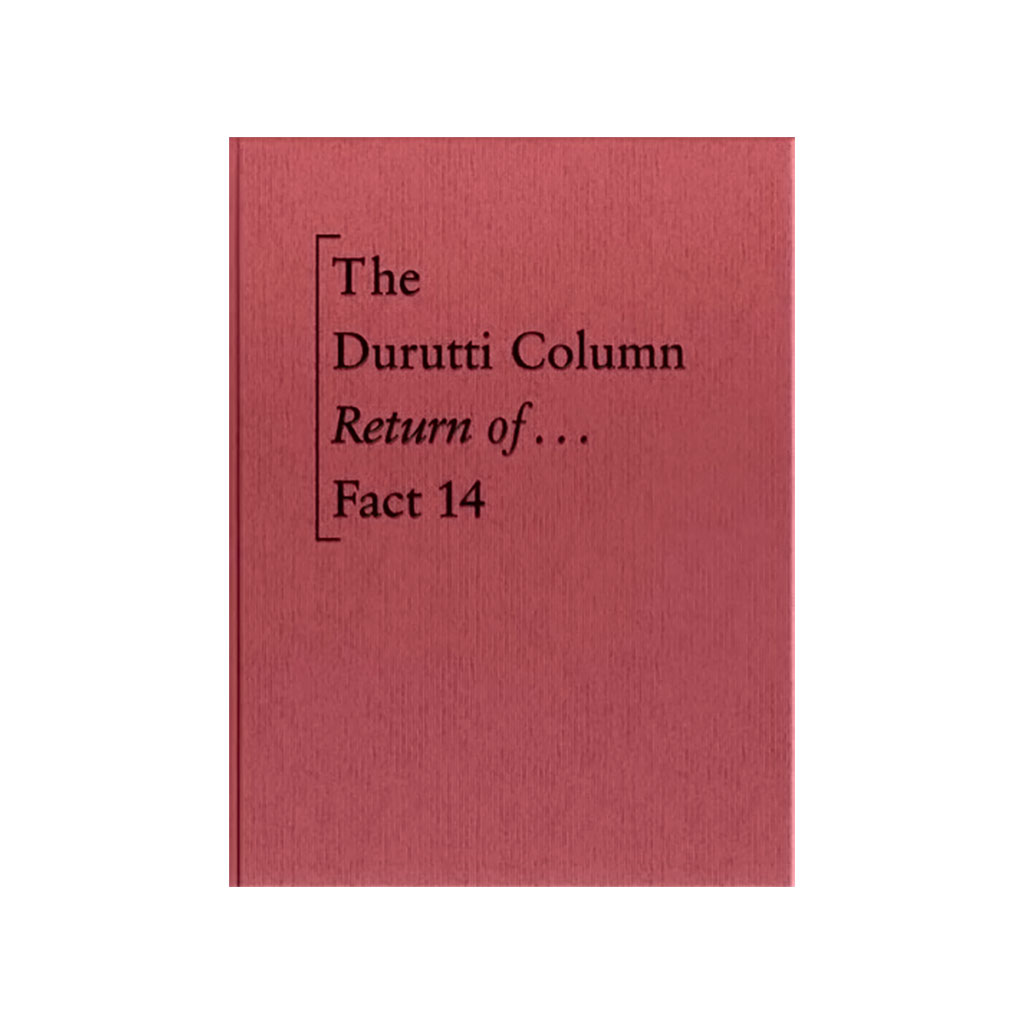
At long last, one of the great and most singular artifacts of the first wave of post-punk - The Durutti Column’s astounding, 1980 debut, ‘The Return of the Durutti Column’ - receives a much-needed, deluxe vinyl and expanded X2 CD reissue via London Records. Only the second full-length to appear on the legendary, Manchester, UK, based imprint, Factory Records, following Joy Division’s ‘Unknown Pleasures’, and created largely in partnership between the guitarist Vini Reilly and Martin Hannett - interweaving Reilly’s groundbreaking melodies and lines with Hannett’s experimental electric textures, rhythms, and processing techniques - it stands as one of the most radically unique and influential releases within the entire movement of post punk, subverting that movement’s perceived aesthetic perimeters and laying the groundwork for countless artists and movements over the decades in its wake.
Few labels have been entwined within the mythology of underground music like the Manchester, England, based Factory Records. Founded in 1978 by the television presenter, Tony Wilson, via the lasting legacies of bands like Joy Division, New Order, A Certain Ratio, Section 25, Cabaret Voltaire, and Orchestral Manoeuvres in the Dark, who made up much of its early roster, it remains a vital force within both the history of post-punk and the contemporary landscape of sound. Particularly noteworthy for the singularity and range of the material that came to rest under a single roof, Factory bands were often unpredictable, highly experimental, and rarely conformed to aesthetic perimeters one might generally associate with the idiom of post-punk. There is perhaps no better example of this than one of Factory’s earliest and most enduring signings, The Durutti Column. Primarily a solo project by the guitarist, Vini Reilly, occasionally joined by a rotating cast of regular contributors, the project stands among the most unique and celebrated within the Factory catalog, as well as being, arguably, among the most distinct and idiosyncratic in the entire canon of post-punk. In recent years, a number of labels have embarked upon issuing a series of vinyl and expanded CD reissues, attending to The Durutti Column’s astounding back catalog, but neglected to offer this treatment to what is arguably its most celebrated and sought after release: the project’s towering 1980 debut, ‘The Return of the Durutti Column’. A landmark with almost no equivalent - standing on its own within the context of underground music of its era - incorporating experimental textures, hypnotic lines and melodies, and pulsing rhythms, propelled by Martin Hannett’s atmospheric production - it is a timeless wonder that has continued to entrance listeners since the day it was released. It is regarded as “a bridge between post-punk, ambient, and classical motifs” that has opened up endless creative possibilities for countless artists following in its wake.
While it went through various line-ups following its founding the year prior, by 1979 The Durutti Column was effectively the solo venture of the Manchester born guitarist Vini Reilly. Like his peers who went on to found bands like Joy Division, Buzzcocks, Magazine, and the Fall, among others, Reilly belonged to the creative upswell in his home city that followed the Sex Pistols’ legendary gig on June 4, 1976, at the Lesser Free Trade Hall. By the founding of The Durutti Column three years later, he was already a veteran of the fabled punk band The Nosebleeds, which also, at various points, counted Morrissey of the Smiths, Billy Duffy of the Cult, and Toby Toman of Primal Scream as members. While The Durutti Column couldn't be further in aesthetics and sound from the early explosions of punk rock, those endeavors trace their way across the length of The Durutti Column’s debut release ‘The Return of the Durutti Column’. When entering the studio with the producer Martin Hannett in tow - embarking on what would become Factory Records’ fourteenth catalog entry and only second full-length after Joy Division’s ‘Unknown Pleasures’ - Reilly enlisted his old Nosebleeds bandmates Pete Crooks to play bass and Toby Toman to play drums: what appears to be the trio’s final collaboration together.
Vini Reilly, under the guise of The Durutti Column, is arguably the most enduring artist / project associated with the Factory stable. Between the release of the project’s debut full-length in 1980, and the label’s initial demise in 1992, The Durutti Column issued nine astounding full-lengths (one of which, LC, has been cited by Brian Eno as his all-time favourite album) and twelve iconic EPs, each honing his distinct approach to guitar explorations, a trajectory that he has continued to pursue over a further eighteen full-lengths into the present day.
There is always a danger, when retrospectively regarding the output of an artist who has worked as long as Vini Reilly, and broken as much ground, to minimize decades of accomplishment by over-romanticizing their early efforts. Acknowledging those pit-falls in the hope to avoid them, there is something truly astounding about The Durutti Column’s debut ‘The Return of the Durutti Column’. There certainly was no precedent for an album like this prior to its release, and there’s really nothing like it since, beyond Reilly’s own explorations of the ground it initially laid. Effectively a collaboration between Martin Hannett and Reilly that was recorded over a single week, much of which was devoted to Hannett’s experimentation with electronic sounds, creating backing tracks to which Reilly's classical influenced guitar playing was added. Later reflecting upon the producer’s contributions, Reilly stated: "...he more or less got sounds for me that no one else could understand that I wanted. And he understood that I wanted to play the electric guitar but I didn't want this horrible distorted, usual electric guitar sound and he managed to get that". Regarding his pursuits within the subsequent nine guitar driven instrumentals that made up the album’s two sides - "...an attempt at experimental things" - he expands: "...I had a lot of classical training when I was young, guitar and formal training, the scales I write with and the techniques I use are classical techniques and scales - a lot of minor melodic and minor harmonic scales, which generally aren't used in pop music… I didn't even know it was going to be an album. It was just the case of jumping at the chance of being in the studio. I actually didn't get up in time, Martin had to physically get me out of bed to get me to the studio - that's how little I believed it would happen. I was still doing late night petrol station shifts. I was even more amazed when Tony presented me with a white label. I was completely baffled. 'What, this is really going to be an album? You must be insane! No-one's going to buy this!” But, people did. ‘The Return of the Durutti Column’ single-handedly charted a brand new path for underground musical exploration, rethinking the possibilities of what was permissible that threaded its way across the 1980s and eventually flowed into the idiom of instrumental post-rock that emerged during the 1990s.
Named after a 1967 Situationist International poster that includes the phrase, ‘The Return of the Durutti Column’ comprises nine meandering guitar explorations, driven by experimental and post-punk approaches, that bridge the divide between those realms and ambient and classical music: “a terrain between jazz phrasings, classical sensibilities, and pastoral ambient soundscapes” played against Martin Hannett’s studio craftsmanship that deploys inventive reverb, phased electronics, and subtle percussive layers. Guided by a sense of luminous introspection, sonic restraint, and melodic ingenuity - lyrical, fragile, and deeply evocative - at the time of the album’s release elegantly crafted pieces like ‘Sketch For Summer’ and ‘Katherine’, coasting and dancing on an inner glow as they entirely confounded perceptions of post-punk’s aesthetics, must have been radically polarizing as they flung open doors.
While London Records’ beautiful, fully remastered vinyl edition immaculately reproduces the original contents of ‘The Return of the Durutti Column’, their towering double CD edition radically expands them with crucial insights and musical joys, comprising a stunning 23 tracks of bonus material, including home and studio demos, unreleased tracks, and live recordings made between 1978 and 1980, enriching the portrait of a band still rooted in the experimental spirit of the time. Particularly for devoted fans of The Durutti Column, these two editions work in perfect complement, making it hard not to recommend picking up both. Easily among the most important documents of British post-punk experimentalism and among the most singular albums ever laid to tape.
Originally published by Soundohm.