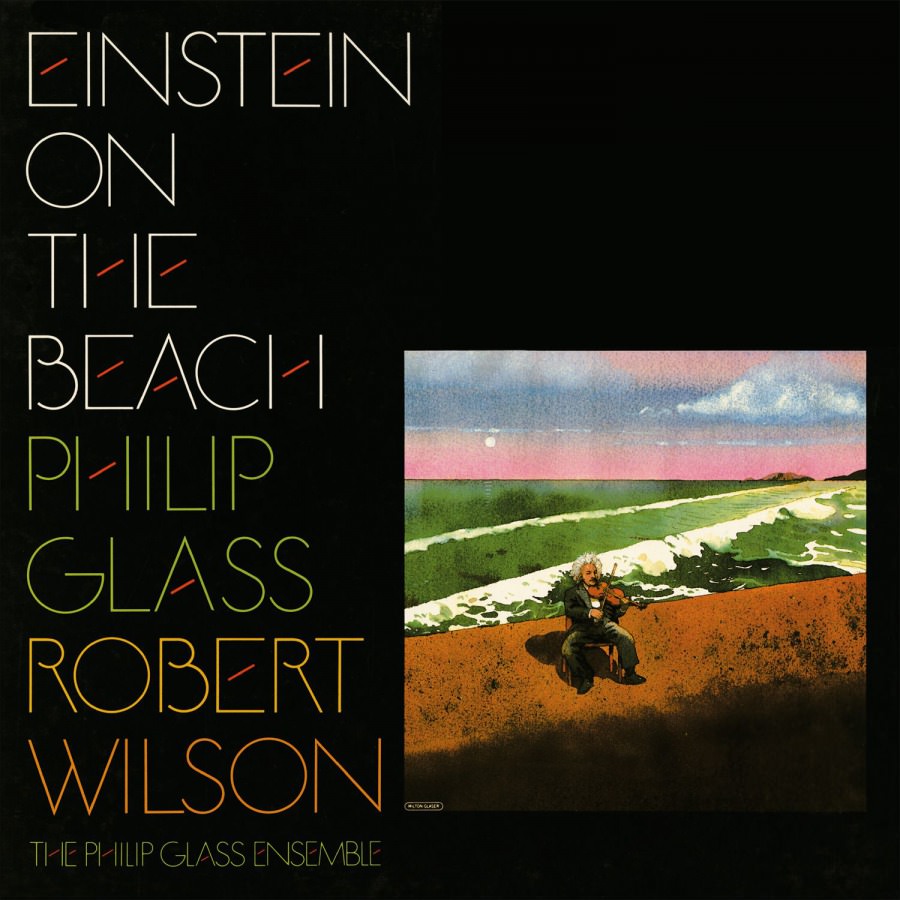
“The result is a nearly three-and-a-half-hour meditation on time, repetition, and perception - a hypnotic landscape where voice, instrument, and architecture dissolve into a free flowing continuum.”
Returning with what might just be their most ambitious release to date, Vlek wades deep into the waters of historical Minimalism and delivers an astounding new rendering of Philip Glass’ monumental debut opera from 1976, ‘Einstein on the Beach’, elegantly reconfigured and performed by Suzanne Vega, Collegium Vocale Gent, and The Ictus Ensemble. Capturing a “site-sensitive” installation of the work from 2022, in the hands of these visionary artists and ensembles this towering historical work comes alive within profound new dimensions that allow it to feel as radical and forward thinking in the contemporary, as it did on the day it first premiered.
Working at a slow and steady pace over the past 15 years, the Brussels based imprint, Vlek, has long stood as one of the more interesting European platforms for different threads of experimental electronic music, issuing full-lengths that vary from the techno adjacent to pure abstraction and drone. While pure electronic expressions are far from the limit of what the label does, their latest - an absolutely stunning new rendering of Philip Glass’ legendary opera, ‘Einstein on the Beach’, realized by Suzanne Vega, The Ictus Ensemble, and Collegium Vocale Gent, and conducted by Tom De Cock, pushes far into waters that are distinct from what we’ve generally come to expect from Vlek, raising their already ambitious bar to startling new heights. Across this brand new realization - the first of its kind - Vega’s singular vocals drive the work’s pulse against a soaring choir and The Ictus Ensemble’s virtuosity, offering an entirely new and intoxicating access to this singular work. Each step of the way, we’re potently reminded of how vital and enduring ‘Einstein on the Beach’ remains nearly half a century since its premiere, furthering our understanding of what an important composer Glass is.
Of all the Minimalist composers, few are in less need of introduction than the American composer Philip Glass. Born in Baltimore, Maryland, in 1937, Glass grew up in a musical family and was introduced early to countless classical works via the record store that his father owned. Incredibly gifted, even as a child, he studied flute at the Peabody Institute of Music before entering university at the age of 15, and then furthering his studies, having shifted toward piano as his primary instrument, at the Juilliard School of Music, where he met future minimalist Steve Reich.
Despite having been an early convert to the activities of the avant-garde, Glass’ evolution toward the revolutionary territory of composition through which he would make his name was slow and steady. As he later stated, when speaking of the creative landscape that he inherited: "That generation wanted disciples and as we didn't join up it was taken to mean that we hated the music, which wasn't true. We'd studied them at Juilliard and knew their music. How on earth can you reject Berio? Those early works of Stockhausen are still beautiful. But there was just no point in attempting to do their music better than they did and so we started somewhere else." This distinction in temperament, combined with numerous points of reference internalized from modernist theatre, coming into contact with Indian music through a collaboration on a film soundtrack with Ravi Shankar and Alla Rakha during the mid-1960s, and returning to New York in 1967 where he encountered early works by his friend and peer, Steve Reich, all laid crucial groundwork for the development of Glass’ singular approach to musical language.
Between the time that Glass returned to New York in 1967 and the premier of ‘Einstein on the Beach’ nine years later, the composer would emerge as one of the crucial voices of the Minimalist movement, alongside Reich, Terry Riley, La Monte Young, Tony Conrad, and a handful of others. Despite being an incredibly prolific period that witnessed the appearance of groundbreaking works like ‘Music in Contrary Motion’, ‘Music in Fifths’, ‘Music in Similar Motion’, ‘Music with Changing Parts’ and ‘Music in Twelve Parts’; as well as a steady stream of LPs and performances, Glass continued to struggle for financial security and widespread acclaim, despite having pointedly conceived a music that had set out to be far more accessible than the generation of avant-garde composers that preceded him: the true people’s avant-garde that was Minimalism during this period. Between 1975-1977 Glass worked upon a series of compositions titled under the heading of ‘Another Look at Harmony’, a marked shift within his focus, of which he stated: “What I was looking for was a way of combining harmonic progression with the rhythmic structure I had been developing, to produce a new overall structure... I'd taken everything out with my early works and it was now time to decide just what I wanted to put in - a process that would occupy me for several years to come”. The first and second part of this would come to form part of ‘Einstein on the Beach’, Glass’ first opera and the first in his portrait opera trilogy, with ‘Satyagraha’, and ‘Akhnaten’.
Composed in close collaboration with the artist Robert Wilson and premiered at the Festival d'Avignon during the summer of 1976, and then again in November of 1976 at the Metropolitan Opera in New York City, ‘Einstein on the Beach’ represents a visionary rethinking of the terms of what an opera can be and remains one of the most celebrated works of Glass’ career. Resting within Glass’ distinct approach to Minimalism that combines the use of cycling, often highly rhythmical repetition of limited tonal material that is often pushed to an almost maximalist sense of density, the work is particularly groundbreaking in its use of the human voice, ranging from spoken passages to complex choral arrangements, and a fair bit in between. Divided into five “Knee Plays”, beyond numerous live performances of the work over the better part of the last half century, recorded access to the work has historically been limited to two renditions, the 1979 original and a second that was recorded and released in 1993, both realized by the Philip Glass Ensemble. Like all works of this nature, there is always a sense of potential and meaning unlocked by further exploration, making Vlek’s brand new release by Suzanne Vega, Collegium Vocale Gent, and The Ictus Ensemble an incredibly exciting event.
Documenting a performance at Elbphilharmonie, in Hamburg, Germany, during November of 2022, that distills ‘Einstein on the Beach’ into a mesmerizing sound ritual, stripping it of Robert Wilson’s staging and presenting the piece as a “site-sensitive” installation that invited the audience to move freely through the concert venue - conceived as a means to “reflect the radical generosity of Glass’s concept - time as a shared condition rather than a story to be consumed” - and addresses the work through its sound alone, together Suzanne Vega, Collegium Vocale Gent, and The Ictus Ensemble foreground sonic clarity and human endurance that is intrinsic within the work. The result is a nearly three-and-a-half-hour meditation on time, repetition, and perception - a hypnotic landscape where voice, instrument, and architecture dissolve into a free flowing continuum. Particularly noteworthy is Vega’s multi-dimensional performance. Where the 1979 recording featured the spoken interludes performed by Christopher Knowles, Lucinda Childs, and Samuel M. Johnson, here she takes on all three positions herself, delivering cryptically playful texts with the intimacy and restraint of a storyteller rather than a performer, threading meaning through abstraction, while balancing Glass’s mathematically precise structures with a human pulse, turning what might seem like pure mechanism into lived experience. Played against Vega’s voice, the Ictus ensemble orchestrate an intricate logic of patterns - marimba pulses, synthesizer clusters, saxophone spirals, and the steady heartbeat of amplified violins - while The Collegium Vocale Gent, long celebrated for their mastery across centuries of repertoire, provide the ethereal choral scaffolding that sustains the music’s vast temporal span.
Absolutely visionary, revealing previously inaccessible attributes of Glass’ original score - hidden scales of emotion, mirroring dimensions of modern life - this brand new rendering of ‘Einstein on the Beach’ is a monumental achievement, pulsing in layers of infinite complexity amongst deceptively elegant forms. It’s a truly incredible vehicle to return our ears to this seminal work. Suzanne Vega, Collegium Vocale Gent, and The Ictus Ensemble have brought the wonders of ‘Einstein on the Beach’ roaring into our lives and reminded us of what a vital piece of work it is. Unquestionably one of the great minimalist releases of 2025!
Originally published by Soundohm.