“Frank had lost none of the incredible power and intelligence that had guided his previous recordings into being.”
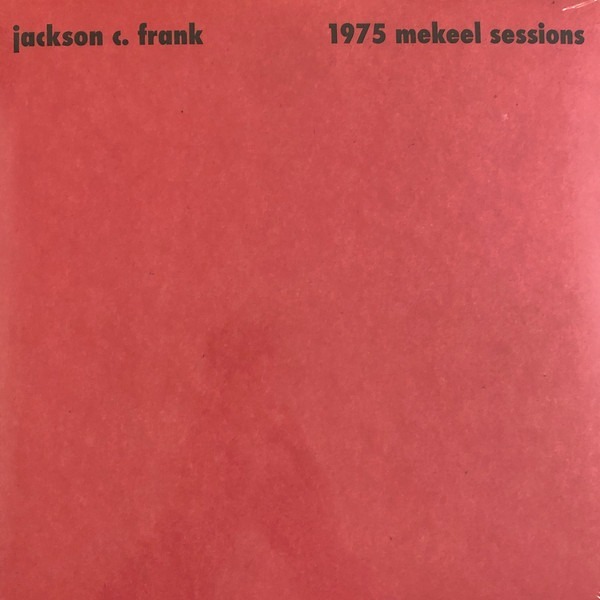
Adding a gem to an already stellar year, Superior Viaduct arcs a full circle for their sub-imprint, Antarctica Starts Here, returning their gaze to the legendary folk singer, Jackson C. Frank, with ‘1975 Mekeel Sessions’, the first ever dedicated vinyl pressing of Frank’s mythic, unreleased follow-up to his 1965 self-titled debut. Comprising six astounding songs, recorded in relative isolation in upstate New York, that collectively harness the raw and delicately emotive talents of one of the most celebrated and influential song-writers of his generation, it is unquestionably one of the most historically important and creatively captivating archival releases of 2025.
Easily one of the best and most ambitious labels working in the field of reissues and archival releases - not to mention many forays into the contemporary via sub-imprint W.25th. - over the last decade, the American imprint, Superior Viaduct, has become synonymous with making the improbable and impossible real. One after another, spanning nearly every idiom of ambitious music, they’ve reissued some of the greatest holy grails in the history of sound. While the label has widely become synonymous with releases attending to various threads of experimental music - notably minimalism, noise, and free jazz - they’ve equally forged, among others, important pathways into the creative heights of 1960s and '70s music via their fantastic offshoot Antarctica Starts Here, which now returns full circle to the artist that inaugurated the imprint back in 2018 - the legendary folk singer Jackson C. Frank. An astounding, stripped back body of work, featuring only acoustic guitar and voice, that further illuminates the towering talent that captivated the likes of Paul Simon, Nick Drake, Bert Jansch, and Sandy Denny when he first appeared upon the scene, only to disappear from view with only one release to his name, this brilliant addition to Antarctica Starts Here captures the vision Frank originally conceived when he returned to the studio, embarking upon the follow-up that never was.
Tragically, it is often the case that artistic heights are bound to hardship in life. Of this, there are few better examples than the American folk singer and songwriter Jackson C. Frank. Born in 1943, in Buffalo, New York, when Frank was eleven a furnace exploded at his school, with the resulting fire killing fifteen students and leaving him badly burned over fifty percent of his body, and deeply psychologically scarred. The only silver lining was that, during his eight and a half month stay in the hospital recovering, he was given a guitar to help pass the time. During his teens, Frank proved to be a gifted writer, first drawn toward poetry and fiction, before dedicating himself to journalism, all the while remaining deeply focused on music. Following an insurance payout for his injuries a few years prior, he made the life changing decision to move to London in 1965, quickly falling into the city’s thriving folk scene, where he made a deep impression and was offered the chance to record his debut, self-titled LP, later that year, issued by Columbia Records and produced by none other than Paul Simon.
While original pressings of Frank’s debut are as rare as hen’s teeth and command eye-watering prices on the secondary market - implying that it sold scant copies upon its original release - the sheer devotion to its songs by Frank’s peers is a testament to both its singularity and its creator’s talents. Its most well known track, "Blues Run the Game", was covered by Simon and Garfunkel, Bert Jansch, and Nick Drake, and its counterpart, "Milk and Honey" was also covered by Drake, Fairport Convention, and Sandy Denny, with those and countless others citing him as a key influence. Tragically, soon after, Frank’s mental health took a turn for the worse - largely cited as connected to the traumas left by the fire - and his money ran dry, forcing him to return to upstate New York, where he would largely remain - interspersed with periods of homelessness in New York City - for the rest of his life, occasionally attempting to relaunch his career. One such case was a body of six songs recorded at a studio in Lake Hill, New York, about five miles from his home, in 1975. Conceived as his sophomore album, these recordings - referred to as the Mekeel Sessions - were tragically shelved and remained unheard until the early 2000s when they began to appear on anthologies attending to Frank’s work, and expanded reissues of his 1965 debut. Never before, until now, have they been issued as the stand-alone album that the artist conceived.
Despite a decade having passed since he was last in the studio and the endless hardship since, across the six tracks that comprise ‘1975 Mekeel Sessions’ - ‘Marlene’, ‘Marcy's Song’, ‘Madonna of Swans’, ‘Relations’, ‘Cryin' Like A Baby’, and ‘The Visit’ - it becomes immediately clear as the needle drops that Frank had lost none of the incredible power and intelligence that had guided his previous recordings into being. Marked by a deep sense of warmth, threaded by the weight of pain and sorrow, and a stark immediacy gifted by Frank’s haunting sense of narrative and delicately fearless fingerpicking, across each track his voice soars and plumbs the depths, backed by rippling melodies that have been carved and honed into elemental states, with each moment emerging as some of the best song-writing that can be called to mind, and historically doubling as an important opening of a window into the mind of a singular artist, when no one was watching.
Ironically, while tragedy and pain lie at the root of so much of Frank’s life and work, unexpected strokes of luck emerged around ‘1975 Mekeel Sessions’, firstly that they were discovered at all - the reels turned up in the mid ‘90s in the archive of engineer Peter Mekeel, still intact - just in time for the resurgence of interest around his work that began to percolate during that period, among an excited new generation of listeners - and the fact that, unlike so many recordings attending to folk music, they were left alone and not subjected to the horrors of 1970s production, allowing them to be heard and appreciated at their best. Now, for the first time, Superior Viaduct and Antarctica Starts Here allows them to be encountered on vinyl and as a stand-alone work, as they might have then, but never were.
Originally published by Soundohm.