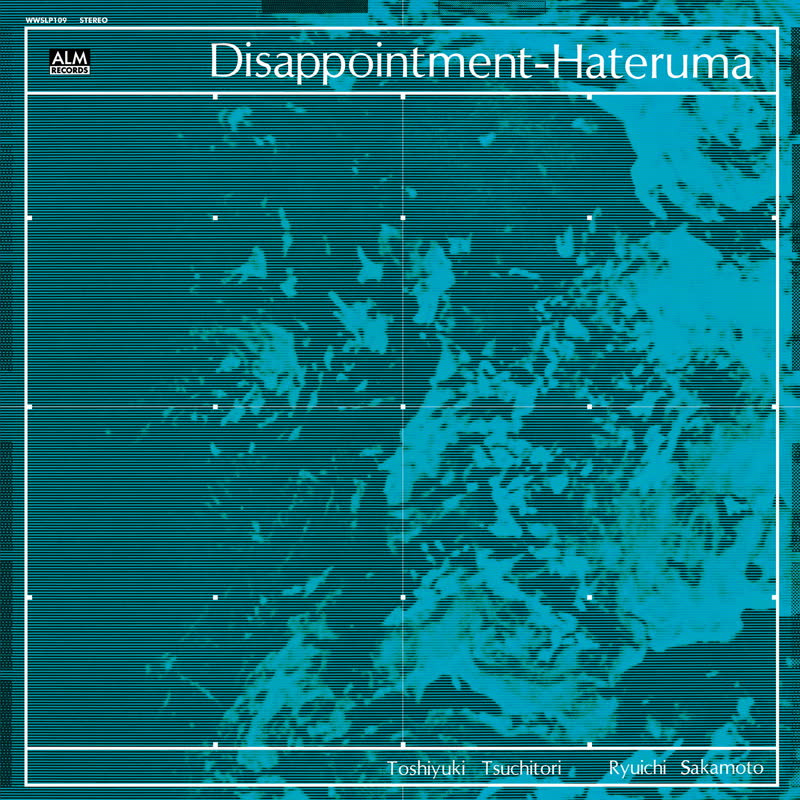
“Toshi Tsuchitori and Ryuichi Sakamoto’s ‘Disappointment - Hateruma’ stands as one of the great documents of Japanese experimentalism from the mid-1970s”
Launching into the new year with full force, the always thrilling world of Wewantsounds delivers one of their most exciting releases to date: the first ever vinyl reissue of Toshi Tsuchitori and Ryuichi Sakamoto's lone collaboration, ‘Disappointment - Hateruma’, originally issued in a tiny edition of 500 copies in 1976. An unexpected meeting of two soon to be luminaries, who occupied distinctly different poles within the history of Japanese experimental music, this remarkable creative statement traces through furious free improvisation, sweeping abstract ambiences, nods toward rhythmic Minimalism, and visionary approaches to electroacoustic practice, representing a towering highpoint - defying expectations of both - at the earliest documented period in their respective careers. It's nothing short of a marvel and a revelation on every possible set of terms.
For the last ten years, the Paris based imprint, Wewantsounds, has plumbed the depths of 20th Century music, assembling a remarkably diverse catalog of releases by artists hailing from nearly every corner of the globe. Looking far beyond simple notions of genre or taste, what binds the label’s forward-thinking approach to multiplicity is creative singularity and ambition: arguably the most succinct way to describe their latest endeavor, the first ever vinyl reissue of ‘Disappointment - Hateruma’, the lone collaboration by the experimental luminaries, Toshi Tsuchitori and Ryuichi Sakamoto, originally issued in 1976 by the legendary Japanese imprint Alm Records. Falling relatively early in both artists’ careers - marking Sakamoto’s first recording under his own name and a rare document of his exploration of improvisation during the 1970s - the album’s remarkable two sides, inspired by concepts of transient culture and geography, within Japan and well beyond - capture a stunning creative journey between the pair, ranging from wild and fiery free improvisations and spacious avant-garde abstractions, to ambient expanses and pulsing minimal explorations underpinned by synthesizers. More than half a century since it was laid to tape it remains one of the most singular experimental records to have emerged from Japan, capturing two of the country’s most influential artists at their most unexpected and absolute best.
While generally regarded as belonging to very different realms of expression and inquiry, Toshi Tsuchitori and Ryuichi Sakamoto are both legends within Japanese experimental music. Sakamoto came to fame as a member of Yellow Magic Orchestra (YMO) during the late 1970s, alongside his bandmates Haruomi Hosono and Yukihiro Takahashi. During roughly the same period, he emerged as an equally noteworthy composer and electronic music pioneer in his own right, assembling a sprawling body of visionary and remarkably varied work, over many decades until his passing in 2023, that regularly connected the radical reaches of experimentalism with a distinct pop sensibility. Tsuchitori, on the other hand, began his career during the early 1970s as a celebrated drummer within the idiom of free jazz, collaborating with the likes of Kondō Toshinori, Takagi Mototeru, Oki Kano, Derek Bailey, and numerous others. Following a period spent in New York studying with Milford Graves during the mid-1970s, he lived in France creating music for the theatrical productions of Peter Brook, in addition to producing a now legendary suite of highly unique experimental records during the late 1970s and 80s, rooted in Japanese folk tradition - ‘Drumythm', ‘Breath', ‘Ajagara', 'Ancient Echoes Of Japan [Dōtaku]', ‘[Keiseki] -Sanukaito', etc. - around which an enduring reputation has been built.
When Tsuchitori and Sakamoto entered the studio in 1975 to record what would be their lone collaboration for the newly launched Alm Records, the pair didn’t know each other well, but had orbited each other for years via the mutual acquaintances - notably the musician and critic Kenichi Takeda (Gakushudan / A-Musik) - who instigated the session. The outcome, ‘Disappointment - Hateruma’, remains free-standing within their respective careers, representing some of the wildest pieces ever recorded by Sakamoto and closing a chapter for Tsuchitori, just before he departed Japan to study with Graves.
Information connected to the origins of ‘Disappointment - Hateruma’ remains cryptic and at times contradictory. Those involved point toward conceptual underpinnings connected to cultural and geographic diversity, with its two artists pointing toward musical traditions within and beyond Japan - distinguished between “North” and “South” - as a means to inquire after certain aspects of a distinctly Japanese vision of sonic expression. Kenichi Takeda, who was intimately involved with the sessions and provided many of the group’s ideas, later illuminated: “Tsuchitori, who used to employ a large drum set modeled after Max Roach, was "returning" to Africa under the guidance of free jazz and black power (although he had already made his own drums and later "returned" more and more to the roots of the Jomon people). For Sakamoto, Balinese gamelan music, whose structure Steve Reich, a composer of minimal music, also paid attention to, was a bridge to the south. I listened to NHK-FM's "Ethnic Music of the World" (which was still moderated by Fumio Koizumi at that time) and King Records's "Ethnic Music Series" as a way to hunt for "Southern" music”.
Comprising four distinct pieces, ‘Disappointment - Hateruma’ launches into states of furious free-improvisational fire with its opener, ‘Aya’, encountering Tsuchitori and Sakamoto locked in a remarkable dialog behind the piano and drums that stretches across the first side, pushing to the furthest reaches of ‘outness’, bordering on pure sonic assault in ways that clearly foreshadow the soon to appear idiom of noise. The album’s second side marks a distinct change of course while remaining inexplicably cohesive, beginning with ‘Utsuwa No Naka’, across which the pair allow space and ambience to take center stage, producing washes of textural sonority with an EMS Synthesizer and processed acoustic sounds, punctuated by blurts of electronics and tuned percussion, amounting to a strikingly distinct gesture of constrained electroacoustic composition that had few equivalents at the time. A similar sensibility, expanded to incorporate a broader sonic palette and more explicitly rhythmic drive, mark the movement into ‘Musique Differencielle 1°’, which weaves striking threads between minimalism and free improvisation with its pulsing tones (sounding like steel drums), textural rattling on metal percussion, and sweeping synth lines that feel both rigorously structured and occurring intuitively in real time, before winding down the momentum with the delicate excursions of ‘Music Differencielle 2°’. It is here, on the album’s final track that Tsuchitori and Sakamoto tie a tight knot that illuminates the cohesive vision of the journey across its two sides, utilizing the free improvisational approaches that defined ‘Aya’, the open spaciousness and abstraction of ‘Utsuwa No Naka’, and the draw toward rhythm that guided its predecessor, with tones and dissonances generated by piano playing counterpart to gentle percussive elements and phonic utterances of Tsuchitori’s voice.
Much like the efforts of East Bionic Symphonia, Somei Satoh, Jo Kondo, Sueko Nagayo (all of which were also originally issued by Alm during the same period), and Flower Traveling Band, Toshi Tsuchitori and Ryuichi Sakamoto’s ‘Disappointment - Hateruma’ stands as one of the great documents of Japanese experimentalism from the mid-1970s, threading ties between numerous forms and idioms of musical expression, while remaining entirely distinct to the culture from which it sprang. Virtually unobtainable since its tiny original pressing of 500 copies in 1976, Wewantsounds’ amazing, first ever vinyl reissue of this masterstroke brings all of its wonders roaring back into the consciousness as a hugely important contribution to the histories of experimental and improvised music, offering important insights into the creative underpinnings and roots of its two famous creators.
Originally published by Soundohm.