“As is so often the case within the arts, the most beautiful flowers bloom in the dark.”
Surveying the tangled constellation of small, private and independent labels that have faithfully attended to spiritual and free jazz over the last 75 years, the singular character and contribution of the American imprint, Nimbus West - arguably the greatest single depository of West Coast avant-garde jazz - is impossible to miss. Founded in 1978 by Tom Albach as a vehicle to support the activities of the Los Angeles based pianist and composer, Horace Tapscott, particularly those within the now legendary Pan Afrikan Peoples Arkestra, which he had founded in 1961. Over the first decade of its activity, Nimbus issued an astounding discography of recordings attending to the Pan Afrikan Peoples Arkestra, Tapscott’s solo and collaborative work, as well as the remarkable musicians that orbited him and the Arkestra: Nate Morgan, Adele Sebastian, Dadisi Komolafe, Jesse Sharps, Billie Harris, Linda Hill, Roberto Miguel Miranda, Curtis Clark, and numerous others, as well as associated offshoots like Creative Arts Ensemble. These recordings - attending to artists and collectives that otherwise remained largely undocumented - represent a treasure trove of profound creativity, as well as an archive of revolutionary activities within the Black Arts movement and avant-garde jazz on the West Coast and within Los Angeles. While Nimbus remained active over the years, following its initial period of fervent activity, it largely focused on maintaining its remarkable back catalog, until relaunching back in 2023 with renewed vigor, delivering new fully remastered editions of some of its best releases, as well as towering, previously unissued archival recordings, and new additions from the contemporary evolutions of the Arkestra and its scene.
The Los Angeles based pianist, band leader, and composer, Horace Tapscott (1934-1999), always stood apart from the pack. A true visionary who was fiercely principled and independent, across the 1960s, 70s, 80s, and 90s, leading his legendary Pan Afrikan Peoples Arkestra, he produced a tour de force of sound, seeded by social, political, and community-based action. Tapscott began his career as a trombonist before switching to piano, playing with Frank Morgan, Don Cherry, and Billy Higgins while still in his teens, before hitting the road with Lionel Hampton during the late 50s and early 60s: an experience formative enough to push him down his own path as a band leader. For most of his career, Tapscott remained one of the unsung giants of jazz; a gifted composer, arranger, and educator, as well as a remarkably original pianist and bandleader. In 1961 he founded the Underground Musicians Association (UGMA) which morphed into the Pan-Afrikan Peoples Arkestra roughly a decade later.
For the entirety of their run together, Tapscott and his Arkestra were among the most important groups working in the United States. They also remain among the most under-appreciated: a true grassroots effort of collective creativity, working in shadows imposed by the racial and economic injustices imposed upon urban Americans, as well as biased attentions within the context of jazz that have always favored the East coast over the West. As is so often the case within the arts, the most beautiful flowers bloom in the dark.
While Tapscott recorded in numerous configurations (almost always as a leader) and solo over the many years of his activity, from its inception UGMA / the Pan-Afrikan Peoples Arkestra remained his central focus. A radical band who lived communally, creating revolutionary music that channeled Afrocentric and self-determinist philosophies - always placing community work and political consciousness at the heart of the project, preferring to play in the street, parks and coffee houses, over traditional venues - extending their efforts into playing fundraisers, organizing workshops for young and old, working with radical theatre groups and poets, political revolutionaries, afro-separatists, community groups and churches, the Arkestra drew its talented membership and inspiration from the immediate community from surrounding Los Angeles neighborhoods within which it worked. In Tapscott’s own words, the project hoped to act as “a cultural safe house for the music” - an “Ark”, stating, “This is your music. This is black music,… a panorama of the whole thing right here”.
Like Sun Ra, from whom he borrowed when naming his own Arkestra, and Kelan Phil Cohran working during the same period in Chicago, Tapscott showed deep dedication to possibilities and inclusiveness presented by working in large ensembles. Attempting to remain as free from the restrictions of the white run music industry, the Pan-Afrikan Peoples Arkestra only began to document their efforts toward the end of the 1970s, offered wings by Nimbus West, an imprint founded in 1978 by Tom Albach, solely as a vehicle for Tapscott and his creative community, which remains the most dedicated body of recording attending to it, even today.
There are few landmarks within the history of jazz equal to Horace Tapscott and the Pan Afrikan Peoples Arkestra’s ‘Flight 17’. Issued in 1978 as the first release on the newly launched Nimbus West, not only does it mark Tapscott’s first release as a leader since 1969 when the Horace Tapscott Quintet delivered the incredible ‘The Giant Is Awakened’ on Flying Dutchman, but it is the debut of the Pan Afrikan Peoples Arkestra, despite having been in activity, in one form or another, for almost two decades.
Comprising five tracks that range from collective pure fire - presenting a West Coast counterpoint to the efforts of Sun Ra - to sublime passages for solo piano, ‘Flight 17’ captures a level of compositional, tonal, and structural ambition that entirely melts the brain. Marked by striking density that seems to gather and layer the entire history of music into discrete moments, it’s a record of such towering ambition that even as it unfolds one rapidly understands that it would take a lifetime of listening to fully unlock and understand.
Released in 1978, hot on the heels of ‘Flight 17’, the Pan Afrikan Peoples Arkestra’s ‘The Call’ - this time led by Jesse Sharps - is every bit as good as (and possibly even better than) its predecessor. Comprised of five stunning compositions, each by an Arkestra member - tapping the beating heart of underground African American music in LA. - ‘The Call’ was recorded across two studio sessions in April 1978 that produced a singularly deep, thick, and emotive body of sonority that takes an almost relentless, frenetic pace, spanning the moody ‘Nakatini Suite’, to the swinging, modal work of ‘Peyote Song No. III’, nodding along the way to Mingus and Coltrane, while entirely its own thing. Brilliant, beautiful, and revolutionary to the core, while almost entirely unheard at the time, ‘The Call’ stands as one of the great documents of free improvisation and spiritual jazz of the decade - holding up to anything produced by Pharoah Sanders, Sun Ra, or anyone else.
In addition to his large ensemble activities within the Pan Afrikan Peoples Arkestra, Horace Tapscott recorded in numerous configurations and solo over the many years of his activity, forming a singular body of recordings that channel his monumental talents, revolutionary spirit, and Afrocentric and self-determinist philosophies. Back in 2022, Nimbus unearthed a never before released album by Tapscott made in 1983, issuing it in a highly limited pressing. Featuring Arkestra heavyweights, the flautist Aubrey Hart and the saxophonist Kafi Roberts, these recordings form a striking counterpoint to the ferocious energy that helped define much of Tapscott’s most celebrated works.
“Tapscott and Winds” encounters the pianist embarking into introspective and restrained territory, his lines carving meditative melodic structures that bristle with tension. Into this tapestry of tonal, rhythmic, structural and intellectual complexity, Hart and Roberts intervene with brilliant responses, building upon years of collaboration and mutual respect between themselves and their leader, that culminates as a quiet discourse - channeling numerous threads of African American music - with one of the most strikingly individual pianists of the 20th century.
Of all Horace Tapscott’s musical partnerships, his relationship with the drummer, Everett Brown Jr., was among the most remarkable and enduring. Not only did they work and record together as members of The Pan-Afrikan Peoples Arkestra on seminal albums like ‘The Call’, ‘Live At I.U.C.C’, ‘Flight 17’, and numerous other Tapscott outings, but also within the ensembles that recorded Billie Harris’ ‘I Want Some Water’, Jesse Sharps Quintet & P.A.P.A.’s ‘Sharps And Flats’, and as members of The Sonny Criss Orchestra and the John Carter & Bobby Bradford Quartet.
Remarkably, ‘At the Crossroads’, issued in 1980, is the only known recording of Tapscott and Brown working as a duo. Raw, direct, and pushing hard, the LP takes us into the eye of the pair’s long brewing storm. Tapscott’s playing ranges from melodic, beautifully constructed lines, to full throttle free playing, met and driven forward by Brown’s rhythmic interventions at every turn. It’s pared down free improvisation at full tilt, taking the listener much further than most full ensembles can.
Born in Los Angeles in 1953, the saxophonist, Jesse Sharps, spent his childhood in Watts. While still in high school, he was asked by Horace Tapscott to join the Pan-Afrikan Peoples Arkestra - only leaving for a handful of years when he went to university to study under Cecil Taylor - which he would eventually lead, playing flute and reeds, for years following the departure of Arthur Blythe from the role.
Sharps led the Arkestra like a well oiled machine during the incredible period which gave way to “Flight 17”, “Live At IUCC”, and “The Call”, and was recalled by Tapscott as “hardcore.. They’d all be quiet and listen to him when he talked.” - a power of personality only trumped by the life his playing breathed into each work. While Sharps was technically the leader of the Arkestra, the chance to record under his own name as a leader didn’t arrive until 1985, with the efforts which became the majority of ‘Sharps and Flats’, which tragically - given the power and vision captured during the sessions - remained unissued until a CD release by Nimbus in 2005.
‘Sharps and Flats’ - featuring players from the orbit of the Ark, Carl Burnett, Joel Ector, Nate Morgan, Alippa, JJ Kabasa, and Steve Smith - encounters Sharps blazing forth on saxophone, tracing across a vast range of sonic touchstones, in a deep, sophisticated and driving body of music at the borders of spiritual jazz and hard bop, rising and falling across six visionary pieces that culminate as one of the most intoxicating and infectious bodies of sound to have been created during the 1980s.
The Nimbus catalog is a clear indication that Tapscott had found a sympathetic mind and was intent on making up for lost time. Of the 17 records that appeared under his name between the late 70s and 1985, only 2 landed elsewhere. The majority of these are with Pan Afrikan Peoples Arkestra or in smaller ensembles that he led, but among the most fascinating are 7 LPs that comprise the original volumes of ‘The Tapscott Sessions’ comprising a visionary body of solo piano recordings made by the composer between 1982-84.
While the entirety of ‘The Tapscott Sessions’ is absolute gold, ‘Volume 3’ offers a particularly noteworthy lens through which to glean its creator’s brilliance. Stretching out in unaccompanied solos that cover a vast spectrum, from free improvised fire to meditative and melodic meandering, ‘Volume 3’ is nothing short of a tour de force, presenting Tapscott not only as a key successor to ambitious predecessors like Duke Ellington and Charles Mingus, but as a startling counterpart to the work of contemporaries like Cecil Taylor and numerous composers working in the field of avant-garde chamber music. Often tense and incredibly complex in their tonal and rhythmic connections before entering states of glorious release, the album’s five pieces present a living, breathing music of deeply emotional exploration that stands, even after forty years, as some of the most distinct and visionary solo piano music ever laid to tape.
The pianist Curtis Clark stands slightly apart from most of his peers on Nimbus. Despite having largely grown up in LA, and retained strong connections to the music scene there, he spent most of his career - before relocating again to New England - in New York, working with artists like David Murray, Prince Lasha, Billy Bang, Frank Lowe, Butch Morris, Charles Tyler, Tristan Honsinger, Oliver Lake, and Han Bennink.
Recorded at Max Bolleman's Studio 44 in Monster, Netherlands, ‘Amsterdam Sunshine’ is Clark’s 2nd LP as leader, and his 2nd outing with Nimbus (issued in 1984 shortly after ‘Phantasmagoria’), featuring the cellist, Ernst Reijseger, and bassist, Ernst Glerum - both stalwarts of the European free jazz scene and members of ICP Orchestra - alongside veteran Sun Ra Arkestra drummer, Don Mumford, and the Amsterdam based American jazz saxophonist Michael Moore. Embodied by spiritual grooves, modal depths, boundary pushing improvisations, and melodic passages of solo piano, ‘Amsterdam Sunshine’ rockets to startling creative heights that open up a whole world that far too few have meaningfully explored, and some of the best jazz from the 80s that anyone is likely to hear.
Few records in Nimbus’ catalog gained the iconic and legendary status of Adele Sebastian’s ‘Desert Fairy Princess’, issued in 1981, just 2 years before her tragic early passing from kidney failure at the age of 27. Sebastian, a remarkably talented flutist and singer, joined the Pan Afrikan Peoples Arkestra in the early 70's as a teenager and remained one of its most dedicated members, almost never missing a practice, despite her illness, and graced many of the collective’s most memorable releases. For many, her lone outing as a leader, backed by Roberto Miranda on bass, Billy Higgins on Drums, Daa'oud Woods on Percussion, Bobby West on Piano, and Rickey Kelly on Marimba, is among the greatest records to emerge from the collective on Nimbus.
Blending elements of Latin, African, and psychedelic musics with heavy spiritual grooves, threaded by free passages - led by Sebastian’s vocals and astounding skills on flute - ‘Desert Fairy Princess’ soars across six astounding compositions that collectively amount to an expansive, rhythmically driven carpet of modal creative magic, that breathed life back into spiritual jazz at the dawn of the 1980s. One of the towering artifacts of LA / the Pan Afrikan Peoples Arkestra scene, and the lone artifact of one of its most talented voices, it’s a timeless wonder the likes of which will likely never be seen again.
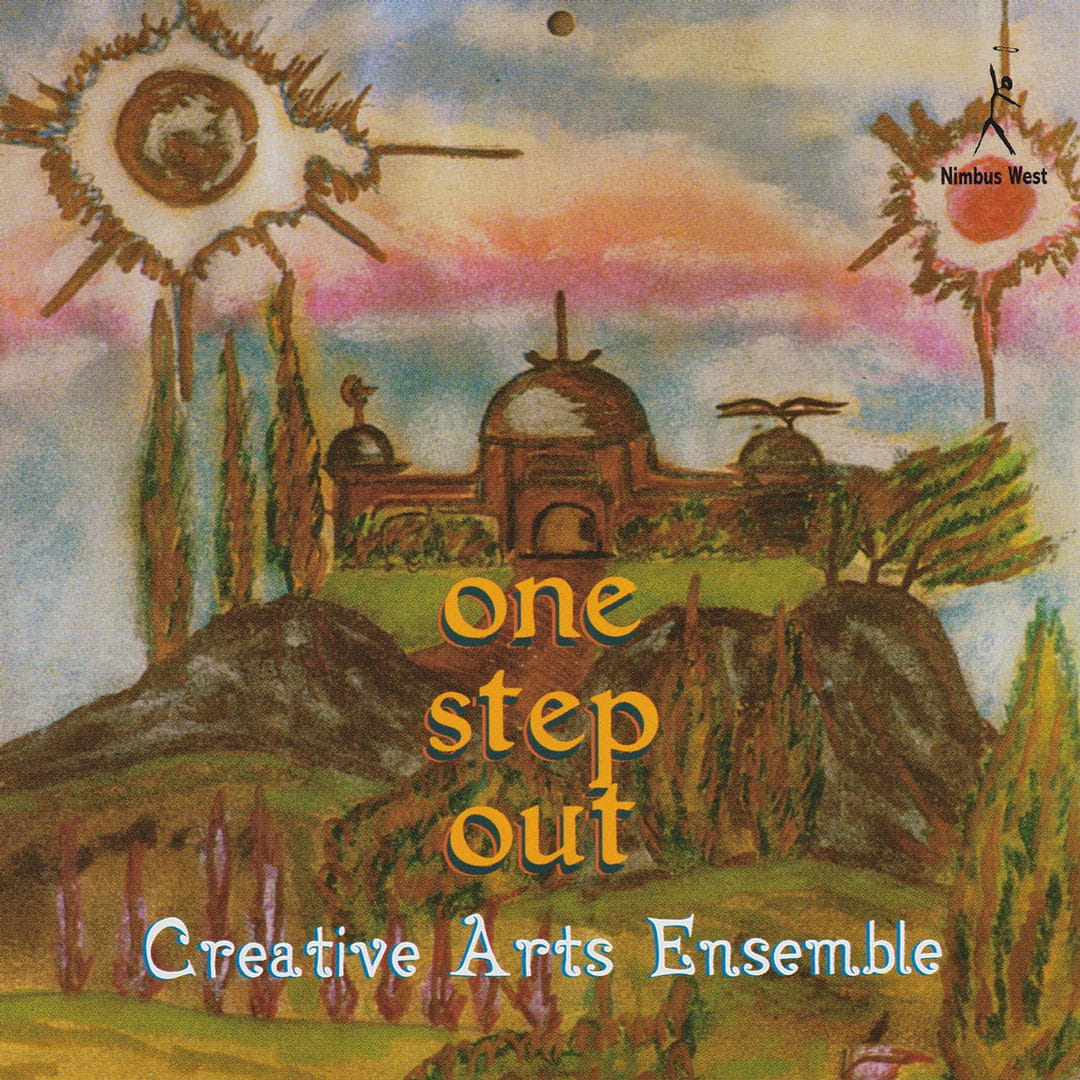
One of the most sought after and highly regarded titles on Nimbus, Creative Arts Ensemble’s 1981 debut ‘One Step Out’, is a towering gem of the Los Angeles jazz underground, capturing the pianist and composer Kaeef Ruzadun Ali’s first recording as leader, drawing inspiration from Horace Tapscott and the Art Ensemble of Chicago. Creative Arts Ensemble was the only large ensemble group that emerged directly from the Pan Afrikan Peoples Arkestra, featuring members like Dadisi Komolafe, Woody ‘Sonship’ Theus, Gary Bias, Henry ‘The Skipper’ Franklin, and George Bohannon.
Driving and chugging, intertwining spiritualism and improvisation - carried by the sanctified and soulful vocals of Kaeef’s sister, B. J. Crowley - ‘One Step Out’ taps community and sacred vision straight from the source. Unquestionably one of the greatest Spiritual Jazz records from the early 1980s ever recorded, presenting a density and complexity that remains focused and direct, this one is an absolute monster and pure fire.
Alongside Adele Sebastian’s ‘Desert Fairy Princess’ and Creative Arts Ensemble’s ‘One Step Out’, the flutist Dadisi Komolafe’s 1983 debut as a leader, ‘Hassan's Walk’, remains one of the most celebrated and sought after releases produced outside of the Pan Afrikan Peoples Arkestra on Nimbus, as well as being regarded as one of the most important documents of the 1980s spiritual and free jazz scenes. An absolutely engrossing and intoxicating immersion that will leave Komolafe’s name written in the stars forever more, it’s hard to think of a more fitting inheritor to the territories first opened by John Coltrane during the 1960s. This is where it was going and where it went. Chugging and infectious, soaring and rippling with deep grooves every step of the way, there are no words to do ‘Hassan's Walk’ the justice it deserves. It’s a towering masterpiece of the form and a proof that the West Coast had its own thing and it was every bit as good, if not better, than everywhere else.
Originally published by Soundohm.