“Its significance extends far beyond the context of Library Music, into the entire spectrum of experimental music at large.”
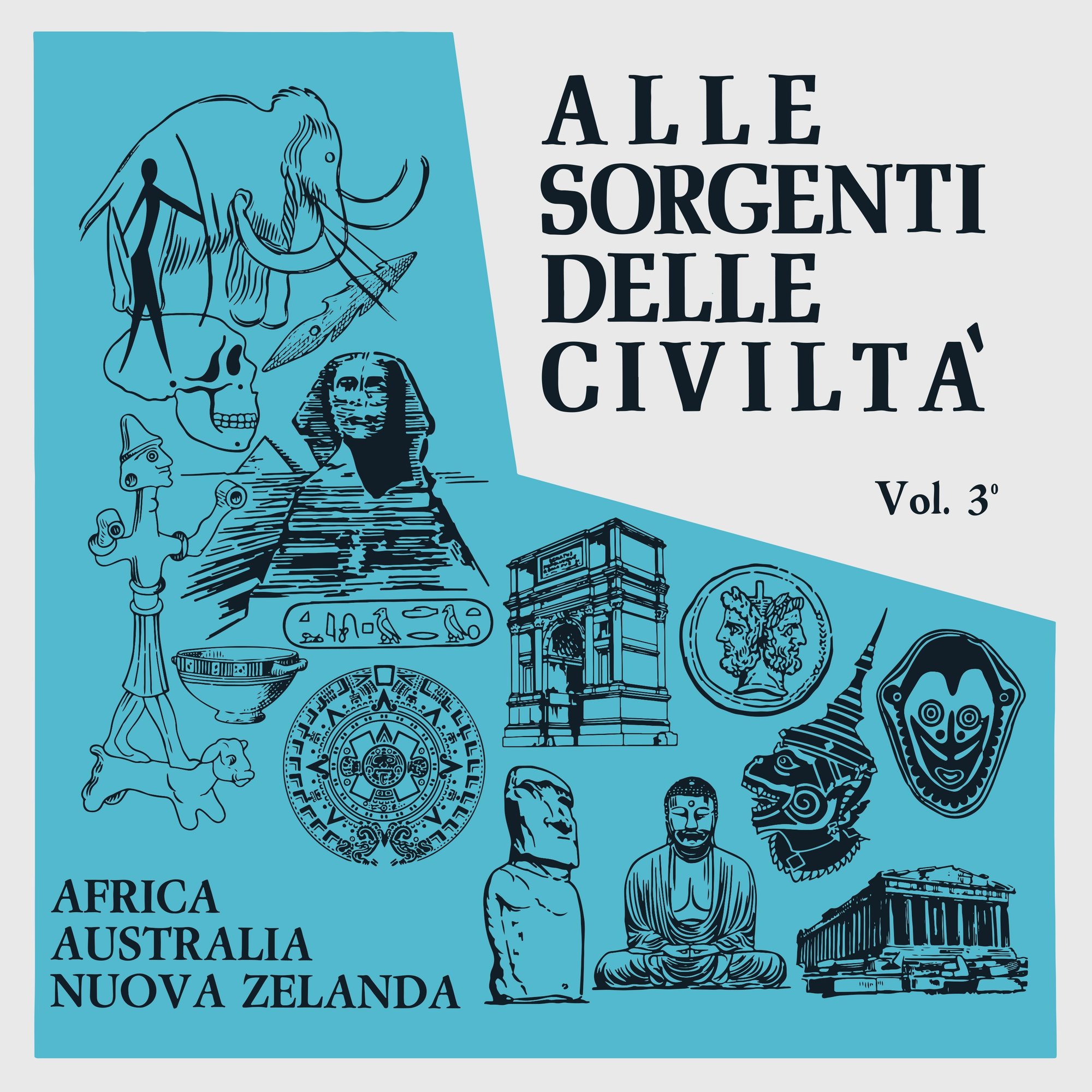
Delivering what might just be the most hotly anticipated Italian Library music release of the year, Musica Per Immagini continues their longstanding efforts in excavating some of the idiom’s most remarkable releases with the first-ever vinyl reissue of Braen & Raskovich’s Alle Sorgenti Delle Civiltà - Vol. 3. Originally issued in 1971 by the tiny Folkmusic imprint, with a series of simulations of numerous folk traditions, Braen & Raskovich - who were in fact the legendary composers Alessandro Alessandroni and Giuliano Sorgini - pushed well beyond the remit, intertwining percussion and wind instruments through electronic techniques. In so doing, the pair sculpted an unparalleled body of conceptual, sonic spaces, traversing minimalism and bristling abstraction, that stands as one of the most remarkable experimental gestures of the 1970s, anticipating the efforts of artists like Roberto Musci, Walter Maioli, Riccardo Sinigaglia, Roberto Laneri, Pier Luigi Andreoni, Jon Hassell, Luis Perez, Jorge Reyes, Antonio Zepeda, Arturo Meza, Carlos Alvarado, Jocy de Oliveira, and numerous others.
With good reason, from time to time, we take the opportunity to point toward historical artifacts of Italian library music. Marked by an unparalleled diversity and range, this sprawling body of sonority was created between the 1960s and 1980s, primarily as stock music for film and television. Yet, unlike contemporaneous parallels within the United States and other parts of Europe, Italy’s context of Library Music doubled as a potent vehicle for the creative freedom and exploration for many of country's most ambitious composers and musicians. Perhaps most strikingly, the vast majority of these artists worked in anonymity under pseudonyms, often creating rigorously experimental and forward-thinking work that, retrospectively, intervenes with standing perceptions regarding the post-war avant-garde and the emergence of post-modernism. A shadowy breadcrumb trail of sounds that encounters seminal figures like Ennio Morricone, Bruno Nicolai, Piero Umiliani, and Egisto Macchi producing groundbreaking work under alter egos, there remains vast quantities to uncover and explore. One such case is a tiny series of releases entitled ‘Alle Sorgenti Delle Civiltà’, conceived to simulate various folk traditions from across the world, issued by the Folkmusic imprint during the early 1970s. At first glance, the third volume of the series, composed by Braen & Raskovich and issued in 1971 - nodding toward the sounds of Africa, Australia, and New Zealand - stands in relative equality with its three companions. Upon closer inspection, it is anything but. Braen is the pseudonym of Alessandro Alessandroni and Raskovich is Giuliano Sorgini, two of the most visionary and prolific composers of their generation. Complex and musically engrossing - engaging striking polyrhythmic sensibilities and a radical use of electronic processing - this remarkable body of work is best regarded as a lost work of Italian Minimalism, rather than an approximation of sonic ethnography. Whether viewed within the context of library music or against 1970s experimental music at large, 'Alle Sorgenti Delle Civiltà Vol. 3' is an absolute marvel that stands years ahead of its time.
Among the most celebrated soundtrack and library music composers to have emerged during the 1960s - producing a sprawling body of singular work that stretches across the subsequent decades - surprisingly, Alessandro Alessandroni is best known for his incredible ability to whistle. Nearly everyone knows the dancing tones produced by his lips as a defining sonic feature of spaghetti western soundtracks - ‘A Fistful of Dollars’ (1964), ‘The Good, the Bad and the Ugly’ (1966) - composed by Ennio Morricone. A multi-instrumentalist who played guitar, sitar, keyboards, mandolin, mandocello, accordion, banjo, flute, harmonica, recorder, and numerous other instruments, as well as a profoundly talented composer, arranger, vocalist, and conductor, Alessandroni’s efforts - hundreds of albums deep - composed under his given name as well as the monikers Braen, Meriggi, and Ron Alexander, represent one of the most striking discographies of music produced in Italy during the second half of the 20th Century. Some of the most exciting of those were created in collaboration with the equally celebrated composer and keyboardist, Giuliano Sorgini, who often worked under the name Raskovich.
While both Alessandroni and Sorgini were prolific and talented on their own, their creative partnership inspired some of the most groundbreaking work in their respective careers, one such case being the LP, ‘Alle Sorgenti Delle Civiltà Vol. 3’, issued in 1971 by the Folkmusic imprint, as a simulation of traditional music from Africa, Australia, and New Zealand. While all four releases in the series, additionally nodding toward the music of Latin America, India, Iran, and Pakistan, and China and other parts of East Asia, are worthy of note, Alessandroni and Sorgini’s contribution, composed as Braen & Raskovich, is not only the best, but stands among the most creatively and conceptually ambitious releases within the entire canon of Italian Library music.
Comprising fourteen pieces, ‘Alle Sorgenti Delle Civiltà Vol. 3’ couldn’t be sonically further from the remit of the series to which it belongs. Rather than trying to simulate an ethnography of the sounds of musical traditions from Africa, Australia, and New Zealand, Alessandroni and Sorgini deployed a loose arrangement of associated instrumentation as a means to sculpt environmental moods. As such, rather than generic, stock music for film and television, or a product of pastiche, the album can be more appropriately regarded as a precursor for the efforts of Italian Minimalists like Roberto Musci, Walter Maioli, Riccardo Sinigaglia, Gabin Dabiré, Roberto Laneri, Pier Luigi Andreoni, and Francesco Paladino, who would subsequently create distinct ambiences within their own efforts by nodding toward a diversity of musical traditions.
With a sonic palette firmly rooted in the realm of percussion, ‘Alle Sorgenti Delle Civiltà Vol. 3’ encounters Alessandroni and Sorgini intertwining striking polyrhythms with startling ease. Rather than indulging the hypnotic, the pair shift between the distant poles of spacious constraint and bubbling abstraction. Threaded by the sounds of various wind instruments, rendered with varying degrees of timbre, texture, sustain, and attack, in both its passages of minimal constraint and abstraction, not to mention everything between, the presence of the studio and electronic technology contributes to varying degrees to the album’s sense of environment and space. In some cases this is voiced through the delicate use of reverb, while in others, more extreme forms of intervention produce shimmering collisions of sounds produced by electronics and tape manipulation that could easily be mistaken for the happenings at studios like Groupe de Recherches Musicales, Elektronmusikstudion EMS, or Westdeutscher Rundfunk (WDR) during the same period. While strikingly ambitious and experimental in all of its discrete moments, it is arguably through the conjoining of the album’s extremes - creating a striking sense of creative multiplicity that flows seamlessly from one piece to the next - that sets ‘Alle Sorgenti Delle Civiltà Vol. 3’ apart from its peers and places it well ahead of its time. While other artists were drawing inspiration from various ethnic traditions, creating minimal percussion driven compositions, and composing electronic abstractions, it would be years before others would begin sculpting sonic spaces that utilized all three across their lengths. As such, not only does ‘Alle Sorgenti Delle Civiltà Vol. 3’ anticipate the innovations of a whole generation of Italian minimalists to come, but also the work of artists like Jon Hassell, Luis Perez, Jorge Reyes, Antonio Zepeda, Arturo Meza, Carlos Alvarado, Jocy de Oliveira, and numerous others.
A truly stunning sonic artifact of the highest order, comprising visionary techniques and conceptual ideas, working under the alias of Braen and Raskovich, with ‘Alle Sorgenti Delle Civiltà Vol. 3’ Alessandro Alessandroni and Giuliano Sorgini produced one of the greatest Italian albums of the 1970s. Its significance extends far beyond the context of Library Music, into the entire spectrum of experimental music at large. After having remained out of print and virtually inaccessible for more than half a century, Musica Per Immagini drops this mind-altering gem into the broad, collective consciousness with its first-ever vinyl reissue.
Originally published by Soundohm.