
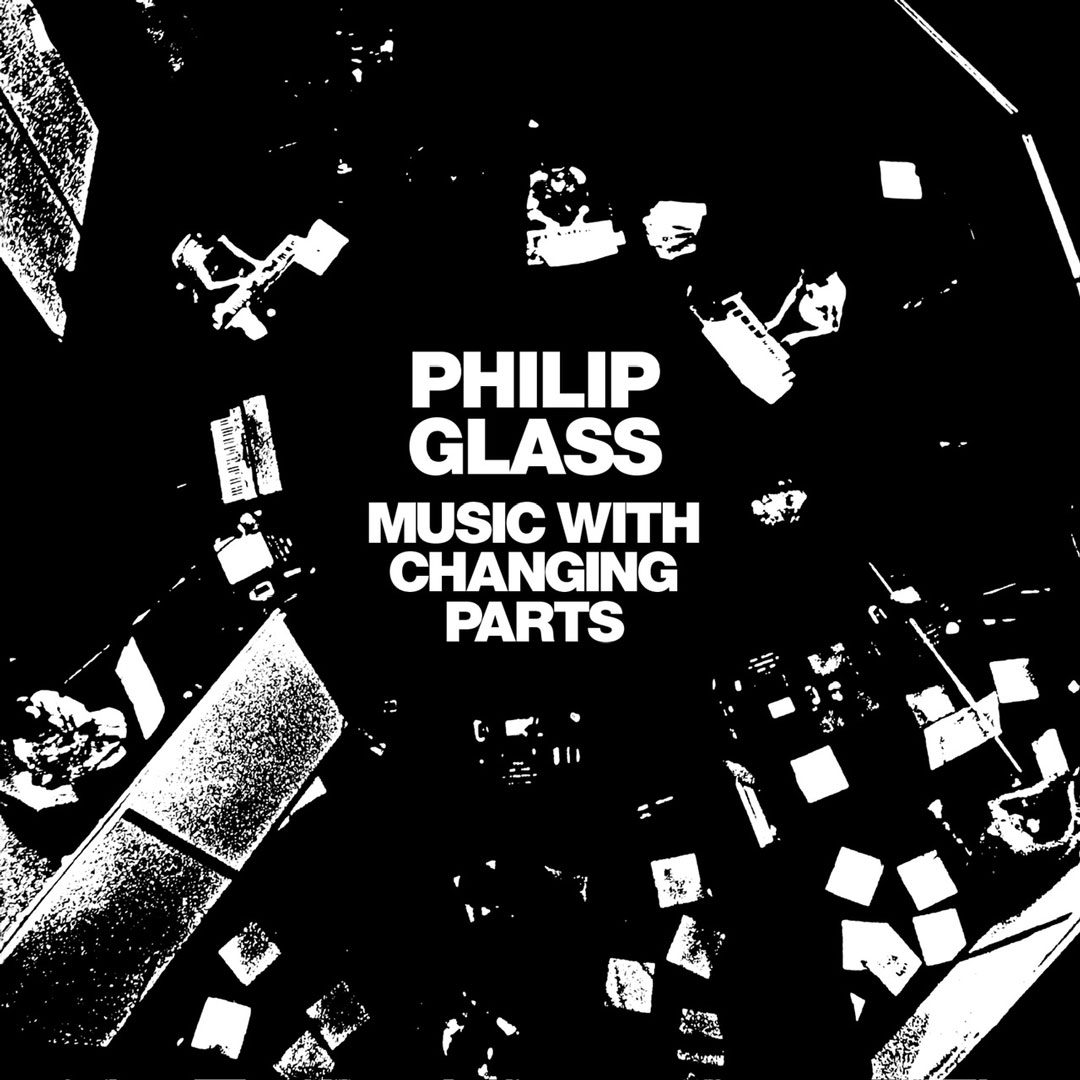
“We don’t throw the term “masterpiece” around often, but ‘Music With Changing Parts’ is exactly that.”
With nearly a decade and a half of activities behind them, assembling a truly astounding catalog of releases under its umbrella, Superior Viaduct returns with one of the most important releases to grace their catalog to date: the first ever vinyl reissue of Philip Glass’ seminal Music With Changing Parts. A cornerstone in American Minimalism, originally released on the composer’s own private imprint, Chatham Square, in 1971, this towering effort, confronting hypnotic sheets of pulses and arpeggios at a furious BPM, marked Glass’ recording debut and emergence into the broader cultural consciousness beyond New York, forever changing everything in its wake. More than half a century on its influence is everywhere, while the source and root remains one of the most engrossingly immersive listens ever laid to tape.
Having already graced 2026 with much needed reissues of Julius Hemphill's ‘Dogon A.D.’, Noah Howard’s ‘The Black Ark’, and Luciano Cilio’s ‘Dialoghi Del Presente’, Superior Viaduct ups their own game with the first ever vinyl reissue of a foundational cornerstone of American Minimalism, ‘Music With Changing Parts’, the debut LP by Philip Glass. Originally issued in 1971 on Glass’ own, privately run imprint, Chatham Square - also the original home for Jon Gibson and Richard Landry’s early efforts that Superior Viaduct previously explored - alongside roughly contemporaneous releases by Terry Riley, Steve Reich, and La Monte Young, ‘Music With Changing Parts’ propelled a new vision of the avant-garde beyond its testing ground in New York across the globe. Composed in 1970, the four-part composition embodies a perfect balance of rigor, ambition, and constraint for which the composer has been forever famed, distilling entire worlds within its hypnotic, rippling tones. After more than a half century, it still manages to present endless streams of revelation and surprise in ways that only great art can.
Born in Baltimore, Maryland, in 1937, Philip Glass stands high among the most celebrated American composers of all time. Having helped pioneer the movement of musical Minimalism during the 1960s - signaling a new evolution of the avant-garde - his efforts belong to a canon of music that remains remarkably popular and influential to this day. Born into a musical family, a gifted child who would go on to the Juilliard School of Music, despite having been an early convert to the avant-garde, Glass’ evolution toward the revolutionary territory of composition through which he would make his name was slow to unfold. As he later stated, when speaking of the creative landscape into which he emerged: "That generation wanted disciples and as we didn't join up it was taken to mean that we hated the music, which wasn't true. We'd studied them at Juilliard and knew their music. How on earth can you reject Berio? Those early works of Stockhausen are still beautiful. But there was just no point in attempting to do their music better than they did and so we started somewhere else." The eventual development of the composer’s singular musical language drew upon multiple streams: elements drawn from modernist theatre, encounters with Indian Classical music while collaborating on a film soundtrack with Ravi Shankar and Alla Rakha during the mid-1960s, and the early innovations of his friend and peer from Juilliard, Steve Reich, with whom he reconnected upon his return to New York in 1967. Having already refined his signature approach and been active for a number of years, it wasn’t until 1970, when Glass was in his mid-30s, that he set out to record his first full-length LP ‘Music With Changing Parts’.
In retrospect, particularly given that his immediate peers in the development of musical Minimalism - Reich, Riley, and Young - began releasing recordings during the late 1960s, it seems surprising that a composer of Glass’ subsequent stature would have found little opportunity to record, leading to the necessity of founding his own imprint, Chatham Square, to release his debut. The inaugural release on a label that would go on to release important LPs by Michael Snow, Richard Landry, Jon Gibson, and Arthur Russell, in addition to his own, as Glass describes in his memoir ‘Words Without Music’, he secured a $500 interest-free loan for the recordings' initial release from the Hebrew Free Loan Society, with which he embarked upon the recording of ‘Music With Changing Parts’ (composed in 1970 and recorded at New York’s Public Theater in 1971, with the original line-up of the Philip Glass Ensemble, including himself playing electric organ and alto flute; Jon Gibson on soprano saxophone, flute, and voice; Richard “Dicky” Landry on soprano and tenor saxophone, piccolo flute and voice; Robert Prado on trumpet, flute, and voice; and Arthur Murphy on Farfisa electric piano; as well as Barbara Benary on violin and vocals, and Kurt Munkacsi on electronics). Divided into four parts that collectively amount to just over an hour of groundbreaking music, it would change the musical landscape upon its release, establishing a set of signifiers in public consciousness regarding Minimalism that arguably eclipsed those of his esteemed peers.
‘Music With Changing Parts’ reveals Glass as a fully formed composer, rather than representing tentative early steps. Most of the hallmarks of his subsequent works - cycling arpeggios, the melding of electronic and acoustic instruments, the elongated vocal drones, and emphasis on pulse and repetition - are already present and refined to the point of rigorous balance and equilibrium. While it is hard not to refract the composition through all of those that followed by Glass, what we know of him, and the monumental influence of his efforts, what is particularly striking about ‘Music With Changing Parts’ is the pace of its drive and tempo. The work delivers its sheets of pulses and arpeggios at a furious BPM, the likes of which would have been unheard of in American music until the emergence of Techno decades later, nodding - albeit through a very different manner of composition, instrumentation, and aesthetics - toward numerous ecstatic musical traditions from across the globe. As such, ‘Music With Changing Parts’ represents the first realisation of a truly ecstatic and transcendental form of American music. Defying the need for (and perhaps the possibility of) detailed description - it is something to be experienced as an immersive whole - ‘Music With Changing Parts’ is hypnotic and captivating. As its cycling patterns of tonal and rhythmic intersections unfold and alter their tempos, the perception of subtle variation toward a monumental scale, with Glass maximizing constrained structure and sonic material to an unprecedented result.
We don’t throw the term “masterpiece” around often, but ‘Music With Changing Parts’ is exactly that. Its place in history, alongside its lasting legacy, is proof enough. More than half a century on, it remains one of the most striking and important Minimalist works ever laid to tape, making the long wait for a vinyl reissue - the format for which it was conceived - that much more inexplicable. Once again, Superior Viaduct has made the seemingly impossible real with their stunningly produced X2LP reissue, immaculately reproducing all that made the original Chatham Square edition so special. This is sonic joy on a towering scale.
Originally published by Soundohm.