
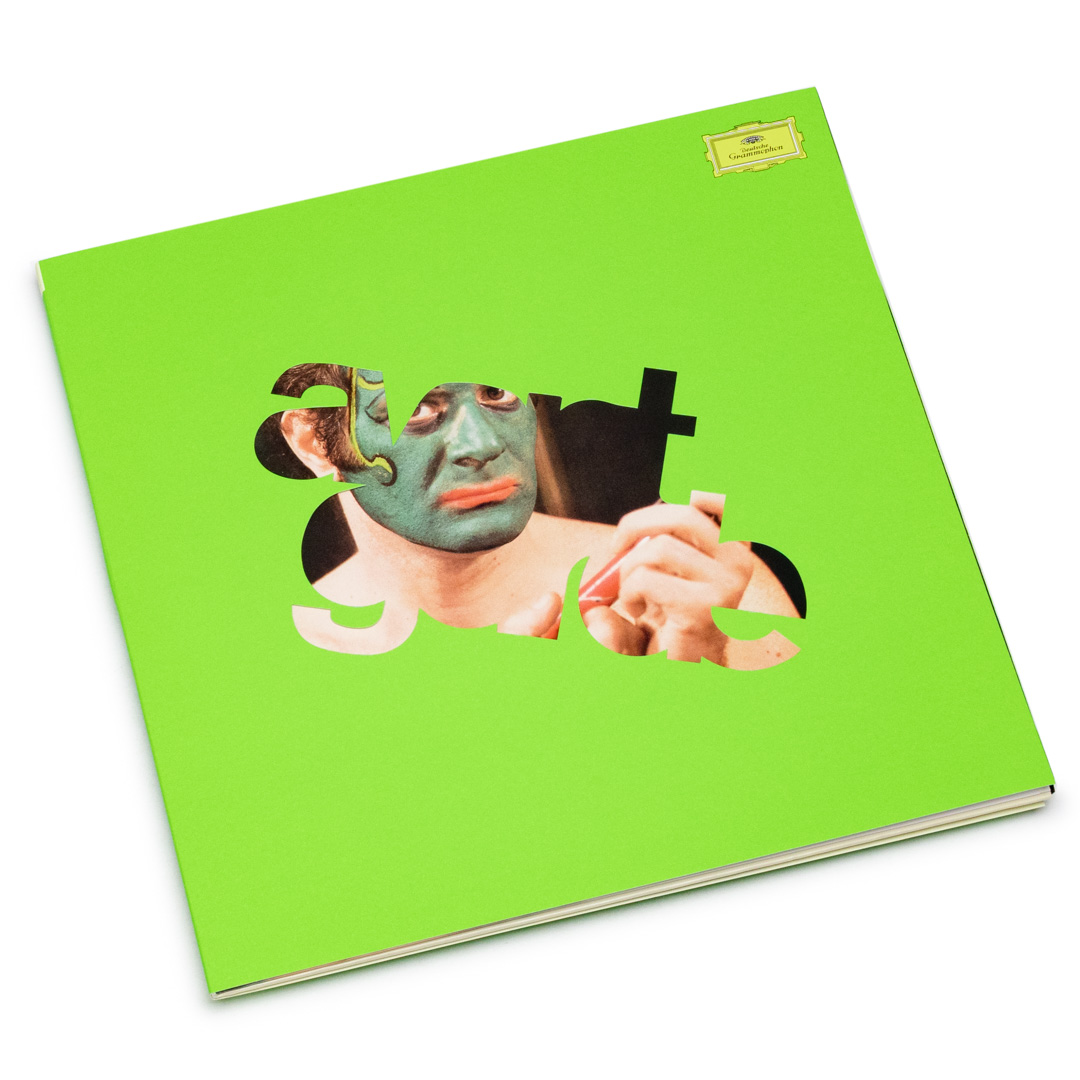
“Within the slim catalog of recordings produced between the early 1950s and late 1970s, attending to avant-garde chamber, orchestral, and electroacoustic music, few are as historically significant and influential as Deutsche Grammophon’s Avant-Garde series.”
Earlier this year, Deutsche Grammophon announced and delivered one of the most exciting initiatives in recent memory: a brand-new audiophile vinyl reissue series dedicated to crucial avant-garde and experimental works from its own extensive catalog. Beginning with Luc Ferrari’s ‘Presque Rien No.1 / Société II’ (1970), Mauricio Kagel’s ‘Acustica’ (1972), and Tōru Takemitsu’s ‘Quatrain / A Flock Descends Into The Pentagonal Garden’ (1980), these deluxe limited editions completely blew us away, returning our ears to some of the most groundbreaking efforts within the canon of the 20th Century avant-garde composition. Now, as we ease into the summer months, they return with the latest installment from the initiative, which may just be better than the last, delivering deluxe, audiophile, first-ever vinyl reissues of Mauricio Kagel’s ‘Exotica’ (1972), The Scratch Orchestra’s ‘The Great Learning’ (1971), and Roland Kayn and Luigi Nono’s ‘Cybernetics III / Contrappunto Dialettico Alla Mente’ (1970).
Within the slim catalog of recordings produced between the early 1950s and late 1970s, attending to avant-garde chamber, orchestral, and electroacoustic music, few are as historically significant and influential as Deutsche Grammophon’s Avant-Garde series. Collectively comprising 24 LPs, issued in four suites of six between 1968 and 1971, it contains some of the most radical and groundbreaking musical gestures of its time, created by many of the most important voices of the post-war period: Luciano Berio, Karlheinz Stockhausen, Gruppe Nuova Consonanza, Mauricio Kagel, John Cage, Cornelius Cardew & The Scratch Orchestra, György Ligeti, Earle Brown, Luc Ferrari, Franco Evangelisti, Krzysztof Penderecki, and numerous others. For generations following in the series’ wake, it represented a crucial and deeply inspiring means through which to begin to reconstruct and access the very origins of experimental music at large, becoming hotly collected and pursued. Having remained out of print on vinyl for decades, earlier this year Deutsche Grammophon took a deep dive into their own archives and embarked upon an initiative to reissue some of the most important and sought after avant-garde releases in their catalog on vinyl for the first time, not only tapping the original series’ key titles, but also crucial avant-garde and experimental works from the label’s expansive discography. Issued in incredible, limited-edition audiophile reissues - accessing newly revealed details, dynamics, and dimensions of these historical recordings - that have been fully remastered and recut from the original 1/2 inch analog tapes by Rainer Maillard and Sidney Claire Meyer at Emil Berliner Studios, and come housed in deluxe sleeves perfectly reproducing the original covers and liner notes, complemented by a stunningly produced die-cut slipcover containing extensive, newly commissioned liner-notes by Bradford Bailey, that illuminate important historical context and dimensions of these seminal works and composers afforded by the passage of time.
Alongside ‘Acustica’, originally released the same year, in 1972, Mauricio Kagel’s ‘Exotica’ stands as arguably the Argentine composer’s most celebrated, sought after, and complex work. Commissioned as part of the 1972 Munich Olympics sweeping cultural program, rather than play by the rules, Kagel composed a work that was radically ahead of its time, utilizing more than 200 instruments from around the globe to construct a searing critique of whiteness, the ham-fisted polyculturalism of the Olympics’ program, and tendency for artists from Europe and the United States to other, through acts of appropriation from cultures other than their own, stating that “White musicians certainly wouldn’t get far with this piece. But others?”.
Imbued with Kagel’s wry humor, sense of paradox (not the least being that all of the musicians on this recording of Exotica - Wilhelm Bruck, Christoph Caskel, Vinko Globokar, Siegfried Palm, Michel Portal, and Theodor Ross - are white) and deep sense of sociopolitical consciousness as a self-described “soft anarchist”, ‘Exotica’ was remarkably groundbreaking, appearing six years before Edward Said’s text, Orientalism - sharing many of its sentiments and themes - encountering the composer calling both his own context and society at large to account in ways that are only fully beginning to become the norm today.
Weird, funny, clattering and squealing across its two stunning sides, ‘Exotica’ remains a rare moment where experimental music stepped out of its own shadow and asked questions that needed to be asked, presenting creative brilliance of profound power, while delivering a critique from Kagel’s distinctly Latin American point of view. It’s an absolute marvel that will leave any listener with plenty to think about as it calls them back to its truly remarkable sounds.
The Scratch Orchestra’s 1971 performance of Paragraph 2 and Paragraph 7 of the English composer Cornelius Cardew’s The Great Learning remains among the most beloved and enduringly complex to address of all the releases within Deutsche Grammophon’s original Avant-Garde series. The only release to document one of the era’s most important and influential musical collectives during its original period of activity, its sounds and the legacies of those who made it have rippled across the context of avant-garde and experimental music for more than fifty years. It was also, as with all of Cardew’s incredible works from this period, renounced by the composer as he drifted further into Marxist belief. Perhaps because The Great Learning is a political work of music - presenting a radically new means for collective interaction and simultaneous individual expression - and its subsequent rejection due to Cardew’s politics, the work continues to beg remarkably prescient questions about purpose and place of experimental music in the world.
Despite the serious questions and demands it renders, The Great Learning is equally rare within the canon of post war avant-garde music for the pure joy of its experience: a glorious explosion of collective organization and freedom - largely built from percussion and vocals - that stands as a potent reminder of music’s humanity and capacity for play, capturing a fertile moment within the Scratch Orchestra before it fell prey to internal tensions and members began to go their own ways.
The third entry in this batch of Deutsche Grammophon’s audiophile reissues - a split LP, originally released in 1970 within the label’s Avantgarde series, comprising Roland Kayn’s ‘Cybernetics III’ and Luigi Nono’s ‘Contrappunto Dialettico Alla Mente’, serves as a fascinating illumination of how the series often operated as well as its groundbreaking nature. As Bradford Bailey points out in his newly commissioned liner notes for the reissue, with these works by Kayn and Nono “encountered as corresponding sides of the same LP, the plurality activated by their conjunction foreshadows important shifts in experimental music that would emerge over the ensuing decades, revealing diverse, highly personal practices coexisting in dialog, populated by ideas that were largely at odds with their own context, but can now be regarded as ahead of their time.”
While remarkably different in both approach and form, both works appearing on this LP are efforts of musique concrète, rooted in recordings of the human voice, that buck the dominant tides most commonly associated with that idiom. Speaking to their power, Contrappunto Dialettico Alla Mente was commissioned by Radio Audizioni Italiane (RAI) as an opera for radio broadcast, before being rejected for fear of political controversy because of its pointed commitment to the struggle of African Americans for social and political equity. ‘Cybernetics III’, on the other hand, stands at the relative beginning of Kayn’s attempt to generate music from ‘self-governing processes in the studio... sounds drive other events.. a bridge between man and machine…, that would both drive him into subsequent obscurity, before emerging within the 21st Century to the regard of having been one of the most groundbreaking and forward-thinking composers of his generation.
Absolutely engrossing both in contrast to each other and as free-standing, autonomous works, for years ‘Cybernetics III / Contrappunto Dialettico Alla Mente’ has remained one of the most sought-after and celebrated releases in Deutsche Grammophon’s original Avantgarde series, not only displaying singular creative vision on the part of its composers, but a sense of purpose and meaning that was so incredibly ahead of its time - be it through our contemporary relationship to politics or technology - that the album’s meanings and potential are only beginning to come into focus today.
Originally published by Soundohm.