
“She was a composer of profound and generous power, creating work rooted in worldly experiences that transcended the earthly realms.”
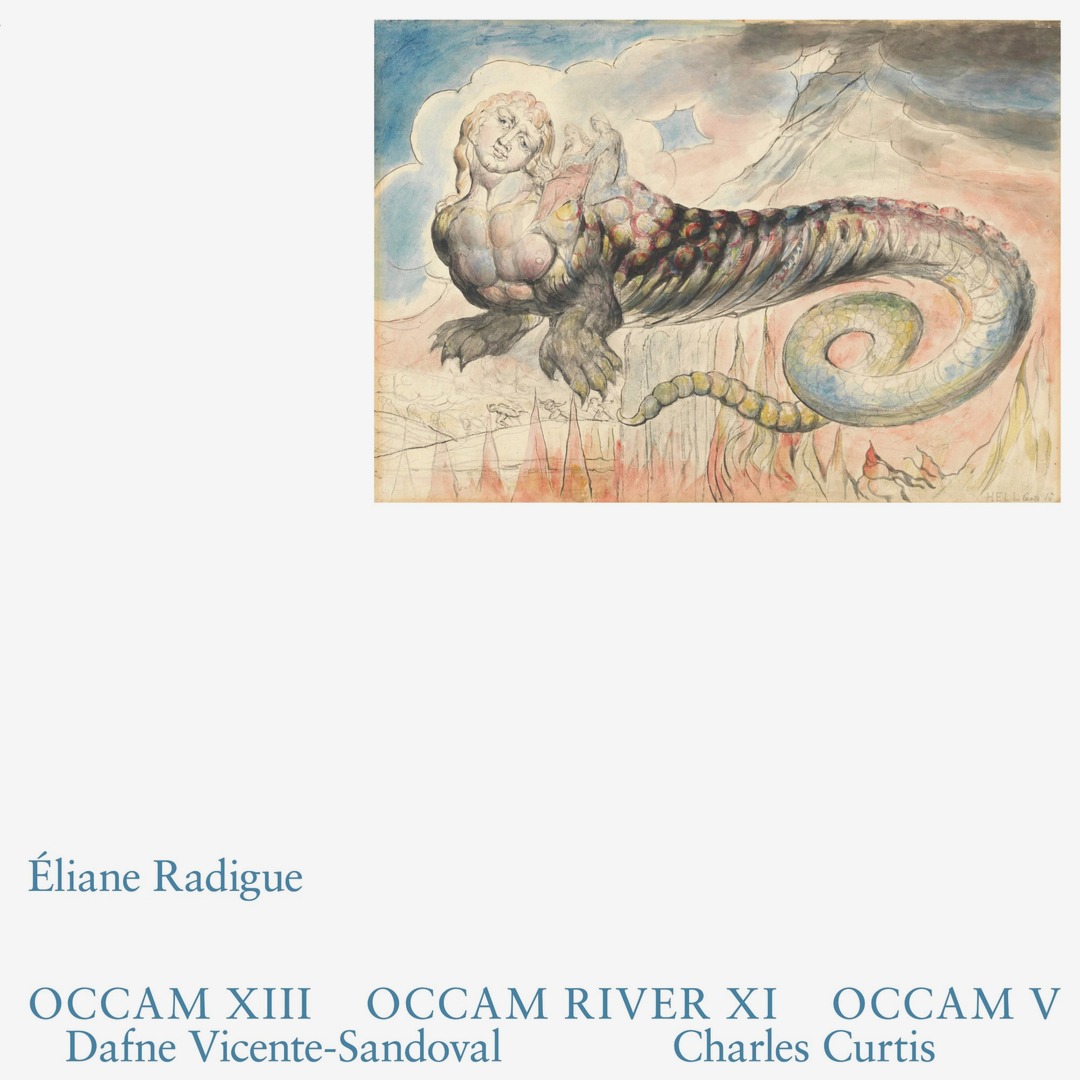
Having already worked with many of the greatest composers of the last 50 or so years, at long last the venerable, New York based cultural platform and imprint, Blank Forms, embarks upon their first release with the late, great French composer, Éliane Radigue, delivering the monumental X2LP (and CD) ‘Occam XIII’, ‘Occam River XI’, and ‘Occam V’. Comprising four profoundly compelling and sonically immersive performances by the bassoonist, Dafne Vicente-Sandoval, and the cellist Charles Curtis - each working with meticulous and exacting focus to extract astounding scope and range from each work's constrained materiality - these stand among the most important recordings of Radigue's 'Occam' works to have appeared so far.
While still mourning her passing earlier this year, we’re currently in the midst of an incredible period of releases of works by the French composer Éliane Radigue that has witnessed, within a handful of months, the first ever vinyl pressing of her groundbreaking, 1978 work, ‘Triptych’, by Important Records, and Alga Marghen's X6LP Box Set 'The Complete Feedback Works'. While those releases addressed Radigue’s more historical output, Blank Forms now adds crucial counterbalance with the release of ‘Occam XIII, Occam River XI, Occam V’, comprising an incredible series of later works, created in collaboration with the bassoonist, Dafne Vicente-Sandoval, and the cellist Charles Curtis. Belonging to the interactive practice developed and embraced by the composer over the last two decades of her life - a scoreless method of composing in dialogue with each performer - instigated with Curtis through ‘Naldjorlak’ (2005-2009) before eventually developing into Occam series’ more than eighty discrete compositions. Amongst the remarkable cast of musicians for and with whom Radigue developed Occam pieces - Julia Eckhardt, Rhodri Davies, Carol Robinson, Frédéric Blondy, Silvia Tarozzi, Deborah Walker, Nate Wooley, and a great many more - Curtis remained a regular collaborator, though to date only ‘Occam V’ has been released. Blank Forms’ stunningly produced X2LP and CD edition - their first release of the composer’s work - co-released with La Becque Editions, takes great leaps toward illuminating this remarkable collaboration, comprising three works - ‘Occam XIII’, ‘Occam River XI’, and ‘Occam V’ - composed with Curtis and Vicente-Sandoval, before being recorded at Temple Saint-Théodule, La Tour-de-Peilz, in 2024. Subtle and engrossing through highly tuned sonic relationships that indicate an expansive scope far beyond the realms of sound, these masterful performances by two of the most talented instrumentalists working today are easily among the most striking of Radigue’s ‘Occam’ to have appeared in recorded form so far, culminating as one of our favorite records of 2026.
Born in 1932, following decades spent working in relative obscurity, over the last 30 years of her life, the French composer, Éliane Radigue, came to be widely recognized as one of the most singular and important artists working in the field of experimental sound: a visionary mind who quietly blazed trails for more than half a century, leaving an unparalleled body of work in her wake. Radigue began her musical endeavors in Paris during the late 1950s and early 60’s, working under Pierre Schaeffer and Pierre Henry, before quickly outstepping the limits of her mentors. First working predominantly in tape, producing a significant body of works centered around the production of feedback, during the early 1970s she made the radical switch to modular synthesis. Over the next three decades, drawing on her practice as a Buddhist, she dedicated herself to an intimate relationship with her ARP 2500, exploring it endlessly, pushing her own notions of musicality and subsequently forever altering the experimental landscape - particularly those connected to Minimalism and electronics - through the release of works like ‘Songs Of Milarepa’, 'Kyema', 'Trilogie De La Mort', 'Adnos I-III', and ‘Triptych’ on imprints like Lovely Music, Experimental Intermedia, Table of the Elements, and Important, among others. During the early 2000s, following a brief retirement, Radigue made the unexpected shift toward composing for acoustic instruments, reinvigorating her career and cultivating a new level of renown, first with ‘Naldjorlak’, created with the cellist Charles Curtis, and then, most notably, via the sprawling, constantly evolving series of ‘Occam Ocean’, composed through an intimate process of collaboration with specific instrumentalists, including Curtis in repeated instances.
Among the most important musicians working in the field of experimental music, Charles Curtis studied at Juilliard, before spending a decade as the Principal Cellist of the NDR Symphony Orchestra in Hamburg, alongside extensive work with numerous other orchestras and chamber music ensembles. Always ambitious and forward thinking, during the 1980s he studied with La Monte Young, subsequently working closely with the composer, becoming an important vehicle for his work through performances of ‘Four Dreams of China’, ‘Composition 1960 #7’, ‘Poem for Chairs, Tables and Benches Etc.’, and ‘Trio for Strings’, as well as having ‘Just Charles and Cello in the Romantic Chord’ composed for him, the only solo work ever created by Young for a performer other than himself. Over the coming decades, Curtis would develop similar collaborative relationships with other composers, including Alison Knowles, Alvin Lucier, Tashi Wada, and most importantly in this case Éliane Radigue, who at the time of their introduction had quietly retired. Despite having not composed for acoustic instruments since the early to mid 1960s, Curtis managed to plant the seed that would first result in ‘Naldjorlak’ - her first acoustic composition since ‘Asymptote Versatile’, which remained unrecorded and unreleased until last year when an ensemble led by Rhodri Davies brought it to light - before flowing into the practice that would underscore the ‘Occam’ series and instigate a new widely celebrated renaissance in her work.
While active on the experimental music scene for years, working with composers and artists like Jakob Ullmann, Christoph Schiller, Sébastien Roux, Hanna Hartman, Phill Niblock, and Rhodri Davies, the French bassoonist, Dafne Vicente-Sandoval, has generally maintained a quieter profile than Curtis. It’s only since 2023, when her piece, ‘Minos Circuit’, was issued by Portraits GRM, that her remarkable talents have begun to perk the quantity of ears that they deserve. For those paying attention, Vicente-Sandoval’s relationship with Éliane Radigue percolated over the years, with the bassoonist capturing hearts with her article on the composer, ‘Living Materials’, published in Sound American No. 26: ‘The OCCAM Ocean Issue’.
While the curation of Blank Forms’ release seems logical enough - collecting works by Radigue, composed for and with these two instrumentalists - it is slightly more considered, resulting in a dynamic illumination of the nature of her practice. Comprising ‘Occam XIII’, a work for solo bassoon; two different renderings of ‘Occam River XI’, a duo for cello and bassoon; and ‘Occam V’, a work for solo cello, the collection invites the mind and ear into the congruencies presented across the Occam works, while also activating a relationship with particularities and personal characteristics brought to each of its pieces by performers, and thus the openness of the works themselves, which are calibrated to the particular sounds and techniques of each individual player and their instrument, indelibly stamping them into the composition. “The piece composes the playing of that musician, as much as the musician plays the composition.”
While Radigue chose her collaborators carefully - all are remarkable musicians in their own right - it is hard to think of any more focused and exacting to her concerns than Vicente-Sandoval and cellist Charles Curtis. Beginning with ‘Occam XIII’, Vicente-Sandoval faces the piece’s materiality with exacting focus and meticulous resolution. Largely comprised of durational, lower register pulses that rumble the soul, like most ‘Occam’ pieces, an awakens of profound range and detail emerge slowly from constrained structures and forms: layers of dancing, subtle harmonics and textures continuously altering the listener’s relationship of scale and event, becoming that much more pointed in its presentation as the bassoonist resolves with almost imperceptible, delicate timbral work. This is followed by the first rendering of Vicente-Sandoval and Curtis’ duo, ‘Occam River XI’, composed by Radigue for them both. From the earliest moments, the synergy between the two players is deeply compelling and unmistakably present, with the cello laying down a bedrock of slowly evolving long-tones, forcefully met by the deep tones of the bassoon, creating a dynamic, minimalist structure of emotive power, as the pair move into more complex waters of psychoacoustic beating patterns and tonal tension that completely immerse the body and mind.
With structural synchronicity, the third side returns to solo performance, in this case ‘Occam V’, played by Curtis. As is always the case, when faced with the cellist’s work, we are treated to a masterclass in range and control, culled from the most minimal means in ways that only he is uniquely capable. While effectively a work of acoustic drone - there isn’t a rest during its roughly 14-minute duration - the piece’s slow evolution, moving through immersive and at times tense tonal relationships, psychoacoustic phenomena, and delicate treatments of texture, is a deeply moving reminder of how much Radigue and Curtis could extract from constrained means, and how truly singular and rewarding their working relationship was. Concluding the collection is a second performance of ‘Occam River XI’ by Vicente-Sandoval and Curtis. While close in the presentation and inherent qualities, this performance possesses a greater tangibility of the space in which it was recorded and possibly a greater textural sense of each instrument and its material properties. While neither is better than the other, the second possesses a raw directness, the presence of which plays back as a reflective refraction between the pair.
While we’ve said plenty, words always seem to fall short when it comes to Radigue. She was a composer of profound and generous power, creating work rooted in worldly experiences that transcended the earthly realms. If there is a single take away from Blank Forms’ release of Dafne Vicente-Sandoval and Charles Curtis’ performances of ‘Occam XIII, Occam River XI, Occam V’, it is this transcendence activated through sound.
Originally published by Soundohm.