“Incredibly inspiring and provoking captivating awe at every turn, these are easily some of the best free jazz records to have been laid to tape during the 90s, not to mention since.”
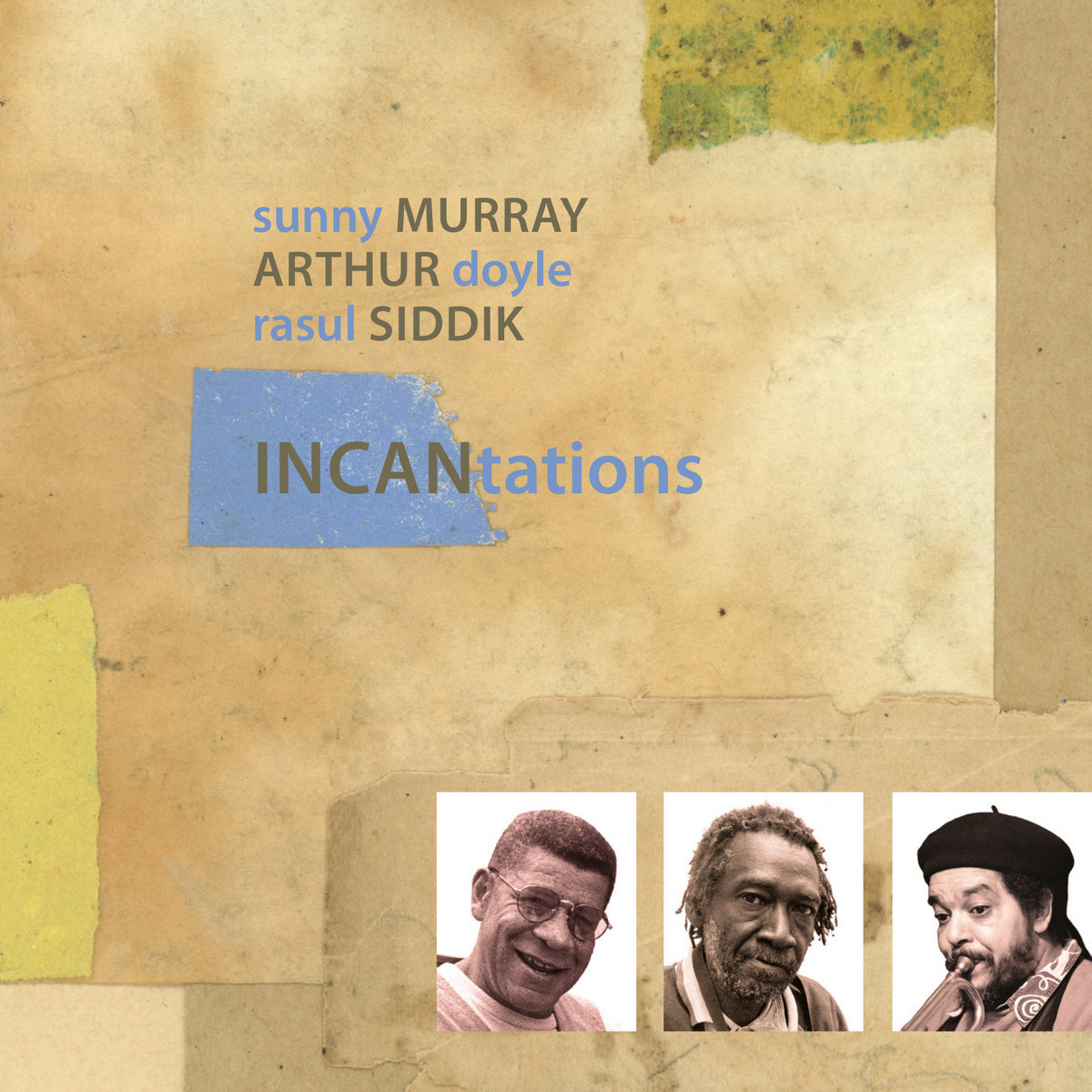
Continuing their incredible work of constantly elevating and rewriting the histories of jazz and freely improvised music, NoBusiness Records returns with two of the most striking and creatively compelling archival releases we’ve encountered so far in 2026: ‘New Light’ and ‘Incantations’, a never before issued body of recordings laid to tape by the largely unknown trio of Sunny Murray, Arthur Doyle, and Rasul Siddik. Ranging from furious fire to intricate and emotive delicacy, every moment that spans these two brilliant LPs is marked by towering artistry, developed by three of the great luminaries of the free jazz form, offering a potent proof that this vital music was thriving and driving as the 20th Century wound to a close.
Going through highs and lows in the cultural consciousness since its emergence from African American communities during the late 1950s, for nearly three quarters of a century free jazz has remained one of the most vital creative idioms within the musical avant-garde. Endlessly forging forward with an unparalleled radical spirit, forming the foundation of community, collaboration, and individual and collective expression that presents a fully liberated sonic space, that indicates what is possible on social and political terms beyond the sonic realm through its groundbreaking approaches to sound. For the most part, listeners tend to locate the most important activities of free jazz artists during the idiom’s heyday in the 1960s and 1970s. Since its founding in 2008, the Vilnius, Lithuania, based imprint, NoBusiness Records, has belonged to a small but stable network of labels rendering potent proof that this music has carried on without losing any of its fire, assembling a catalog of archival and contemporary releases by its most potent voices: Mats Gustafsson, Jemeel Moondoc, Barry Guy, Charles Gayle, William Hooker, Joe McPhee, Billy Bang, Julius Hemphill, Peter Kowald, Nate Wooley, Bobby Bradford, Frode Gjerstad, Ingebrigt Håker Flaten, Paal Nilssen-Love, John Tchicai, Evan Parker, Paul Lytton, William Parker, Alexander von Schlippenbach, Wadada Leo Smith, Marion Brown, Dave Burrell, Sam Rivers, and too many others to count. Now, emerging alongside their publication of Ed Hazell’s incredible book, ‘Energy Center’, charting the history of Sam and Bea Rivers’ Loft Jazz venue, Studio Rivbea, NoBusiness Records delivers ‘New Light’ and ‘Incantations’, two astounding never before released full-length recordings by Sunny Murray, Arthur Doyle, and Rasul Siddik, furthering NoBusiness’ remarkable efforts to construct a more dynamic and inclusive history of free jazz. Capturing three of the great luminaries of the art form, working in a trio formation of drums, saxophone, and trumpet at the venue, Thelonious, in Bordeaux, France, during late October of 1999, both albums seethe with energy, fire, and force during a moment when free jazz began to harness and internalize the attention and spirit of a new, young generation of fans at the end of the millennium. Once again, NoBusiness has leveled the field and shown us what it’s all about.
Many years ago, Anthony Braxton pointed out that every art form has a first wave of innovators who instigate revolutionary change; a second generation who receive less attention, while refining the idiom toward its highest state of accomplishment; and a final period of “classicism” where it enters into a state of stasis and preservation that can only be broken by a new wave of radicalism. Braxton, of course, was speaking most specifically of his own creative idiom, free jazz, which at that point, was entrenched within a relative low-point that spanned the 1980s and 90s, having witnessed many of its artists step back from its more forward-thinking temperaments. Building upon the early innovations of artists like Ornette Coleman, John Coltrane, Albert Ayler, and Cecil Taylor, freely improvised jazz represented a distinctly African American pursuit of the avant-garde that mirrored the social and political temperaments within that community - searching for justice and fully liberated forms of freedom and collaboration - during the 1960s and 70s. Despite quickly catching fire and becoming adopted by countless artists from different cultures across the globe, as the years passed free jazz artists, particularly those who remained in the United States, increasingly found themselves isolated with fewer opportunities to play and record than those of the Be-Bop and Post-Bop eras. Taking matters into their own hands, many left the US for greener and more supportive pastures of Europe, or started their own record labels and venues to support their own work and that of their peers. While relatively hard times, the music that blew forth remains some of the most groundbreaking and vital of the 20th century. Among the most important and innovative artists of this context were the drummer Sunny Murray, the saxophonist Arthur Doyle, and the trumpeter Rasul Siddik, the three of whom are captured in a rare trio by ‘New Light’ and ‘Incantations’.
Sunny Murray will need no introduction to even the most casual fans of free jazz. Arguably the most important drummer of the movement’s first wave, Murray cut his teeth working in the groundbreaking bands of Cecil Taylor, Albert Ayler, and John Coltrane, before, in 1965, venturing out on his own as a leader, delivering a startlingly potent debut, ‘Sonny's Time Now’, featuring Ayler, Don Cherry, Henry Grimes, and Lewis Worrell, that was privately issued by Amiri Baraka’s legendary Jihad imprint, that was followed by hugely important full lengths on ESP, Pathé, BYG Actuel, and Shandar, each laying a foundation for evolutions within the context that emerged in their wakes. A drummer and leader of rare force and power, as the writer Val Wilmer once stated: “Murray's aim was to free the soloist completely from the restrictions of time, and to do this he set up a continual hailstorm of percussion… lay[ing] down a shimmering tapestry behind the soloist, enabling him to move wherever he wanted.”
Arthur Doyle, almost a decade younger than Murray, belongs to the second wave of free jazz that would refine and push the idiom across the 1960s and 70s. Remarkably, despite being regarded as one of the fiercest saxophonists of his generation, Doyle began his professional career playing in the popular realms with Gladys Knight and Donny Hathaway, as well as straight-ahead jazz in the band of Louis Smith. It was through his involvement with civil rights and playing at a Black Panthers festival, that his singular approach to the instrument - raw, deeply human, and urgent - began to emerge. In 1968, he relocated to New York City and began working with Sun Ra and Bill Dixon, before making his recording debut as a member of the ensemble that recorded Noah Howard's legendary ‘The Black Ark’. Over the coming years, Doyle would maintain himself as a central force within New York’s flourishing, DIY loft jazz scene, as well as notably contributing serious fire across the length of Milford Graves’ seminal ‘Bäbi’ and recording his own debut as a leader, ‘Alabama Feeling’, which appeared in 1977 on Charles Tyler’s Ak-Ba Records. It was this album, alongside Sunny Murray’s ‘Sonny's Time Now’, through its appearance on Thurston Moore’s now legendary 1996 ‘Top Ten Free Jazz Underground’ list, that would help spark a new generation’s interest in free jazz during the last years of the previous millennium.
By far the least well known of the three, largely due to his tendency to work as a side-man rather than a bandleader, Rasul Siddik is a hugely significant figure in the idiom of free jazz and a player of profound power. First appearing as a member of St. Louis’ Creative Ensemble - a band associated with The Black Artist Group and The Human Arts Ensemble - within which he played with Charles "Bobo" Shaw and Joseph Bowie, he eventually relocated to Chicago where he joined the Association for the Advancement of Creative Musicians (AACM), and eventually becoming a steady member of Henry Threadgill's sextet, as well as playing and recording regularly with Lester Bowie, Oliver Lake, David Murray, and Julius Hemphill, among others.
While Sunny Murray had belonged to the great free jazz migration that unfolded during the late 1960s, living in Paris from 1968 to 1971, he returned to the United States for a number of decades, before returning once again to France during the 90s where he lived out the remainder of his life. It was during this same period that both Doyle and Siddik also moved to France, bringing the three luminaries into a closer orbit. Doyle and Murray would release two full-lengths as a duo during the early 2000s, and Murray and Siddik would work within a jointly billed quartet with Christian Brazier and Sophie Agnel during the late 90s. However, little known over the decades was the fact that these three players came together within a seemingly short-lived trio, never before released in recorded form prior to the appearance of ‘New Light’ and ‘Incantations’, now issued by NoBusiness Records.
In more ways than one, ‘New Light’ and ‘Incantations’ are effectively a pair and arguably best addressed and listened to as such. Both albums were recorded by the trio of Murray, Doyle, and Siddik on the same day - October 21st, 1999 - at the longstanding jazz venue, Thelonious, in Bordeaux, France. ‘New Light’, featuring Murray behind the kit; Doyle on tenor saxophone, flute, and vocals; and Siddik on trumpet, comprises four pieces: an untitled improvisation, a brilliant rendering of the Doyle penned ‘African Express’, an equally potent rendition of Don Cherry’s ‘Complete Communion’, and a fourth piece, the title of which remains unidentified. Beginning with a raw and soulful saxophone passage by Doyle, Murray then launches in with a vibrant, textured solo, with Siddik then following suit with creatively brilliant timbral and tonal work on trumpet before the three finish out together with a stunning collective dance featuring astounding playing by each. From here they pick up the pace with rapid fire delivery, as each player pushes the others forward with the fuel of the heart, before launching into a joyous and playful rendering of ‘Complete Communion’, with Murray’s free-flowing work behind the drums keeping things in solidly abstract realms, before concluding the set with a stunningly emotive improvised ballad, the glacial movement of which keeps you on the edge of your seat every step of the way.
‘Incantations’, featuring the same instrumentation as its companion, comprises five pieces: three unidentified tunes, the Doyle penned ‘Goverey’, and a ‘trio improvisation’. Launching to some serious fire, firmly grounded abstraction, the trio is off to a killer start from the opening notes, howling and rattling in the best free jazz any of us are likely to encounter from the final years of the last millennium, dancing around subtle deconstructions of an unknown tune. As they move further into the set, Murray providing a driving pulse, Doyle and Siddik continuously add fuel to the flame, pushing hard toward remarkably thrilling sonic unknowns, increasingly picking up the pace as they go, marked by an especially moving passage during which Doyle sets down his sax and lets his voice offer a foil for his collaborators. As the second side gets underway with Doyle’s ‘Goverey’, primarily rendered on flute met by sparse textural work by Murray’s drums, restraint, precision, and emotively rich artistry packs a powerful punch with the most minimal of means, before launching back into a lengthy passage of pure, driving fire that rounds out the LP.
Whether confronted together or separately, ‘New Light’ and ‘Incantations’ are nothing short of an absolute revelation, offering a rare and previously inaccessible window into the work of three of free jazz’s great luminaries at the end of the 20th century. Not only proving that this art form didn’t wither and die during the dark years of the 1980s, but rather thrived and grew, these newly unearthed recordings provide a potent proof of the power of staying the path and of creative collaboration at large. Incredibly inspiring and provoking captivating awe at every turn, these are easily some of the best free jazz records to have been laid to tape during the 90s, not to mention since.
Originally published by Soundohm.