“Vogler has further positioned themselves in our consciousness as a singular figure in the creative landscape of today.”
Hot on the heels of Holidays Records’ much needed, first-ever vinyl pressing of their mesmerizing 2025 full-length, ‘Au Nom Deus Asos’, Elizabeth Vogler returns with ‘Le Carnaval Perdu’, arguably their most engrossing and creatively ambitious recorded outing to date. Tapping their singular approach to folk traditions through the use of vocals and instrumental drones, this astounding LP forges deep into bristling experimental territories, radically deploying Vogler’s rigorous background in electroacoustic practice, culminating as a boundary blurring and profoundly emotive hybrid with almost no equivalent to be called to mind.
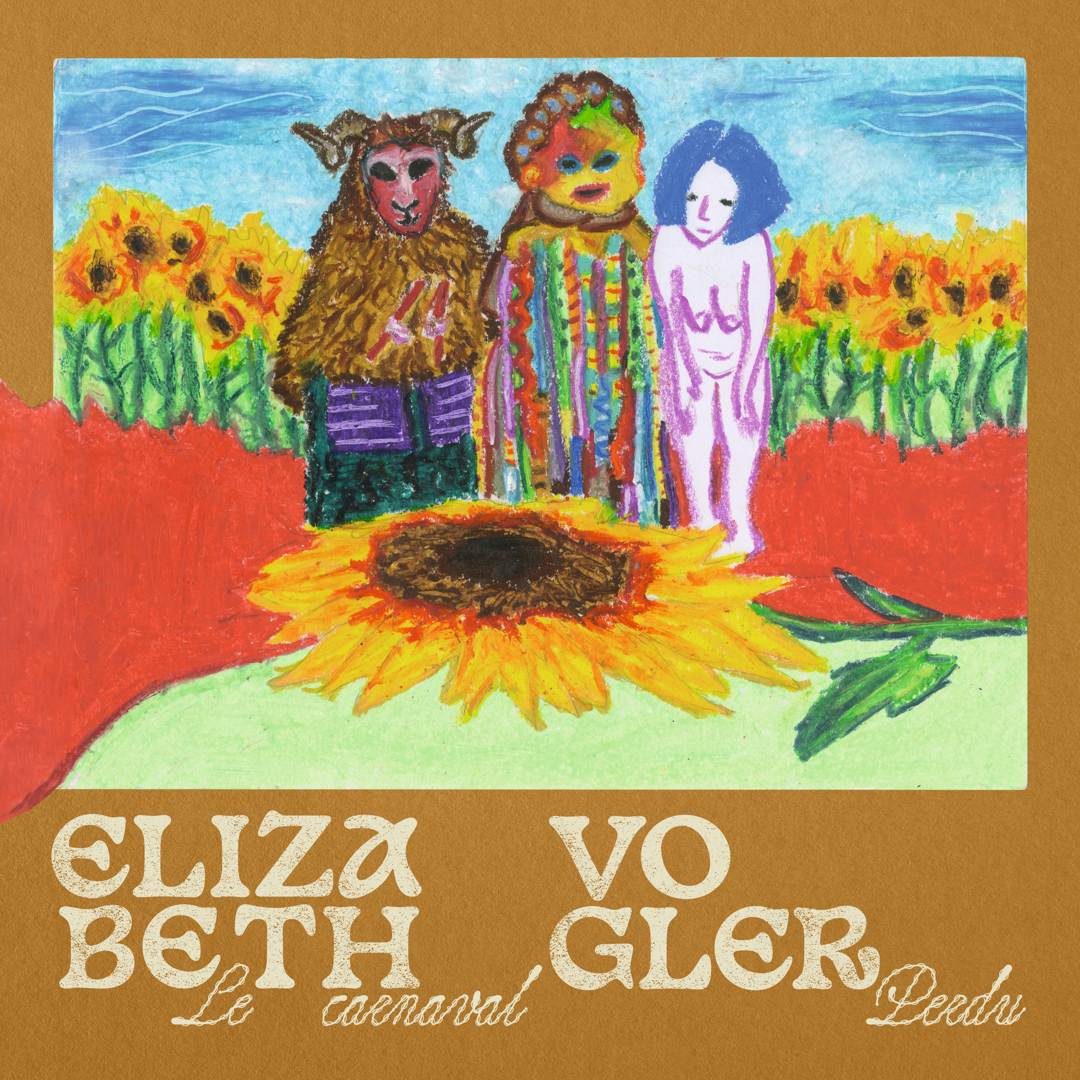
Since the practices of song collecting and folk revivalism began in the late 19th century, there’s been a danger of regarding historical forms of music through a nostalgic and romantic lens that calls us back to a simpler time. Despite the gravity of these charms, there have always been artists (Emmanuelle Parrenin, John Fahey, Lula Côrtes, Third Ear Band, and a near countless number of others) who have understood more ancient forms of music as holding a pathway toward something fundamental in us all and our need to express and commune through organizations of sound, harnessing their elements in new experimental and exploratory forms. One such case in the contemporary musical landscape is the French singer and instrumentalist Elizabeth Vogler, who loosely belongs to an incredible constellation of artists (Roxane Metayer, Lise Barkas, Delphine Dora, Luster, Jon Collin, etc.) currently working across Europe with intertwined sonic elements drawn from the indigenous folk traditions within frameworks of experimentalism. In recent years Vogler has developed a faithful following through riveting live performances, as well as two stunning full-lengths, including ‘Au Nom Deus Asos’, which received its first ever vinyl pressing via the venerable Holidays Records only last month. Now Vogler is back with their third full-length, the absolutely engrossing ‘Le Carnaval Perdu’, co-released by the fantastic trio of French imprints, Editentités, Illogique Musique and La République des Granges. Comprising eleven stunning tracks that thread their way across the beautifully produced vinyl edition’s two sides (housed in a sleeve featuring artwork by Vogler, providing a perfect pairing between the visual and auditory realms), it encounters the artist pushing their explorations of folk forms into increasingly experimental territory, incorporating elements drawn from pop, bal folk and Bulgarian polyphony, transforming their voice and long-tones, through electroacoustic interventions, into deeply personal folklore that is both timeless and entirely rooted in place. Vogler has further positioned themselves in our consciousness as a singular figure in the creative landscape of today.
Hailing from Southern France and trained in musicology and electroacoustic composition, for more than a decade Elizabeth Vogler has slowly carved out a unique territory within the sonic realm, singing in several polyphonic ensembles, creating electroacoustic compositions centered around voice and drones (combining choir-like layers, long-tones, electronics, field-recordings, and textures, described as “somewhere between imagined traditional song and unstable electronic ritual”), improvised performances, and increasingly unique expressions of experimental music that draw upon Bulgarian vocal techniques, and the Occitan traditions from Béarn, in the South of France, often singing in Béarnais, a dialect local to the region where she grew up. In 2024 and 2025 Vogler quietly released two full-lengths, ‘Les Mains Tordues’ and ‘Au Nom Deus Asos’, both projecting the singular territory explored within their work beyond the limits of live performance for the first time and receiving critical acclaim.
So far, Vogler’s recorded output has been fairly stripped back and elemental, internalizing its more experimental temperaments within primarily acoustic expressions: voice and instrumentation interacting with the properties of a given space. While still retaining this firm grounding, ‘Le Carnaval Perdu’ draws upon a greater breadth of Vogler’s musical practices, most specifically their strong background in electroacoustic composition, which becomes immediately apparent at the album’s outset through the presence of heavily processed sonic fragments and textures, alongside percolations of non-instrumental sound sources, which foreshadow and underscore the emergence of deeply emotive vocals, accompanied by the ebb and flow of shruti box long-tones. As the album progresses, Vogler’s sonic palette subtly expands, developing choir-like layers populated by field recordings of environmental sounds, untraceable pulses and ripples, and beautifully balanced electronic interventions, including tracks like ‘Le Temps Disgracieux’, ‘La Maison’, and ‘Les Autres Prisons’ that deploy the techniques of musique concrète and synthesis to weave states of near total abstraction. Still, despite the strongest use of experimental techniques and signifiers that we’ve encountered from the artist to date, Vogler continuously achieves the unexpected through the sheer power of their voice, singing in the distinct dialects of their native region in the South of France, culminating as a form of progressive and radically experimental folk music that draws on the ancient and elemental without indulging the rose colored tints of the past: an urgent music that draws upon a deep well in its quest for radical and forward looking forms.
When we had the great pleasure of shining light upon Elizabeth Vogler’s ‘Au Nom Deus Asos’ just a short while back - sparking a sonic love affair that has endured ever since - little did we know what they had lying in wait with ‘Le Carnaval Perdu’. Immersive, establishing a distinct locality at the juncture of folk, ambient music, and rigorously experimental electroacoustic practice (bringing together all of the distinct trajectories of their sonic explorations into a single, seamless form), it’s an absolute stunner, emotive as it is creatively and conceptually rich, that requires repeated immersions for its depths to fully reveal. It lands as one of 2026’s most surprising and exciting releases so far.
Originally published by Soundohm.