★Wergo
The Wild Beasts - Landmark Recordings
*2022 stock* Morton Subotnick achieved fame in the field of electronic music with Silver Apples of the Moon and The Wild Bull, his best-known tape works of the late 1960s. Since then, he has been active combining electronics with other media, notably employing gestural sketches on tape to alter sounds produced by voices and instrumentalists. The two works on this 2015 Wergo release are representative of Subotnick's methods, using a trumpet with a chamber ensemble in After the Butterfly, to reali…
Heliogabalus Imperator / Works For Orchestra
*2022 stock* The relationship between Hans Werner Henze and Oliver Knussen was one of great mutual respect. The German composer admired the British conductor and composer for electrifying performances of Henze’s own and other composers’ works. Knussen was an untiring and enthusiastic champion of his friend Henze’s music. The recordings collected here display Knussen’s deep understanding of Henze’s music. Knussen conducts the BBC Symphony Orchestra in sensitive and meticulous performances of comp…
For Philip Guston
*2022 stock* Performed by Julia Breuer (flutes), Matthias Engler (vibraphone, marimba, glockenspiel, tubular bells), Elmar Schrammel (piano, celesta). Recorded 2007. One of Feldman's classic long-term late works, written in 1984. Wergo is proud to present Morton Feldman's four-hour-long trio For Philip Guston, performed by the ensemble Breuer-Engler-Schrammel. Feldman disagreed with those who regarded his works since the 1970s as being too long. 'In music, it's very difficult to distinguish betw…
Canti Del Capricorno
*2022 stock* Giacinto Scelsi wrote the twenty Canti del Capricorno between 1962 and 1972 for and with the Japanese singer Michiko Hirayama, who inspired them and who for decades remained their unique performer. The cycle is for solo voice, with instruments in some of the songs: a spiritual yet energy-filled music made of single sounds, microtonal inflections, breath, cries and invented syllables, closer to ritual than to song.
Hirayama, born in 1923, recorded it for Wergo when she came to Ulm in…
Nothing Is Real ...
CD with 20-page booklet. Recorded March 2001, Hessischer Rundfunk, Frankfurt. "Time and again I find myself having to pare away any musical gestures in a work in order to uncover the true idea in a piece." Alvin Lucier said this about his own practice of stripping composition back to its acoustic logic - removing the performer's ego, the expressive gesture, the narrative arc, until only the phenomenon remains. What is left, in each of the five works gathered here, is resonance: sympathetic vibra…

Phase Patterns / Pendulum Music / Piano Phase / Four Organs
"What I'm interested in is a compositional process and a sounding music that are one and the same thing" (Steve Reich, 1968). Minimal music, which numbers Steve Reich among its founders and as one of its most significant representatives, existed for hardly more than ten years. The Ensemble Avantgarde presents a wonderful survey of Reich's minimal music-compositions. The conceptional concentration in the musical work on the structurally simple means of its creation is seen especially in Reich's "…
s/t
Yiran Zhao makes use not only of musical elements but also of objects, bodies, movements and light-sources as compositional material. Many of her pieces inhabit the various boundary states between instrumental music, performance, sound-installation, and video-art. Leonie Reineke describes the composer in the CD-booklet as a “prudent researcher“, who encounters the sonic cosmos of her environment with great earnestness, and comes microscopically close to things.
In the composition “Piep“ she focu…
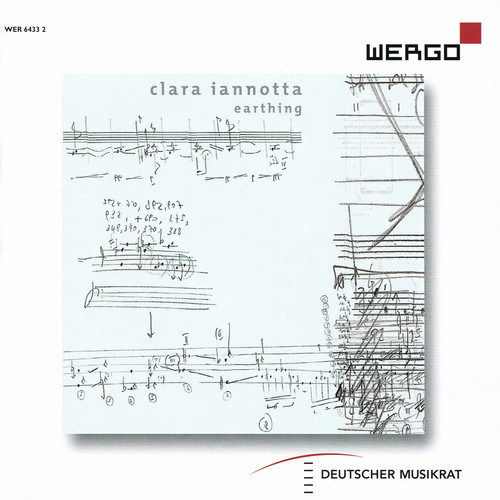
Earthing
"String quartet” seems a rather reductive way of describing any of the four utterly compelling works by Clara Iannotta that the Jack Quartet play here. For as well as demanding that the string players employ every conventional technique, the Italian composer extends their sound world farther, both with electronics and with “found objects” applied to the strings and bodies of the instruments.
The four pieces all date from the last seven years. The earliest, A Failed Entertainment, borrows the wor…
Ursonate Und Andere Konsequente Dichtung
*2022 stock* Kurt Schwitters’ “Sonate in Urlauten” [Sonata in Primal Sounds] is the prototypical work at the border between speech and music. The concise title of the work alone forges a suggestive link between language material and the musical form of the sonata; the "Ursonate" almost proverbially stands for sound poetry. For Schwitters, who was actively involved in promoting his sound-poetical opus magnum, even as his own interpreter, it was difficult to imagine that his work could survive wit…

Fluxus
*2022 stock* George Brecht, Alison Knowles, Philip Corner. "Fluxus! The New York-born artists whose radio plays are collected on this CD, Philip Corner, Alison Knowles, and George Brecht, have appeared together in performances, and they are also connected by their relationship to John Cage's aesthetic, by work with chance operations, and by Zen. Explaining Fluxus is like wanting to hold a river in your hand." Includes the pieces "Satie's Rose Cross as a Revelation" by Philip Corner, "Bean Sequen…
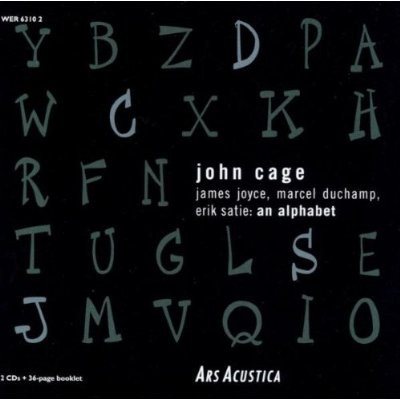
James Joyce, Marcel Duchamp, Erik Satie: An Alphabet
*2022 stock* This work began life as a radio play in 1982, a commission from and for Klaus Schöning and Cologne’s WDR. Working on the principles of collage, Cage brought together 15 unlikely characters – Narrator, James Joyce, Marcel Duchamp, Vocoder, Erik Satie, Jonathan Albert, Mao Tse Tung (as a child), Henry David Thoreau, Rrose Selavy, Thorstein Veblen, Buckminster Fuller, Brigham Young, and Robert Rauschenberg – who speak together, their dialogue comprised of literal quotations, freely ada…
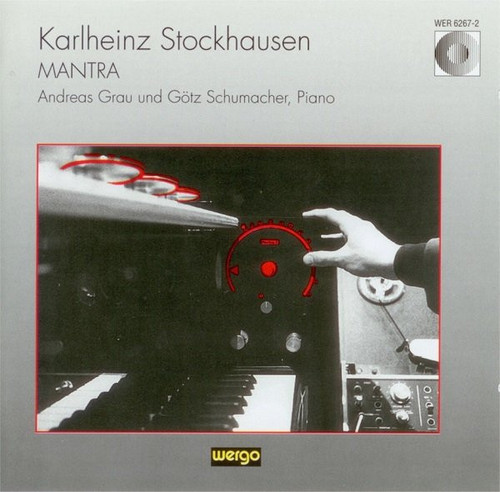
Mantra
'Composed in 1970, Mantra, for two pianos and ring modulation, was one of the decisive turning points in Karlheinz Stockhausen’s career. The 70-minute piece not only signalled a break with the text-based intuitive works, relying heavily on improvisation, that had come to dominate his output towards the end of the previous decade and a return to fully notated scores, but also introduced the idea of melodic formulae, the “mantra” of the title, which Stockhausen would eventually develop into the or…

Musica Da Camera
*2022 stock* The Polish composer Krzysztof Penderecki used to write chamber music even as a student in Krakow. He was writing the chamber music works for himself, then already an accomplished violinist, and his fellow students (The title "Sonata for Violin and Piano" from 1953 has only recently been published.). A specialty of these early works are Penderecki's inventions with which he altered the sound of the stringed instruments, indeed almost to the point of being completely unrecognizable. W…
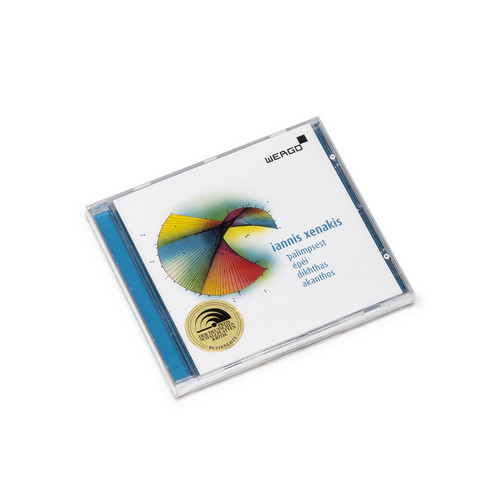
Palimpsest | Épéi | Dikhthas | Akanthos
*2022 stock* 'This collection of ensemble works, six altogether, ranges across the last two decades of Iannis Xenakis's life. It includes the last two pieces he composed, Zythos, for trombone and six marimbas, and O-Mega, for percussion and ensemble, both written in 1997, four years before his death. They are striking, small-scale examples of the bareness and drastic compression of his late style, but the finest music here is a bit earlier. In Échange, from 1989, a bass clarinet painstakingly un…

For Franz Kline · For Frank O'Hara · De Kooning · Piano Piece To Philip Guston
*2022 stock* Wergo presents Moton Feldman's compositions For Franz Kline · For Frank O'Hara · De Kooning · Piano Piece To Philip Guston. Performed by Ensemble Avantgarde.
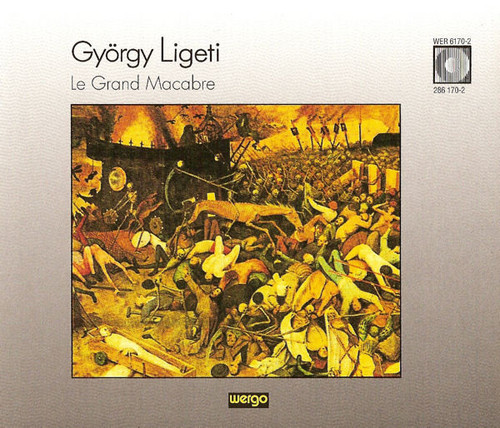
Le Grand Macabre
György Ligeti's only opera, Le Grand Macabre, is an entertaining, taut piece of musical theatre that sits somewhere between parody and ominous seriousness, between clowning and wisdom. Based on Michel de Ghelderode's play and set in the imaginary land of Breughelland, it follows Nekrotzar, alias the Grand Macabre, who has not only ambitions to suck blood but apocalyptic visions: he wants to bring about the end of the world personally, and fails.
Ligeti himself said its bizarre, exaggerated music…
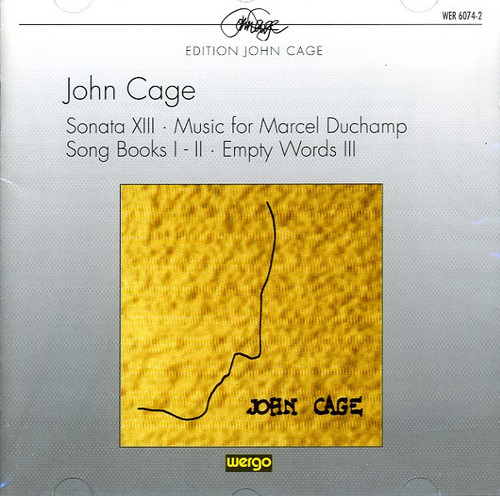
Sonata XIII / Music For Marcel Duchamp / Song Books I-II / Empty Words III
*2022 stock* John Cage's first manifesto, written in 1937, was called The Future of Music: Credo, and the future it described was an "all-sound music" open to every kind of noise. This volume of Wergo's Edition John Cage follows that idea across three decades, from the prepared piano of the 1940s to the vocal and spoken works of the 1970s.
Sonata XIII, from the Sonatas and Interludes, and Music for Marcel Duchamp are pieces for prepared piano, played by Peter Roggenkamp: screws, bolts and rubber…
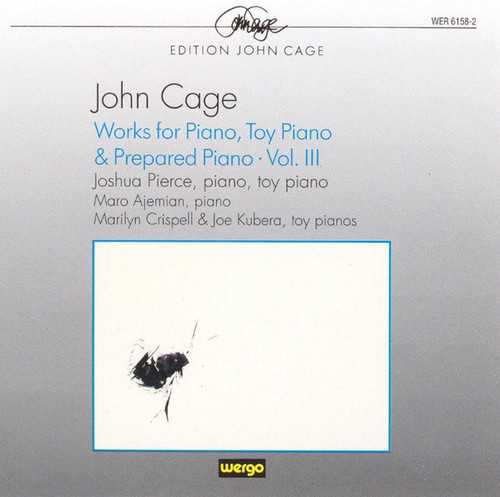
Works For Piano, Toy Piano & Prepared Piano · Vol. III
*2022 stock* It may come as a surprise but one of the leading creators of keyboard music in the twentieth century is a composer by the name of John Cage. Cage’s reputation is so deeply associated with the avantgarde, with chance music, graphic notation, performance art, technology and Zen Buddhism that is early, conventionally-notated music for percussion ensemble and keyboards is sometimes neglected. Or was until recently. In the last few years – with the advent of performances and recordings l…
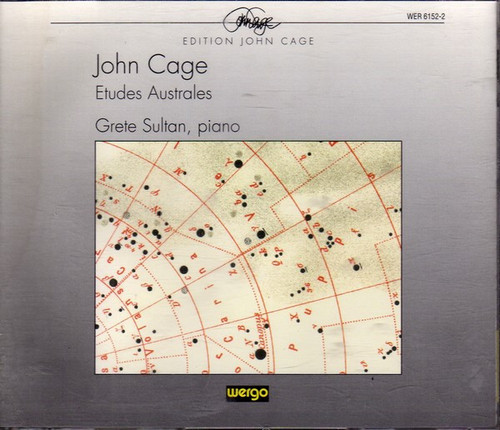
Etudes Australes
'Etudes Australes was composed specifically for Grete Sultan, so this album is among the definitive recordings. As an indeterminate piece for solo piano (okay, well, a "duet for two hands"), this sounds very similar to Music of Changes, Winter Music, etc. Here, though, Cage generates indeterminacy by turning once again to using star charts as tools of composition, as he did previously in the wonderful Atlas Eclipticalis.
In a way, I find the piano to be more suited to star charts than almost any…
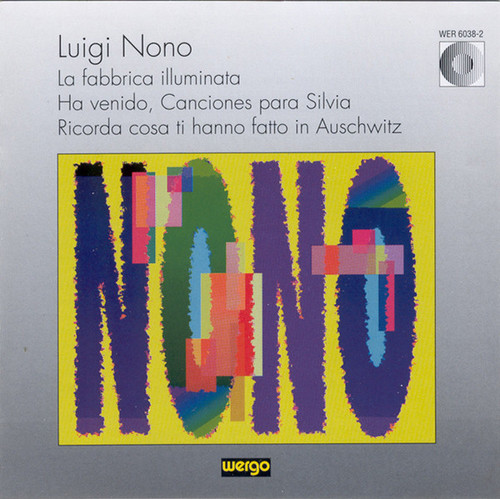
La Fabbrica Illuminata / Ha Venido, Canciones Para Silvia / Ricorda Cosa Ti Hanno Fatto In Auschwitz
*2022 stock* Magnetic tape for serial use is not the prerogative of Stockhausen or the French members of the GRM. On the other side of the Alps, at the RAI Studio di Fonologia in Milan, Luigi Nono worked for a long time on the development of a new form of theatrical composition. In the 1960s, his research led to the creation of a series of works that are difficult to classify: A floresta è jovem e cheja de vida (1966), Y entonces comprendió (1969-70), but especially La fabbrica illuminata from 1…